
AverPoint Classroom
Product by AverPoint
Facts checked: Not yet checked
Our take (not a Learning Standard rating). This label applies to learning-science judgments throughout this overview.
Our take (not a Learning Standard rating)
AverPoint Classroom provides promising tools for inquiry-based media literacy, but remains unevaluated by The Learning Standard. It forces students to slow down and analyze claims on real websites, which supports deep cognitive processing. However, without formal evaluation, its long-term impact on source evaluation skills is unverified.
Pros
- Promotes active reading by requiring students to extract and evaluate evidence directly from authentic texts.
- Applies inquiry-based learning mechanics to help students practice distinguishing factual claims from opinions.
- Connects reading comprehension directly to writing output by scaffolding argumentative essays with collected evidence.
- Tracks reading duration to discourage skimming and encourage sustained attention on complex topics.
Cons
- Lacks formal evaluation data from The Learning Standard to confirm pedagogical efficacy.
- Relies heavily on teacher facilitation to ensure students actually understand the media literacy concepts being practiced.
- Measuring reading duration does not inherently guarantee actual reading comprehension or cognitive engagement.
What Do We Know About AverPoint Classroom?
AverPoint Classroom shows strong potential for teaching media literacy, but its overall effectiveness remains pending evaluation by The Learning Standard. This platform integrates directly into your child's social studies, science, or English classes to help them analyze real-world news and documents. Instead of reading passive textbook summaries, your child interacts with actual websites and PDFs. The system requires them to slow down, question claims, and find supporting evidence. This approach uses active learning principles to build critical thinking skills. One notable feature measures how long and closely your child reads an article. While time spent on a page does not guarantee comprehension, it discourages the rapid skimming common in digital environments. The app then guides your child to use the evidence they gathered to write argumentative essays. Because it relies on authentic media, the app requires strong teacher oversight to ensure the selected texts are age-appropriate and aligned with learning objectives. If your child's school uses this tool, expect them to spend significant time dissecting the credibility of online information rather than just memorizing facts.
How Does AverPoint Classroom Work?
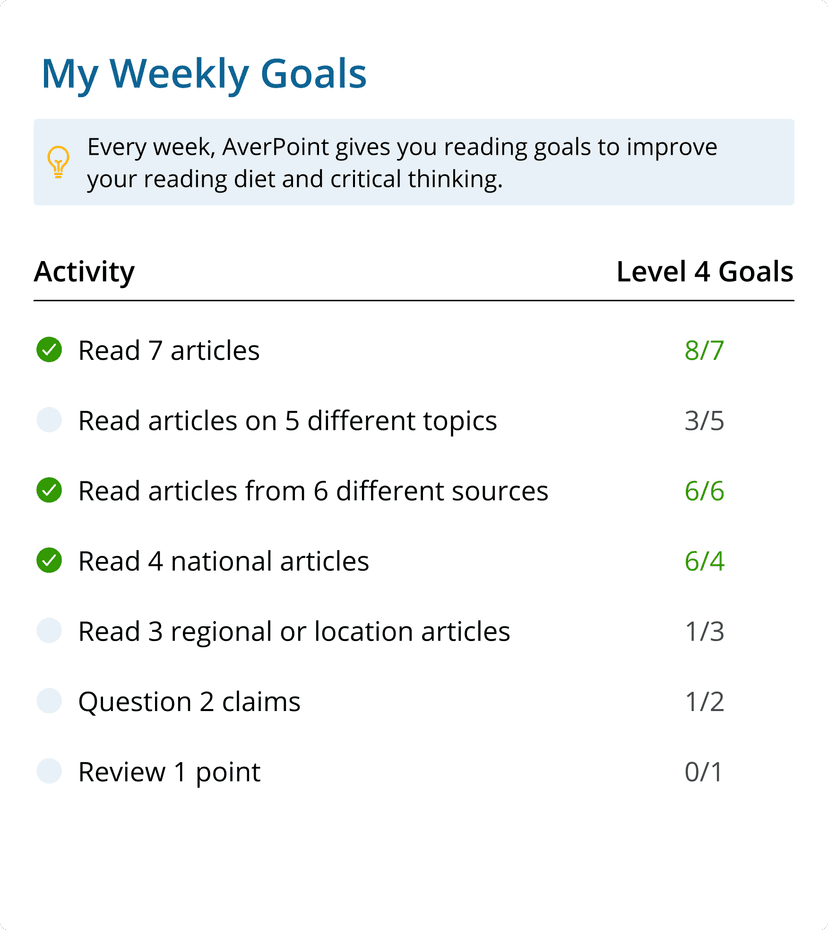
AverPoint Classroom uses inquiry-based learning and active reading to teach media literacy and source evaluation. The platform operates primarily as an overlay on real websites and digital documents. When students open an assigned article, the system's Conscious Reading tracker monitors their pace to encourage deliberate reading rather than rapid scrolling. As students read, they engage with the Credibility Layer. This mechanic forces them to stop and interrogate the text. They highlight specific claims, question the author's logic, and search for corroborating or conflicting evidence. This active retrieval and analysis prevents passive consumption of information. Finally, students move to the writing phase. The platform provides scaffolding for argumentative essays, requiring students to pull the exact evidence they previously verified to support their own arguments. This creates a closed-loop learning environment where reading comprehension directly fuels written expression.
Strengths and tradeoffs of AverPoint Classroom
AverPoint Classroom's biggest strength is its use of authentic texts for active evidence gathering, while its biggest weakness is the assumption that tracking reading time equates to cognitive engagement. Active learning is highly evident in the platform's design. By forcing students to pause and evaluate claims on real websites, the app uses elaboration, a cognitive science principle where learners add meaningful details to new information to improve retention and understanding. Connecting this active reading process to a writing tool also provides excellent scaffolding for argumentative writing, helping students bridge the gap between research and expression. However, the Conscious Reading feature relies heavily on behavioral proxies. Measuring how long a student stays on a page does not guarantee they are engaged in deep reading; they could simply leave the tab open while distracted. Additionally, because the app has not yet been formally evaluated by The Learning Standard, we cannot verify if its gamification elements distract from or enhance the core learning objectives. The platform's overall success relies heavily on teacher facilitation to guide inquiry, monitor actual comprehension, and correct misconceptions during the digital evidence-gathering phase.
Who Might Benefit From AverPoint Classroom?
AverPoint Classroom is best for middle school, high school, and college students who need structured practice evaluating the credibility of digital information. It explicitly targets adolescent and adult learners in grades 8 through 12, as well as higher education students enrolled in humanities, social sciences, and science courses. The tool is highly suitable for classrooms focused on building advanced research skills, digital media literacy, and evidence-based argumentative writing. It works best in traditional or blended environments where teachers actively curate reading materials and provide direct feedback on student essays, rather than functioning as an independent, self-guided study tool for isolated learners.
Sources and review method
TLS combines product information and editorial analysis to explain how AverPoint Classroom works, its tradeoffs, and the questions to ask before choosing it. Product features, an instructional rationale and evidence of learning outcomes are different kinds of information.
Formal Learning Standard assessment: not yet completed. Data Transparency findings are reported separately and do not establish learning effectiveness. Read our methodology.
Frequently Asked Questions About AverPoint Classroom
Is AverPoint Classroom free?
No, AverPoint Classroom is not free. It costs $10 per student per year for middle and high schools. For higher education institutions, the cost is $10 per student per semester. The developer does offer a free trial for all users to test the platform before committing to a paid subscription. Schools and districts typically purchase these licenses in bulk for classroom integration, so parents will rarely pay this fee out of pocket.
Is AverPoint Classroom good for high schoolers?
Yes, AverPoint Classroom is specifically designed for 8th through 12th graders, as well as college students. The reading materials and analytical tasks require advanced cognitive skills suitable for teenagers. High schoolers benefit immensely from practicing media literacy on real-world websites, which prepares them for college-level research and informed civic participation. The platform demands a level of critical thinking, reading comprehension, and independent writing that would be too advanced for elementary school students.
What does AverPoint Classroom teach?
AverPoint Classroom teaches media literacy, advanced reading comprehension, and argumentative writing. It trains students to analyze the credibility of online information, distinguish between factual evidence and opinion, and gather reliable data. Students learn to apply these critical research skills to construct well-supported argumentative essays for subjects like social studies, English, and science. The app shifts instruction away from passive memorization and focuses entirely on teaching students how to interrogate the validity of the media they consume.
How does AverPoint Classroom compare to standard reading comprehension tools?
AverPoint Classroom focuses heavily on source evaluation and media credibility rather than basic reading fluency. Unlike traditional reading comprehension tools that use closed, predetermined textbook passages, AverPoint forces students to interact with live websites and digital PDFs. This requires a much higher level of critical thinking, digital navigation skills, and independent inquiry than standard comprehension drills, making it a better fit for research-based assignments.
Has The Learning Standard evaluated AverPoint Classroom?
TLS has not yet completed a Learning Standard evaluation of how well AverPoint Classroom teaches. TLS has not published a Data Transparency result for its privacy policy.
Follow TLS Research
Subscribe to future TLS research updates: app reviews, findings, and what the evidence shows.
Screenshots



Take Action
For AverPoint Classroom
If you represent AverPoint and have a correction or new evidence, send the relevant source so we can review and update this page.
Submit a correctionDetails
- Pricing
- High school and middle school: $10/student/year. Higher education: $10/student/semester. We offer a free trial to all users.
- Platforms
- Web Browser, iOS (Apple mobile), Android (Google mobile)
- Grade Levels
- 8th Grade, 9th Grade, 10th Grade, 11th Grade, 12th Grade, Bachelor's degree
- Website
- Visit site