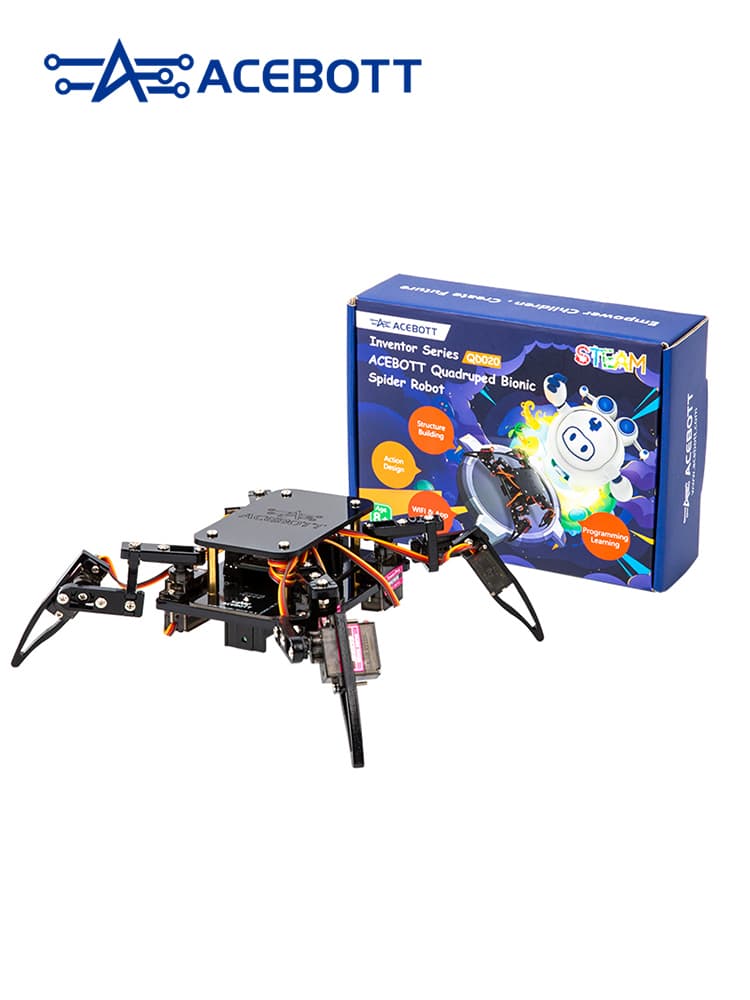
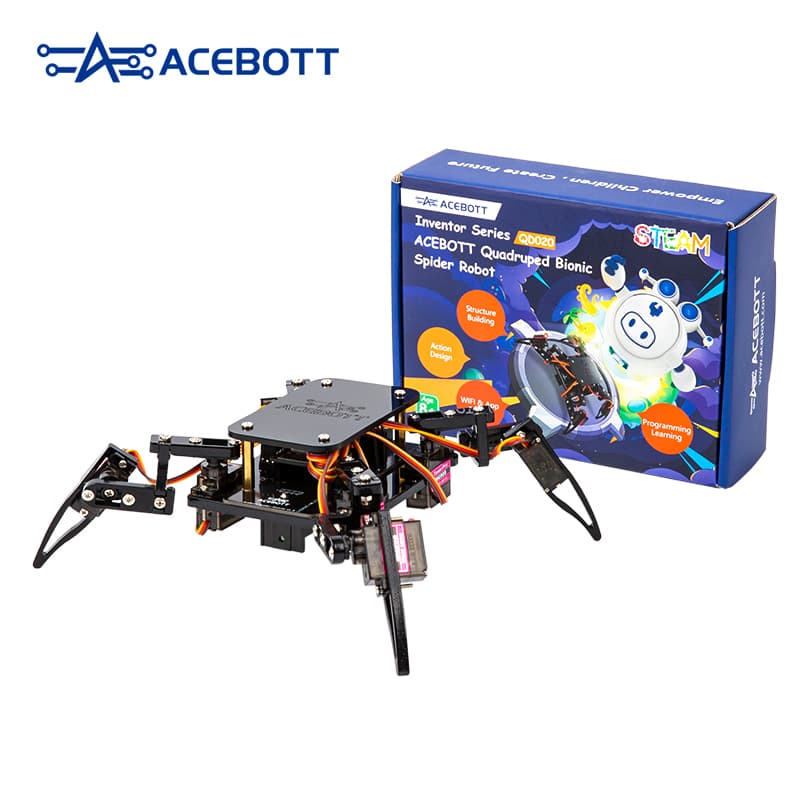
ACEBOTT QD020 ESP8266 Quadruped Bionic Spider Robot kit with Arduino/ACECode (Scratch)
Product by ACEBOTT
Facts checked: Not yet checked
Our take (not a Learning Standard rating). This label applies to learning-science judgments throughout this overview.
Our take (not a Learning Standard rating)
While The Learning Standard has not yet formally evaluated the ACEBOTT Spider Robot Kit, physical robotics kits generally excel at teaching algorithmic thinking through constructionism. Your child learns by doing, translating block-based Scratch code into immediate physical movement, though success depends heavily on the quality of included instructional scaffolding.
Pros
- Connects abstract coding concepts to concrete physical movements, reinforcing learning through multimodal feedback.
- Supports both block-based ACECode and text-based Arduino, providing a clear progression path for algorithmic thinking.
- Encourages spatial reasoning and fine motor development during the physical assembly of the eight-servo chassis.
Cons
- Hardware troubleshooting often introduces high cognitive load that distracts from the core coding objectives.
- Lacks built-in adaptive feedback, requiring your child to independently identify why their programmed code failed.
- Assembly instructions for multi-servo robots often lack the comprehensive worked examples necessary for novices to avoid early frustration.
What Do We Know About ACEBOTT QD020 ESP8266 Quadruped Bionic Spider Robot kit with Arduino/ACECode (Scratch)?
This kit teaches foundational engineering and coding skills through hands-on construction, though its ultimate effectiveness relies on your child's persistence. The Learning Standard has not yet evaluated the ACEBOTT Spider Robot Kit, but learning science supports its core approach: constructionism. When your child builds a physical robot and programs it to move, they engage in active problem-solving that solidifies abstract computer science concepts. Working with the ESP8266 board and eight MG90 servos introduces real-world hardware integration. Your child will likely start with ACECode, a visual block-based environment based on Scratch. This reduces the working memory load required to remember programming syntax, letting them focus on logic and sequence. However, parents must be prepared for the friction inherent in physical robotics. Hardware bugs, wiring issues, and mechanical binding often frustrate young learners. Unlike purely digital apps that offer immediate, targeted hints, physical kits require manual troubleshooting. You should expect to provide guidance during the initial mechanical assembly to ensure the servos are calibrated correctly before your child attempts complex coding tasks.
How Does ACEBOTT QD020 ESP8266 Quadruped Bionic Spider Robot kit with Arduino/ACECode (Scratch) Work?
The ACEBOTT Spider Robot Kit employs a constructionist pedagogical approach where learners build tangible artifacts to explore algorithmic logic. First, your child physically assembles the quadruped spider using the included ESP8266 control board, eight steering servos, and structural pieces. This mechanical phase develops spatial reasoning and mechanical engineering basics. Next, they connect the robot to a computer to program its behavior. Beginners use ACECode, dragging and dropping logical blocks to control the eight legs. When they run the code, the robot provides immediate physical feedback. If the spider walks backward instead of forward, your child must debug the logic, adjusting angles and delays. This iterative cycle of coding, observing physical execution, and refining code relies heavily on trial-and-error learning. More advanced learners can transition to the Arduino IDE to write text-based C++ code, bridging the gap between introductory visual programming and professional software engineering.
Strengths and tradeoffs of ACEBOTT QD020 ESP8266 Quadruped Bionic Spider Robot kit with Arduino/ACECode (Scratch)
The biggest strength of the ACEBOTT Spider Robot Kit is its use of immediate multimodal feedback to reinforce coding logic, while its biggest weakness is the high cognitive load introduced by physical hardware troubleshooting. Multimodal Feedback: When your child changes a variable in their code, the robot physically moves differently. This tangible result grounds abstract concepts like loops and conditional statements in physical reality, improving long-term retention. Progressive Complexity: Supporting both block-based and text-based coding allows the kit to grow with the learner, applying the learning science principle of scaffolding. Beginners master logic without syntax barriers, then remove the visual training wheels. Cognitive Overload: Troubleshooting a robot requires distinguishing between mechanical failures, electrical wiring mistakes, and software bugs. This simultaneous demand on working memory easily overwhelms an eight-year-old. Lack of Guided Correction: Without a digital tutor providing targeted feedback on incorrect code, learners must rely entirely on their own deduction. If the provided manual lacks sufficient worked examples, novices hit a wall of frustration before mastering the intended computer science standards.
Who Might Benefit From ACEBOTT QD020 ESP8266 Quadruped Bionic Spider Robot kit with Arduino/ACECode (Scratch)?
Best for upper elementary and middle school students who want a hands-on introduction to robotics and are patient enough for mechanical troubleshooting. Targeted primarily at learners aged eight and older, this kit bridges the gap between basic coding concepts and applied engineering. It serves as an excellent tool for fourth graders transitioning out of purely digital Scratch environments into physical computing. Your child will need strong fine motor skills for assembly and a high tolerance for iterative problem-solving. It functions well in home environments where a parent can provide occasional scaffolding, or in structured STEM classrooms.
Data Transparency
Does Not Meet Data Transparency Standard
ACEBOTT QD020 ESP8266 Quadruped Bionic Spider Robot kit with Arduino/ACECode (Scratch) does not meet our data transparency standard. Its privacy policy does not document basic protections, including a statement that it does not sell data, a commitment against targeted advertising and limits on sharing children's data.
11 of 35 checks passed
Evaluated September 2026
Privacy policy →Level 1 · Basic protections
Does not sell data or target ads at students, limits sharing, and lets parents see and delete their child's data.
Not documented: a statement that it does not sell data, a commitment against targeted advertising, limits on sharing children's data, contractual limits on service providers, a COPPA or FERPA commitment, parents' right to see their child's data
Level 2 · Parent control (meets the standard)
Families can get their data out, know who processes it, and know how long it is kept.
Not documented: a data retention timeline, self-service deletion
Level 3 · Direct data access
Families or schools can pull their own data through an API, in a stated format.
Not documented: an API for retrieving their own data, a named export format
View all 35 checks
Parent Access3/8
Does the policy mention parents specifically?
“If you are the parent or guardian of a child who has provided us with their personal information, you may contact us using the contact details set out below to request that it be deleted.”
Can parents view their child's data?
The policy only lets parents ask for a child's data to be deleted, not to view it.
Can parents modify their child's data?
The policy only lets parents ask for a child's data to be deleted, not to change it.
Can parents delete their child's account?
“If you are the parent or guardian of a child who has provided us with their personal information, you may contact us using the contact details set out below to request that it be deleted.”
Is there a dedicated Children's Privacy section?
“The Services are not intended to be used by children, and we do not knowingly collect any personal information about children.”
Does it reference COPPA compliance?
The policy does not mention COPPA.
Does it reference FERPA compliance?
The policy does not mention FERPA.
Is parental consent required for child accounts?
The policy says the Services are not meant for children and does not require parental consent.
Data Portability2/5
Can users access their personal data?
“You may have a right to request access to personal information that we hold about you, including details relating to how we use and share your information.”
Can users download/export their data?
“You may have a right to receive a copy of the personal information we hold about you and to request that we transfer it to a third party, in certain circumstances and with certain exceptions.”
Is there a self-service data access tool?
The policy says rights are exercised through the Site or by contacting the company and describes no self-service access tool.
Is a specific data format mentioned for export?
The policy does not name a format for exported data.
Is there an API for data access?
The policy does not mention an API for getting data.
Data Minimization2/6
Is data collection itemized?
“Basic contact details including your name, address, phone number, and work email.”
Can the app be used without a real name?
The policy says it collects users' names.
Can the app be used without an email?
The policy says it collects email addresses.
Does it state collection is limited to what is necessary?
The policy does not say collection is limited to what is necessary.
Is IP address anonymized or truncated?
The policy says it collects IP addresses but does not say they are anonymized or truncated.
Is location tracking explicitly excluded?
“We need location permission because Bluetooth requires location permission. The purpose is only to ensure the normal use of Bluetooth communication and will not upload the user’s location information.”
Third-Party Protection2/7
Does it explicitly state no selling of data?
The policy offers an opt-out of sale or sharing and makes no general statement that it does not sell data.
Are third-party providers named?
“Companies who support our Site and Services, such as woocommerce.”
Are providers contractually restricted?
The policy does not say providers are contractually limited in how they use data; it mentions contracts only for international transfers.
No-targeted-advertising commitment?
The policy says it uses information to tailor advertising.
Is AI/ML data sharing addressed?
The policy does not address AI or machine learning.
Child-specific sharing restriction?
The policy only says it has no actual knowledge of sharing or selling data of people under 16, without committing to a restriction.
Cookies/tracking limited or opt-out?
“Most browsers automatically accept Cookies by default, but you can choose to set your browser to remove or reject Cookies through your browser controls.”
Deletion & Retention1/5
Can users delete their account?
“You may have a right to request that we delete the personal information we maintain about you.”
Self-service deletion mechanism?
The policy describes deletion by request only, with no self-service tool.
Specific data retention timeline?
The policy says retention depends on various factors and gives no specific timeline.
Auto-deletion of inactive accounts?
The policy does not mention automatic deletion of inactive accounts.
Post-deletion handling described?
The policy does not describe what happens to data after deletion.
Advertising1/4
Advertising model explicitly disclosed?
“We use your information for marketing and promotional purposes, such as to send marketing, advertising and promotional communications by email, and to show you advertisements for products or services.”
Free from third-party advertisements?
The policy says third parties may use cookies to tailor advertising and that data is shared with advertising partners.
Children excluded from ad targeting?
The policy does not commit to excluding children from ad targeting, only that it has no actual knowledge of sharing data of people under 16.
Ad-free option available?
The policy describes advertising and offers no ad-free option.
What This Means
The policy review did not meet our data transparency standard. The checks above show the documented findings and unknowns. A missing statement does not establish how the app handles data in practice.
About this evaluation: Based on automated analysis of Privacy policy against 35 policy-disclosure questions, including questions adapted from the Common Sense Privacy Program's published evaluation questions. TLS is not affiliated with Common Sense Media, and this is not a Common Sense rating. Quoted text is copied from the policy; unquoted notes are our summary. Results describe what the policy documents, not the company's actual practices. Privacy policies can change: this review reflects the version we analyzed and does not determine legal compliance.
Sources and review method
TLS combines product information and editorial analysis to explain how ACEBOTT QD020 ESP8266 Quadruped Bionic Spider Robot kit with Arduino/ACECode (Scratch) works, its tradeoffs, and the questions to ask before choosing it. Product features, an instructional rationale and evidence of learning outcomes are different kinds of information.
Formal Learning Standard assessment: not yet completed. Data Transparency findings are reported separately and do not establish learning effectiveness. Read our methodology.
Frequently Asked Questions About ACEBOTT QD020 ESP8266 Quadruped Bionic Spider Robot kit with Arduino/ACECode (Scratch)
Is the ACEBOTT Spider Robot Kit free?
No. The physical kit requires a one-time purchase of approximately $81. This includes the ESP8266 control board, eight servos, chassis parts, and access to the necessary programming software.
Is the ACEBOTT Spider Robot Kit good for 4th graders?
Yes, it targets students aged eight and up. Fourth graders are at an ideal developmental stage to transition from simple visual programming to applying those skills in physical computing, provided they have adult support for complex assembly steps.
What does the ACEBOTT Spider Robot Kit teach?
It teaches mechanical assembly, spatial reasoning, algorithmic thinking, and computer programming. Learners write code to control multi-axis movement, mastering loops, variables, and sequential logic through either block-based Scratch or text-based Arduino C++.
Does the ACEBOTT Spider Robot Kit require prior coding experience?
No prior coding experience is strictly necessary, though it is highly beneficial. The inclusion of ACECode provides a low-barrier entry point for absolute beginners to learn coding logic before attempting text-based Arduino programming.
ACEBOTT Spider Robot Kit vs. LEGO SPIKE Prime?
The ACEBOTT kit offers an affordable, Arduino-compatible introduction to open-source robotics using standard servos. LEGO SPIKE Prime is significantly more expensive but provides superior instructional scaffolding, more reliable hardware, and a far gentler learning curve for younger elementary students.
Has The Learning Standard evaluated ACEBOTT QD020 ESP8266 Quadruped Bionic Spider Robot kit with Arduino/ACECode (Scratch)?
TLS has not yet completed a Learning Standard evaluation of how well ACEBOTT QD020 ESP8266 Quadruped Bionic Spider Robot kit with Arduino/ACECode (Scratch) teaches. Its privacy policy has been reviewed for Data Transparency and does not yet document the basic protections (Level 1).
Is ACEBOTT QD020 ESP8266 Quadruped Bionic Spider Robot kit with Arduino/ACECode (Scratch) COPPA compliant?
A COPPA reference was not found in the reviewed privacy policy. This does not determine whether the app complies with COPPA. Policy review note: The policy does not mention COPPA.
Is ACEBOTT QD020 ESP8266 Quadruped Bionic Spider Robot kit with Arduino/ACECode (Scratch) FERPA compliant?
A FERPA reference was not found in the reviewed privacy policy. This does not determine whether the app complies with FERPA. Policy review note: The policy does not mention FERPA.
Does ACEBOTT QD020 ESP8266 Quadruped Bionic Spider Robot kit with Arduino/ACECode (Scratch) have a children's privacy policy?
The reviewed policy includes a dedicated children's privacy section. Policy review note: The policy has a section headed "Children's Data".
Does ACEBOTT QD020 ESP8266 Quadruped Bionic Spider Robot kit with Arduino/ACECode (Scratch) sell student data?
A statement ruling out data selling was not found in the reviewed policy. This does not establish that the app sells student data. Policy review note: The policy offers an opt-out of sale or sharing and makes no general statement that it does not sell data.
Can you delete your data from ACEBOTT QD020 ESP8266 Quadruped Bionic Spider Robot kit with Arduino/ACECode (Scratch)?
The reviewed privacy policy describes account deletion. We have not tested the deletion process. Policy review note: Users can ask for their personal data to be deleted.
Follow TLS Research
Subscribe to future TLS research updates: app reviews, findings, and what the evidence shows.
Screenshots

Take Action
For ACEBOTT QD020 ESP8266 Quadruped Bionic Spider Robot kit with Arduino/ACECode (Scratch)
If you represent ACEBOTT and have a correction or new evidence, send the relevant source so we can review and update this page.
Submit a correctionDetails
- Pricing
- $81
- Platforms
- Web Browser, iOS (Apple mobile), Android (Google mobile), Windows (Microsoft), macOS (Apple)
- Grade Levels
- 4th Grade
- Website
- Visit site