
A World In Motion® (AWIM®)
Product by SAE International
Facts checked: Not yet checked
Our take (not a Learning Standard rating). This label applies to learning-science judgments throughout this overview.
Our take (not a Learning Standard rating)
While The Learning Standard has not yet formally evaluated A World In Motion® (AWIM®), its reliance on inquiry-based and project-based learning aligns with established frameworks for deep cognitive engagement in STEM. The physical kits and mentorship model likely provide strong experiential contexts, though specific efficacy data remains pending our review.
Pros
- Integrates physical, hands-on kits to facilitate experiential learning and spatial reasoning.
- Employs inquiry-based frameworks that require students to hypothesize and test, deepening cognitive processing.
- Connects classroom concepts to real-world applications through industry volunteer mentorship.
- Scaffolds STEM concepts progressively from preschool through twelfth grade.
Cons
- Relies heavily on educator facilitation and volunteer availability, making implementation quality variable.
- Lacks automated feedback mechanisms found in digital-first adaptive learning platforms.
- Physical kits and materials require continuous funding or regional grants to sustain.
- Has not yet undergone rigorous efficacy evaluation by The Learning Standard.
What Do We Know About A World In Motion® (AWIM®)?
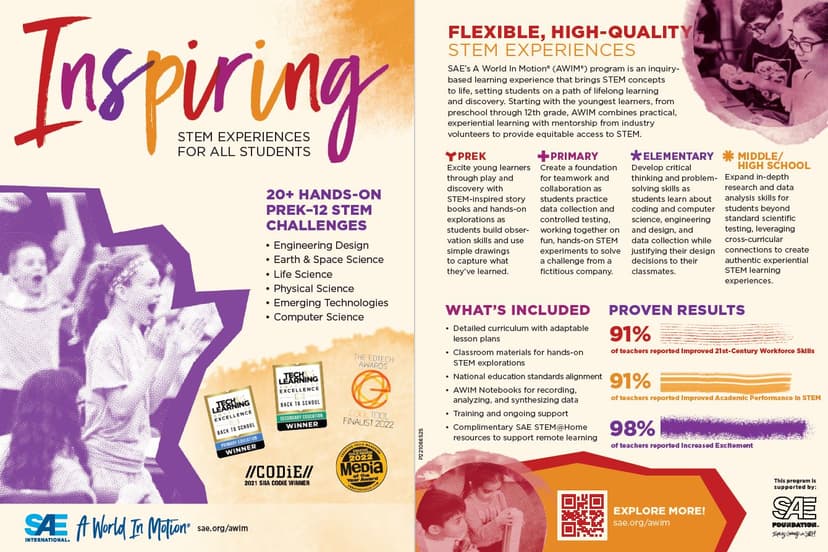
A World In Motion® (AWIM®) utilizes proven project-based learning frameworks to teach STEM, though its ultimate effectiveness depends heavily on how your child's teacher implements the physical materials in the classroom. Unlike digital apps that your child uses independently at home, AWIM® is an instructional program designed for school environments. It pairs physical engineering kits with curriculum guides to teach applied science and math. Your child will likely work in teams to design, build, and test physical models like motorized toy cars or gliders. This approach grounds abstract mathematical and scientific concepts in tangible reality. Learning science shows that when students physically manipulate objects to test hypotheses, they build stronger mental models and retain information longer. The program also incorporates mentorship from industry professionals, which helps bridge the gap between classroom theory and career reality. However, because AWIM® is not a standalone digital product, it lacks built-in assessments or adaptive algorithms to catch individual knowledge gaps. Parents should understand that this is a classroom enrichment tool requiring active teacher facilitation, not a direct-to-consumer software application. Effectiveness will vary based on your local school's resources and instructor training.
How Does A World In Motion® (AWIM®) Work?
A World In Motion® utilizes an inquiry-based, hands-on pedagogical approach where students solve engineering design challenges using physical materials. The program operates primarily through classroom kits that educators deploy to teach specific STEM units. Instead of passively receiving lectures, students are presented with a real-world problem. They work collaboratively to research, design, construct, and test a physical prototype to solve that problem. For example, younger students might explore friction and gravity by building ramps, while older students tackle complex physics by constructing motorized vehicles or coding autonomous rovers. Throughout this process, students collect data, analyze their results, and iterate on their designs. This cycle mirrors the engineering design process and heavily utilizes active learning methodologies. Educators act as facilitators rather than direct instructors, guiding student inquiry and connecting their physical experiments back to core math and science standards. Industry volunteers often join the classroom to provide feedback on student designs and share their professional expertise.
Strengths and tradeoffs of A World In Motion® (AWIM®)
The biggest strength of A World In Motion® is its translation of abstract STEM concepts into tangible, project-based experiences, while its biggest weakness is its reliance on variable teacher facilitation and physical material funding. Experiential learning is a highly effective instructional method; when students physically build and test models, they engage multiple cognitive pathways. This hands-on manipulation reduces cognitive load when learning complex physics or engineering principles. Furthermore, AWIM® excels at fostering collaborative problem-solving, requiring students to articulate their reasoning and negotiate design choices with peers, which solidifies understanding through peer teaching. However, the program faces distinct structural limitations. Without automated retrieval practice or built-in formative assessments, educators must independently identify and correct individual student misconceptions. The absence of adaptive software means the curriculum does not automatically adjust to a struggling student's pace. Additionally, the fidelity of the program depends entirely on the educator's comfort level with STEM instruction and the availability of the physical kits. If an educator lacks training, the inquiry-based model can degrade into simple unstructured play, reducing its instructional efficacy.
Who Might Benefit From A World In Motion® (AWIM®)?
A World In Motion® is best for K-12 classroom educators who want to integrate structured, hands-on engineering challenges into their science and math curriculum. It is ideally suited for schools looking to transition away from rote memorization toward project-based learning. Because the curriculum spans from early childhood through high school, it serves districts aiming for vertical alignment in STEM education. Parents seeking at-home, independent digital practice for their children will not find it here. Instead, AWIM® serves communities and schools that can leverage its physical kits and industry mentorship to make applied science highly collaborative and experiential.
Data Transparency
Does Not Meet Data Transparency Standard
A World In Motion® (AWIM®) does not meet our data transparency standard. Its privacy policy does not document basic protections, including a statement that it does not sell data, a commitment against targeted advertising and limits on sharing children's data.
3 of 35 checks passed
Evaluated September 2026
Privacy Policy →Level 1 · Basic protections
Does not sell data or target ads at students, limits sharing, and lets parents see and delete their child's data.
Not documented: a statement that it does not sell data, a commitment against targeted advertising, limits on sharing children's data, contractual limits on service providers, a COPPA or FERPA commitment, parents' right to see their child's data, parents' right to delete their child's data, account deletion
Level 2 · Parent control (meets the standard)
Families can get their data out, know who processes it, and know how long it is kept.
Not documented: users' right to access their data, data export, a data retention timeline, self-service deletion
Level 3 · Direct data access
Families or schools can pull their own data through an API, in a stated format.
Not documented: an API for retrieving their own data, a named export format
View all 35 checks
Parent Access0/8
Does the policy mention parents specifically?
The policy does not mention parents.
Can parents view their child's data?
The policy does not give parents any right to view their child's data.
Can parents modify their child's data?
The policy does not give parents any right to change their child's data.
Can parents delete their child's account?
The policy does not give parents any right to delete their child's data or account.
Is there a dedicated Children's Privacy section?
The policy's table of contents links to a "Children" section, but the policy contains no text for that section.
Does it reference COPPA compliance?
The policy does not mention COPPA.
Does it reference FERPA compliance?
The policy does not mention FERPA.
Is parental consent required for child accounts?
The policy does not address parental consent for child accounts.
Data Portability0/5
Can users access their personal data?
The policy does not describe a right for users to access their personal data.
Can users download/export their data?
The policy does not address downloading or exporting data.
Is there a self-service data access tool?
The policy does not describe a self-service data access tool.
Is a specific data format mentioned for export?
The policy does not name any export format.
Is there an API for data access?
The policy does not describe an API for users to access their data.
Data Minimization1/6
Is data collection itemized?
“This information will include your first and last name, email address, and business or home address. We may also request that you voluntarily provide other information, such as your phone number, year of birth, gender, demographic information, educational background, work experience, or courses or areas of study in which you may be interested”
Can the app be used without a real name?
The policy says registration requires the user's first and last name.
Can the app be used without an email?
The policy says registration requires the user's email address.
Does it state collection is limited to what is necessary?
The policy does not say collection is limited to what is necessary.
Is IP address anonymized or truncated?
The policy says it collects IP addresses but does not say they are anonymized or truncated.
Is location tracking explicitly excluded?
The policy says it may identify the location of a user's mobile device.
Third-Party Protection2/7
Does it explicitly state no selling of data?
The policy does not say that SAE does not sell personal data.
Are third-party providers named?
“We may use Adobe Analytics and Google Analytics, and web analytics services provided by Adobe and Google (“Analytics Tools”) to collect information about your use of the Sites.”
Are providers contractually restricted?
The policy does not describe contractual limits on service providers.
No-targeted-advertising commitment?
The policy makes no commitment against targeted advertising.
Is AI/ML data sharing addressed?
The policy does not address AI or machine-learning data sharing.
Child-specific sharing restriction?
The policy states no child-specific limits on sharing.
Cookies/tracking limited or opt-out?
“You can set your browser to reject cookies or to notify you when you are sent a cookie. To learn more about your ability to manage cookies and web beacons, please consult the privacy features in your browser.”
Deletion & Retention0/5
Can users delete their account?
The policy does not describe a way to delete an account.
Self-service deletion mechanism?
The policy does not describe a self-service deletion mechanism.
Specific data retention timeline?
The policy gives no specific data retention timeline.
Auto-deletion of inactive accounts?
The policy does not address automatic deletion of inactive accounts.
Post-deletion handling described?
The policy does not describe how data is handled after deletion.
Advertising0/4
Advertising model explicitly disclosed?
The policy only mentions in passing advertisers whose ads users may click on the Sites, and does not explicitly disclose an advertising model.
Free from third-party advertisements?
The policy refers to advertisers whose ads may appear on the Sites and does not say the product is ad-free.
Children excluded from ad targeting?
The policy does not exclude children from ad targeting.
Ad-free option available?
The policy does not describe an ad-free option or say the product has no advertising.
What This Means
The policy review did not meet our data transparency standard. The checks above show the documented findings and unknowns. A missing statement does not establish how the app handles data in practice.
About this evaluation: Based on automated analysis of Privacy Policy against 35 policy-disclosure questions, including questions adapted from the Common Sense Privacy Program's published evaluation questions. TLS is not affiliated with Common Sense Media, and this is not a Common Sense rating. Quoted text is copied from the policy; unquoted notes are our summary. Results describe what the policy documents, not the company's actual practices. Privacy policies can change: this review reflects the version we analyzed and does not determine legal compliance.
Sources and review method
TLS combines product information and editorial analysis to explain how A World In Motion® (AWIM®) works, its tradeoffs, and the questions to ask before choosing it. Product features, an instructional rationale and evidence of learning outcomes are different kinds of information.
Formal Learning Standard assessment: not yet completed. Data Transparency findings are reported separately and do not establish learning effectiveness. Read our methodology.
Frequently Asked Questions About A World In Motion® (AWIM®)
Is A World In Motion® (AWIM®) free?
Some digital resources and open-source materials are free for educators, but the core physical classroom kits and accompanying curriculum books require purchase. Because the program relies on tangible engineering materials, there is a recurring cost for schools. However, regional grants, industry sponsorships, and community funding often subsidize these costs for specific districts, making it accessible to a wider demographic. Parents do not pay for this program directly, as it is implemented at the school level.
Is A World In Motion® (AWIM®) good for elementary students?
Yes, the program provides highly effective experiential learning for elementary students. It uses play-based and inquiry-based activities to introduce foundational physics, math, and engineering concepts before students reach advanced grade levels. Rather than using abstract formulas, elementary children build physical models to explore concepts like friction and gravity. This hands-on manipulation is deeply aligned with early childhood cognitive development and effectively builds spatial reasoning skills.
What does A World In Motion® (AWIM®) teach?
The program teaches applied science, mathematics, engineering, and career technical education (CTE). Specific units cover concrete concepts like aerodynamics, structural engineering, and the physics of motion through hands-on model building. More importantly, it explicitly teaches the engineering design process. Students learn how to hypothesize, build prototypes, collect data, analyze failures, and iterate on their designs. This fosters critical thinking and collaborative problem-solving skills rather than just rote memorization.
How does A World In Motion® (AWIM®) compare to digital STEM apps?
Unlike digital STEM apps that rely on algorithmic personalized learning and screen-based simulations, A World In Motion® (AWIM®) uses physical kits and human collaboration. It trades automated digital feedback for tangible, real-world engineering experience. While digital apps are excellent for independent spaced repetition and drilling math facts, AWIM® excels at teaching applied problem-solving. Students must physically manipulate objects and negotiate with peers, which builds completely different cognitive and social skills than a tablet application.
Has The Learning Standard evaluated A World In Motion® (AWIM®)?
TLS has not yet completed a Learning Standard evaluation of how well A World In Motion® (AWIM®) teaches. Its privacy policy has been reviewed for Data Transparency and does not yet document the basic protections (Level 1).
Is A World In Motion® (AWIM®) COPPA compliant?
A COPPA reference was not found in the reviewed privacy policy. This does not determine whether the app complies with COPPA. Policy review note: The policy does not mention COPPA.
Is A World In Motion® (AWIM®) FERPA compliant?
A FERPA reference was not found in the reviewed privacy policy. This does not determine whether the app complies with FERPA. Policy review note: The policy does not mention FERPA.
Does A World In Motion® (AWIM®) have a children's privacy policy?
No dedicated children's privacy section was found in the reviewed policy. Policy review note: The policy's table of contents links to a "Children" section, but the policy contains no text for that section.
Does A World In Motion® (AWIM®) sell student data?
A statement ruling out data selling was not found in the reviewed policy. This does not establish that the app sells student data. Policy review note: The policy does not say that SAE does not sell personal data.
Can you delete your data from A World In Motion® (AWIM®)?
Account deletion was not documented in the reviewed privacy policy. This does not establish whether deletion is available. Policy review note: The policy does not describe a way to delete an account.
Follow TLS Research
Subscribe to future TLS research updates: app reviews, findings, and what the evidence shows.
Screenshots
Take Action
For A World In Motion® (AWIM®)
If you represent SAE International and have a correction or new evidence, send the relevant source so we can review and update this page.
Submit a correctionDetails
- Pricing
- Some elements are open-source for all educators. Classroom kits and books are available for purchase. Some funded opportunities exist regionally.
- Platforms
- Web Browser
- Grade Levels
- Preschool, Prekindergarten, Transitional Kindergarten, Kindergarten, 1st Grade, 2nd Grade, 3rd Grade, 4th Grade, 5th Grade, 6th Grade, 7th Grade, 8th Grade, 9th Grade, 10th Grade, 11th Grade, 12th Grade
- Website
- Visit site