
Thinking Nation Supplemental Social Studies Curriculum
Product by Thinking Nation
Facts checked: Not yet checked
Our take (not a Learning Standard rating). This label applies to learning-science judgments throughout this overview.
Our take (not a Learning Standard rating)
While The Learning Standard has not yet fully evaluated Thinking Nation, its inquiry-based approach strongly aligns with established learning science principles like cognitive load management and active retrieval. It effectively shifts students from passive memorization to active historical analysis using structured protocols, though its reliance on AI grading requires careful educator oversight.
Pros
- Scaffolds complex historical analysis using specific graphic organizers and a proprietary protocol to manage cognitive load.
- Promotes active learning and knowledge retrieval through structured Socratic Seminars and curated research papers.
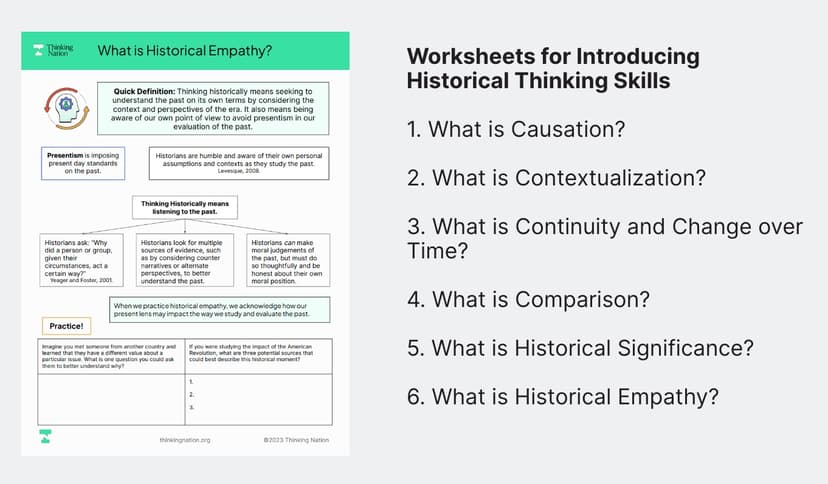
- Aligns directly with Advanced Placement historical thinking skills to prepare middle and high school students for rigorous coursework.
- Incorporates formative assessments before writing tasks to ensure students understand foundational concepts before applying them.
Cons
- The heavy reliance on artificial intelligence for grading essay assignments may miss nuanced historical arguments or provide generic feedback.
- Extensive professional development is required for teachers to implement the inquiry-based protocols effectively.
- The curriculum is purely supplemental and does not replace core chronological history textbooks.
- Equity-based pricing models make cost unpredictable for individual schools or educators who want to adopt the program independently.
What Do We Know About Thinking Nation Supplemental Social Studies Curriculum?
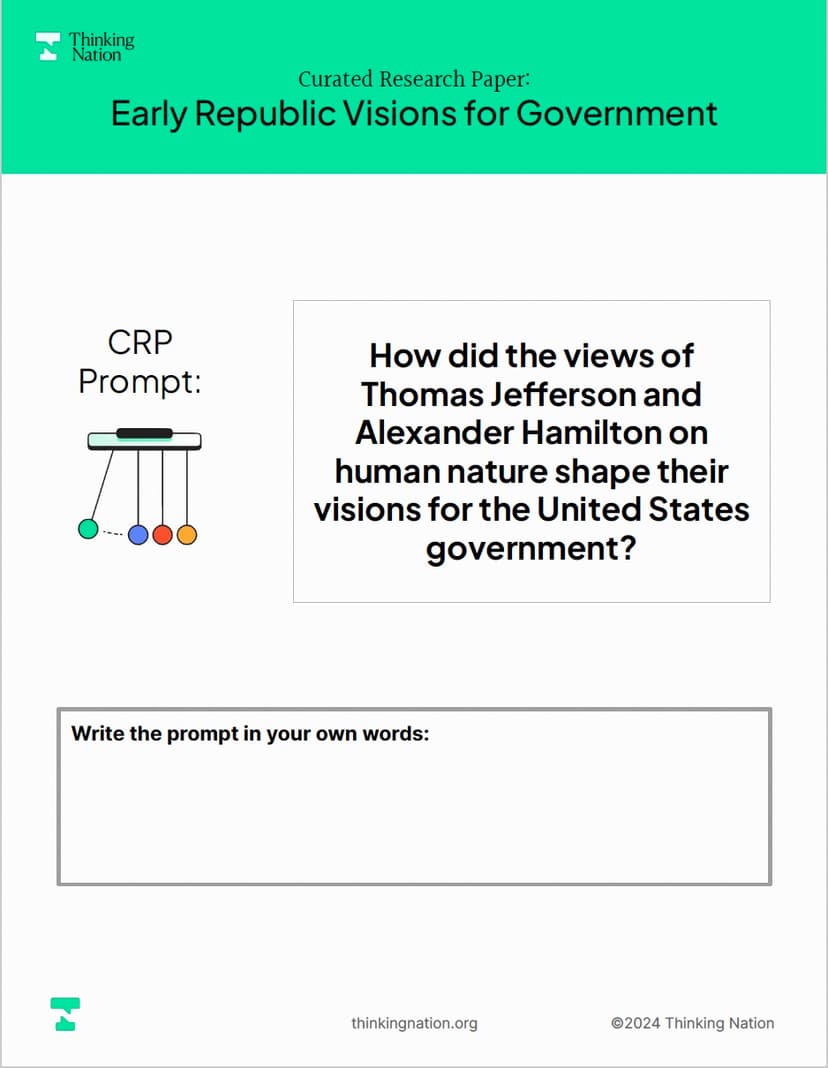
This curriculum is highly effective for building your child's critical thinking and persuasive writing skills in social studies, though it is pending formal evaluation by The Learning Standard. Rather than memorizing dates and names, your child will learn to analyze historical documents like a historian. The platform uses a specific framework called the THINKS protocol, which scaffolds the analytical process and reduces the cognitive load often associated with complex primary sources. After analyzing documents, your child will participate in Socratic Seminars. These discussions force them to practice active retrieval, defending their historical interpretations aloud before writing them down. Finally, they will write a Curated Research Paper. This progression from guided reading to discussion to writing is grounded in sound pedagogical theory. However, you should know that the platform uses artificial intelligence to grade your child's essays. While this provides teachers with immediate data, AI tools can sometimes struggle to evaluate highly original or nuanced historical arguments accurately. Your child's teacher will still need to review these AI-generated grades to ensure feedback is meaningful and accurate.
How Does Thinking Nation Supplemental Social Studies Curriculum Work?
Thinking Nation uses an inquiry-based learning model combined with direct instruction to teach historical analysis and persuasive writing. The curriculum begins by presenting students with complex historical tasks and primary source documents. To prevent students from becoming overwhelmed, the platform provides specialized graphic organizers and its THINKS protocol. This scaffolding breaks down the source analysis into manageable steps. Once students process the information, they complete a formative assessment. This allows teachers to check for understanding and correct misconceptions before moving forward. Next, students engage in Socratic Seminars, structured classroom discussions that require them to verbally articulate and defend their historical arguments using evidence. Finally, students synthesize their learning by writing a Curated Research Paper. The platform then utilizes an artificial intelligence engine to grade these assignments and generate performance data reports for the teacher.
Strengths and tradeoffs of Thinking Nation Supplemental Social Studies Curriculum
Thinking Nation's biggest strength is its systematic scaffolding of complex historical analysis, while its biggest weakness is the inherent unreliability of using AI to evaluate subjective student writing. Structuring cognitive load is critical when teaching students to read primary sources. By using graphic organizers and a standardized analysis protocol, the curriculum prevents working memory overload, allowing students to focus on evaluating evidence rather than just comprehending dense archaic text. Furthermore, the progression from reading to discussing to writing relies heavily on active retrieval practice. Socratic Seminars force students to pull information from memory and apply it in real-time debate, which strengthens long-term retention far better than passive review. Formative assessments placed strategically before the final writing task ensure that foundational knowledge is secure. However, the platform relies on AI-automated grading for the final Curated Research Papers. While immediate feedback is generally beneficial for learning, automated essay scoring systems often reward structural formulas over deep, original historical insight. Without careful teacher moderation, students may learn to write for the algorithm rather than developing genuine persuasive arguments.
Who Might Benefit From Thinking Nation Supplemental Social Studies Curriculum?
This curriculum is best for middle and high school students who need structured support to transition from memorizing historical facts to writing analytical research papers. Because the material heavily targets Advanced Placement historical thinking skills, it serves as an excellent preparatory tool for rigorous high school social studies tracks. It is specifically designed for classroom environments where teachers can facilitate live Socratic Seminars and guide inquiry-based tasks. It is not suitable for independent self-study or homeschooling without a trained educator to interpret the AI-generated data and moderate discussions.
Data Transparency
Does Not Meet Data Transparency Standard
Thinking Nation Supplemental Social Studies Curriculum reaches Level 1 of 3 (Basic protections), below our data transparency standard. Reaching Level 2 needs the policy to document users' right to access their data, data export and self-service deletion.
15 of 35 checks passed
Evaluated October 2026
Privacy Policy →THINKING NATION PRIVACY POLICY →THINKING NATION PRIVACY POLICY →Level 1 · Basic protections
Does not sell data or target ads at students, limits sharing, and lets parents see and delete their child's data.
Level 2 · Parent control (meets the standard)
Families can get their data out, know who processes it, and know how long it is kept.
Not documented: users' right to access their data, data export, self-service deletion
Level 3 · Direct data access
Families or schools can pull their own data through an API, in a stated format.
Not documented: an API for retrieving their own data, a named export format
View all 35 checks
Parent Access5/8
Does the policy mention parents specifically?
“In the event a User or User’s parent, when appropriate, wishes to delete or remove the User’s PII or account, please send an email to”
Can parents view their child's data?
The policy only describes what COPPA requires in general and does not say parents can review their child's data with TNC.
Can parents modify their child's data?
The policy does not give parents a way to correct or modify their child's data; it only mentions FERPA correction rights students have with their schools.
Can parents delete their child's account?
“In the event a User or User’s parent, when appropriate, wishes to delete or remove the User’s PII or account, please send an email to”
Is there a dedicated Children's Privacy section?
The policy has no section headed for children's privacy; COPPA appears only as an entry in the definitions list.
Does it reference COPPA compliance?
“TNC and School each will comply with all applicable provisions of CCPA, CIPA, COPPA, FERPA, SOPIPA and any other applicable law including California Education Code sections 49060 - 49085.”
Does it reference FERPA compliance?
“TNC and School each will comply with all applicable provisions of CCPA, CIPA, COPPA, FERPA, SOPIPA and any other applicable law including California Education Code sections 49060 - 49085.”
Is parental consent required for child accounts?
“School also will solicit, procure, receive and maintain any and all consents required by law for User access to and use of the Services.”
Data Portability0/5
Can users access their personal data?
The policy gives users no right to access their data from TNC; it only summarizes CCPA disclosure rights and FERPA rights students have with their schools.
Can users download/export their data?
The policy does not address downloading or exporting data.
Is there a self-service data access tool?
The policy does not describe a self-service data access tool.
Is a specific data format mentioned for export?
The policy does not name any export format.
Is there an API for data access?
The policy does not describe an API for retrieving data; Clever is mentioned only for rostering and sign-on.
Data Minimization0/6
Is data collection itemized?
The policy gives only example PII types and what is sent through Clever, not a full list of data collected.
Can the app be used without a real name?
The policy says student names are passed through Clever to set up accounts.
Can the app be used without an email?
The policy does not say student email addresses are never collected, and it lists email address as a type of PII.
Does it state collection is limited to what is necessary?
The policy limits only what Clever receives to what is necessary; it does not say TNC's own collection is limited.
Is IP address anonymized or truncated?
The policy says analytics services may collect IP addresses and does not mention anonymizing or truncating them.
Is location tracking explicitly excluded?
The policy does not address location tracking.
Third-Party Protection7/7
Does it explicitly state no selling of data?
“TNC does not sell or rent PII or other data.”
Are third-party providers named?
“Clever, Inc. Website: clever.com Contact: [privacy@clever.com](mailto:privacy@clever.com) Purpose: Clever is used for identity management, single sign-on (SSO), and student rostering.”
Are providers contractually restricted?
“Each such provider is contractually obligated to handle PII in accordance with applicable student privacy laws, including COPPA, FERPA, SOPIPA, and CCPA, and consistent with this Privacy Policy.”
No-targeted-advertising commitment?
“TNC will not use PII or other data for marketing purposes and will not knowingly direct or send marketing communications to a User. TNC does not permit third-party advertising networks or similar services to access or collect PII or other data from TNC’s website or within the Services.”
Is AI/ML data sharing addressed?
“Data used in AI models is either anonymized or de-identified, where appropriate. TNC does not use AI to make high-stakes decisions about students without human review and oversight.”
Child-specific sharing restriction?
“It prohibits TNC from (i) selling student information, (ii) using student information collected from its Services to target advertising, (iii) creating advertising profiles of students; and (iv) the disclosure of PII unless required by law, for education or School purposes only, or as part of the maintenance and development of its Services.”
Cookies/tracking limited or opt-out?
“Users and Schools have a variety of tools to control the use of, block and delete Cookies, Beacons and similar technologies.”
Deletion & Retention2/5
Can users delete their account?
“In the event a User or User’s parent, when appropriate, wishes to delete or remove the User’s PII or account, please send an email to”
Self-service deletion mechanism?
The policy only offers deletion by emailing a request, with no self-service option.
Specific data retention timeline?
“At the conclusion of the school year, all data collected and stored within the system, including personally identifiable information (PII) of students, will be securely stored in the platform and retained for a period of four (4) years, provided that the partner remains contracted with TNC.”
Auto-deletion of inactive accounts?
The policy does not address automatically deleting inactive accounts.
Post-deletion handling described?
The policy says data is destroyed when a contract ends but does not describe what happens to data after deletion, such as backups.
Advertising1/4
Advertising model explicitly disclosed?
The policy limits marketing use of data and ad network access but never states whether the product shows ads.
Free from third-party advertisements?
The policy bars ad networks from collecting data but does not state that the product has no third-party ads.
Children excluded from ad targeting?
“TNC will not use PII or other data for marketing purposes and will not knowingly direct or send marketing communications to a User.”
Ad-free option available?
The policy does not state that the product has no ads or offer an ad-free option.
What This Means
The policy review did not meet our data transparency standard. The checks above show the documented findings and unknowns. A missing statement does not establish how the app handles data in practice.
About this evaluation: Based on automated analysis of Privacy Policy, THINKING NATION PRIVACY POLICY and THINKING NATION PRIVACY POLICY against 35 policy-disclosure questions, including questions adapted from the Common Sense Privacy Program's published evaluation questions. TLS is not affiliated with Common Sense Media, and this is not a Common Sense rating. Quoted text is copied from the policy; unquoted notes are our summary. Results describe what the policy documents, not the company's actual practices. Privacy policies can change: this review reflects the version we analyzed and does not determine legal compliance.
Sources and review method
TLS combines product information and editorial analysis to explain how Thinking Nation Supplemental Social Studies Curriculum works, its tradeoffs, and the questions to ask before choosing it. Product features, an instructional rationale and evidence of learning outcomes are different kinds of information.
Formal Learning Standard assessment: not yet completed. Data Transparency findings are reported separately and do not establish learning effectiveness. Read our methodology.
Frequently Asked Questions About Thinking Nation Supplemental Social Studies Curriculum
Is Thinking Nation Supplemental Social Studies Curriculum free?
No, it is a paid platform that uses an equity-based pricing model. Districts pay a per-student subscription fee and professional development costs, which are discounted based on the school's percentage of students receiving free and reduced lunch. Because pricing is negotiated at the district or school level, individual teachers and parents cannot purchase a standalone retail subscription. This model ensures broader access for underfunded schools but limits individual consumer availability.
Is Thinking Nation Supplemental Social Studies Curriculum good for middle schoolers?
Yes, the curriculum is highly effective for students in grades 6 through 12. The graphic organizers and structured THINKS protocols provide necessary cognitive scaffolding for middle schoolers who are just beginning to learn complex historical analysis. By starting in sixth grade, students can gradually build the analytical writing and debate skills required for rigorous high school Advanced Placement courses.
What does Thinking Nation Supplemental Social Studies Curriculum teach?
It teaches social science and career and technical education, with a heavy emphasis on historical inquiry, primary source analysis, and persuasive writing. Rather than functioning as a traditional chronological textbook, it teaches students how to process historical documents using the THINKS protocol. Students learn to extract evidence, formulate arguments, participate in Socratic Seminars, and synthesize their findings into comprehensive research papers.
How does Thinking Nation Supplemental Social Studies Curriculum compare to traditional history textbooks?
Thinking Nation Supplemental Social Studies Curriculum replaces rote memorization with active historical inquiry. Instead of passively reading a chronological narrative from a standard textbook, students actively analyze primary documents and write curated research papers. They act as historians rather than just consumers of information. This requires significantly more active retrieval and cognitive engagement than traditional read-and-respond textbook assignments.
Has The Learning Standard evaluated Thinking Nation Supplemental Social Studies Curriculum?
TLS has not yet completed a Learning Standard evaluation of how well Thinking Nation Supplemental Social Studies Curriculum teaches. Its privacy policy has been reviewed for Data Transparency and reaches Level 1, Basic protections.
Is Thinking Nation Supplemental Social Studies Curriculum COPPA compliant?
The reviewed privacy policy references COPPA. A policy reference alone does not establish COPPA compliance. Policy review note: The policy commits to complying with COPPA.
Is Thinking Nation Supplemental Social Studies Curriculum FERPA compliant?
The reviewed privacy policy references FERPA. A policy reference alone does not establish FERPA compliance. Policy review note: The policy commits to complying with FERPA.
Does Thinking Nation Supplemental Social Studies Curriculum have a children's privacy policy?
No dedicated children's privacy section was found in the reviewed policy. Policy review note: The policy has no section headed for children's privacy; COPPA appears only as an entry in the definitions list.
Does Thinking Nation Supplemental Social Studies Curriculum sell student data?
The reviewed policy states that the app does not sell data. This is a policy statement; actual data practices were not verified. Policy review note: The policy states TNC does not sell data.
Can you delete your data from Thinking Nation Supplemental Social Studies Curriculum?
The reviewed privacy policy describes account deletion. We have not tested the deletion process. Policy review note: Users can ask by email to delete their account.
Follow TLS Research
Subscribe to future TLS research updates: app reviews, findings, and what the evidence shows.
Screenshots


Take Action
For Thinking Nation Supplemental Social Studies Curriculum
If you represent Thinking Nation and have a correction or new evidence, send the relevant source so we can review and update this page.
Submit a correctionDetails
- Pricing
- We offer equity based pricing on both the per student subscription price and professional development (based on number of teachers and hours requested). Discounted pricing reflects the percentage of students receiving free and reduced lunch.
- Platforms
- iPadOS (Apple tablet), Android (Google mobile), Windows (Microsoft), macOS (Apple), Chrome OS (Google)
- Grade Levels
- 6th Grade, 7th Grade, 8th Grade, 9th Grade, 10th Grade, 11th Grade, 12th Grade
- Website
- Visit site