
Thinking Nation AP Aligned World History Curriculum
Product by Thinking Nation
Facts checked: Not yet checked
Our take (not a Learning Standard rating). This label applies to learning-science judgments throughout this overview.
Our take (not a Learning Standard rating)
While The Learning Standard has not yet formally evaluated this curriculum, its inquiry-based approach strongly aligns with active learning principles. It effectively requires high schoolers to analyze primary sources and synthesize arguments rather than passively memorize facts. However, successful implementation likely depends heavily on teacher scaffolding to prevent cognitive overload during complex research tasks.
Pros
- Promotes active learning by requiring students to analyze and interpret primary source documents rather than passively reading textbook summaries.
- Uses formative assessments to provide ongoing feedback on disciplinary skill development before the final essay.
- Reduces extraneous cognitive load in the final assessment by using Curated Research Papers with pre-selected sources.
- Aligns directly with Advanced Placement historical thinking skills, providing targeted practice for document-based questions.
Cons
- Inquiry-based learning models risk overwhelming novice learners if foundational background knowledge is not explicitly taught first.
- The effectiveness of the curriculum relies heavily on individual teacher implementation and feedback quality.
- Lacks built-in spaced repetition mechanics for retaining specific historical dates and vocabulary over the long term.
- Text-heavy document analysis presents significant barriers for students reading below grade level without adaptive text features.
What Do We Know About Thinking Nation AP Aligned World History Curriculum?
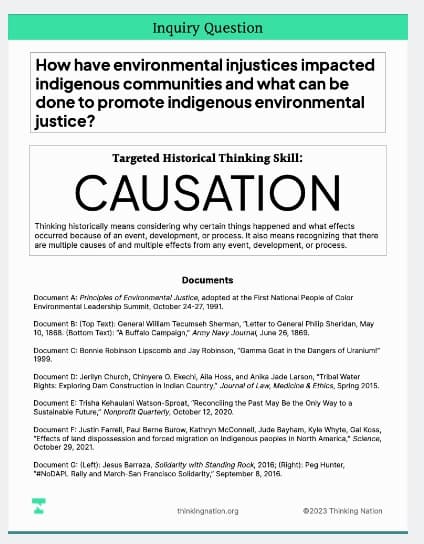
Thinking Nation AP Aligned World History Curriculum utilizes evidence-based active learning strategies to teach historical analysis, though its ultimate effectiveness depends heavily on how your child's teacher guides the inquiry process. Your child will not spend time memorizing lists of dates and battles. Instead, this curriculum forces students to act like historians. They will read primary source documents, analyze visual evidence, and construct historical arguments about complex events like the Haitian Revolution or European Imperialism. This approach leverages the cognitive science principle of elaboration, forcing your child to connect new information to existing knowledge by answering complex questions. The program uses formative assessments to check your child's understanding of specific historical skills, like identifying author bias or contextualizing events. Each unit ends with a Curated Research Paper. By providing the sources for this paper, the curriculum effectively reduces extraneous cognitive load: your child focuses purely on synthesizing an argument rather than getting lost trying to find reliable sources on the internet. However, because inquiry learning requires a strong foundation of background knowledge, your child may struggle if their teacher does not explicitly teach the necessary historical context before assigning the primary documents.
How Does Thinking Nation AP Aligned World History Curriculum Work?
Thinking Nation uses an inquiry-based learning pedagogy built around primary source analysis and structured argumentative writing. Rather than reading a traditional chronological textbook chapter, students are presented with historical questions surrounding specific events, such as the causes of the French Revolution or the impact of the Mexican Revolution. Students engage directly with curated sets of text-based and visual primary sources. As they read, they complete formative assessments designed to isolate and practice specific disciplinary skills, such as sourcing, contextualization, and corroboration. This acts as a form of guided practice, allowing teachers to identify skill gaps. The learning sequence culminates in a Curated Research Paper (CRP) for each unit. Students synthesize the documents they have analyzed to construct a formal, evidence-based essay. This mirrors the exact mechanics required for the Document-Based Question (DBQ) on the AP World History exam, ensuring alignment between daily practice and summative assessment goals.
Strengths and tradeoffs of Thinking Nation AP Aligned World History Curriculum
The biggest strength of Thinking Nation is its rigorous application of active learning through primary source synthesis, while its biggest weakness is the potential for cognitive overload if students lack sufficient background knowledge. Active learning is highly effective for deep comprehension. By forcing students to interpret foundational texts and visual sources themselves, the curriculum demands higher-order thinking and deep processing. The use of Curated Research Papers is a significant strength grounded in cognitive science; by curating the research materials, the curriculum minimizes extraneous cognitive load. Students can dedicate their working memory to constructing logical arguments rather than evaluating the credibility of random internet search results. Conversely, pure inquiry-based learning has notable limitations. Cognitive science research demonstrates that novices struggle to analyze complex information without a strong foundation of prior knowledge. If the curriculum or the teacher fails to provide direct instruction on the historical context before students tackle 18th-century political documents, students will experience severe cognitive overload. Additionally, the curriculum lacks built-in mechanisms for spaced repetition or retrieval practice regarding foundational historical facts, meaning students may struggle to recall specific contextual details months later during their AP exams without supplemental drill practice.
Who Might Benefit From Thinking Nation AP Aligned World History Curriculum?
This curriculum is best for high school educators looking for rigorous, AP-aligned materials that train students in historical writing and document analysis. It is specifically designed for 9th through 12th-grade social science classrooms. The platform serves as a strong primary curriculum for AP World History teachers who want to shift away from lecture-heavy instruction toward student-led inquiry. It is highly beneficial for school districts focused on building college-readiness skills, particularly synthesizing complex texts into coherent arguments. Because of its reliance on complex historical texts, it requires teachers who are comfortable scaffolding reading assignments for diverse learner populations.
Data Transparency
Does Not Meet Data Transparency Standard
Thinking Nation AP Aligned World History Curriculum reaches Level 1 of 3 (Basic protections), below our data transparency standard. Reaching Level 2 needs the policy to document users' right to access their data, data export and self-service deletion.
16 of 35 checks passed
Evaluated September 2026
Privacy Policy →Level 1 · Basic protections
Does not sell data or target ads at students, limits sharing, and lets parents see and delete their child's data.
Level 2 · Parent control (meets the standard)
Families can get their data out, know who processes it, and know how long it is kept.
Not documented: users' right to access their data, data export, self-service deletion
Level 3 · Direct data access
Families or schools can pull their own data through an API, in a stated format.
Not documented: an API for retrieving their own data, a named export format
View all 35 checks
Parent Access4/8
Does the policy mention parents specifically?
“In the event a User or User’s parent, when appropriate, wishes to delete or remove the User’s PII or account, please send an email to [help@thinkingnation.org](mailto:help@thinkingnation.org).”
Can parents view their child's data?
The policy mentions a parent's right to review PII only when describing what COPPA requires, and never says parents can view their child's data.
Can parents modify their child's data?
The policy does not give parents a way to modify their child's data; its only mention of correction is FERPA rights exercised through educational institutions.
Can parents delete their child's account?
“In the event a User or User’s parent, when appropriate, wishes to delete or remove the User’s PII or account, please send an email to [help@thinkingnation.org](mailto:help@thinkingnation.org).”
Is there a dedicated Children's Privacy section?
The policy has no section headed for children's privacy; COPPA appears only as an entry in the definitions list.
Does it reference COPPA compliance?
“TNC and School each will comply with all applicable provisions of CCPA, CIPA, COPPA, FERPA, SOPIPA and any other applicable law including California Education Code sections 49060 - 49085.”
Does it reference FERPA compliance?
“TNC and School each will comply with all applicable provisions of CCPA, CIPA, COPPA, FERPA, SOPIPA and any other applicable law including California Education Code sections 49060 - 49085.”
Is parental consent required for child accounts?
The policy makes the school responsible for any consents required by law and says the school may consent on the parent's behalf; it does not require parental consent for child accounts.
Data Portability0/5
Can users access their personal data?
The policy lets California residents request information about how their PII is collected and used, but it does not give users access to the personal data itself.
Can users download/export their data?
The policy does not address downloading or exporting data.
Is there a self-service data access tool?
The policy does not describe a self-service data access tool.
Is a specific data format mentioned for export?
The policy does not mention any export format.
Is there an API for data access?
The policy does not mention an API for users or schools to retrieve their data.
Data Minimization1/6
Is data collection itemized?
“Student PII — including names, grade levels, school enrollment, and unique identifiers — is transmitted through Clever to provision and authenticate user accounts within the Services.”
Can the app be used without a real name?
The policy says student names are received through Clever rostering.
Can the app be used without an email?
The policy does not say student email addresses are not collected, and it lists email address as an example of PII.
Does it state collection is limited to what is necessary?
The policy limits only what Clever receives to what is necessary and does not state that its own collection is limited.
Is IP address anonymized or truncated?
The policy says analytics providers may collect IP addresses and does not say they are anonymized or truncated.
Is location tracking explicitly excluded?
The policy does not address location tracking.
Third-Party Protection7/7
Does it explicitly state no selling of data?
“TNC does not sell or rent PII or other data.”
Are third-party providers named?
“Clever, Inc. Website: clever.com Contact: [privacy@clever.com](mailto:privacy@clever.com) Purpose: Clever is used for identity management, single sign-on (SSO), and student rostering.”
Are providers contractually restricted?
“Each such provider is contractually obligated to handle PII in accordance with applicable student privacy laws, including COPPA, FERPA, SOPIPA, and CCPA, and consistent with this Privacy Policy.”
No-targeted-advertising commitment?
“TNC will not use PII or other data for marketing purposes and will not knowingly direct or send marketing communications to a User. TNC does not permit third-party advertising networks or similar services to access or collect PII or other data from TNC’s website or within the Services.”
Is AI/ML data sharing addressed?
“TNC reviews all AI-driven processes regularly to ensure fairness, transparency, and compliance with applicable education and privacy laws. Data used in AI models is either anonymized or de-identified, where appropriate.”
Child-specific sharing restriction?
“TNC may use de-identified, aggregated data solely for internal research, product improvement, and educational efficacy purposes. TNC shall not publicly report student performance data, even in de-identified form, for commercial marketing purposes without prior written consent of the School.”
Cookies/tracking limited or opt-out?
“Users and Schools have a variety of tools to control the use of, block and delete Cookies, Beacons and similar technologies.”
Deletion & Retention3/5
Can users delete their account?
“In the event a User or User’s parent, when appropriate, wishes to delete or remove the User’s PII or account, please send an email to [help@thinkingnation.org](mailto:help@thinkingnation.org).”
Self-service deletion mechanism?
The policy offers deletion only by emailing a request, not through a self-service tool.
Specific data retention timeline?
“At the conclusion of the school year, all data collected and stored within the system, including personally identifiable information (PII) of students, will be securely stored in the platform and retained for a period of four (4) years, provided that the partner remains contracted with TNC.”
Auto-deletion of inactive accounts?
The policy does not address automatic deletion of inactive accounts.
Post-deletion handling described?
“In the event that the contract is terminated, all data, including PII and educational records, will be securely destroyed to ensure privacy and compliance with applicable data protection regulations.”
Advertising1/4
Advertising model explicitly disclosed?
The policy bars marketing use of data and ad-network data collection, but it does not state whether the product shows ads.
Free from third-party advertisements?
The policy stops third-party ad networks from collecting data but does not state that the product has no third-party ads.
Children excluded from ad targeting?
“TNC will not use PII or other data for marketing purposes and will not knowingly direct or send marketing communications to a User. TNC does not permit third-party advertising networks or similar services to access or collect PII or other data from TNC’s website or within the Services.”
Ad-free option available?
The policy does not state that the product is ad-free or offer an ad-free option.
What This Means
The policy review did not meet our data transparency standard. The checks above show the documented findings and unknowns. A missing statement does not establish how the app handles data in practice.
About this evaluation: Based on automated analysis of Privacy Policy against 35 policy-disclosure questions, including questions adapted from the Common Sense Privacy Program's published evaluation questions. TLS is not affiliated with Common Sense Media, and this is not a Common Sense rating. Quoted text is copied from the policy; unquoted notes are our summary. Results describe what the policy documents, not the company's actual practices. Privacy policies can change: this review reflects the version we analyzed and does not determine legal compliance.
Sources and review method
TLS combines product information and editorial analysis to explain how Thinking Nation AP Aligned World History Curriculum works, its tradeoffs, and the questions to ask before choosing it. Product features, an instructional rationale and evidence of learning outcomes are different kinds of information.
Formal Learning Standard assessment: not yet completed. Data Transparency findings are reported separately and do not establish learning effectiveness. Read our methodology.
Frequently Asked Questions About Thinking Nation AP Aligned World History Curriculum
Is Thinking Nation AP Aligned World History Curriculum free?
No, Thinking Nation AP Aligned World History Curriculum requires a paid subscription. The pricing model includes a per-student fee with tiered options. The developer offers an equity-based pricing model that provides cost deductions based on a school's free and reduced-price lunch population.
Is Thinking Nation AP Aligned World History Curriculum good for high school students?
Yes, it is highly appropriate for 9th through 12th-grade students preparing for college-level coursework. The curriculum aligns directly with Advanced Placement expectations, pushing teenagers to develop advanced reading comprehension, critical thinking, and argumentative writing skills required for success in higher education.
What does Thinking Nation AP Aligned World History Curriculum teach?
It teaches historical thinking skills and AP World History content. Specific topics include the French, Haitian, and Mexican Revolutions, as well as European Imperialism in Africa. The primary instructional focus is on disciplinary skills like sourcing documents, analyzing bias, and writing structured historical arguments.
How does Thinking Nation AP Aligned World History Curriculum compare to a traditional textbook?
Thinking Nation replaces passive reading with active inquiry. While a traditional textbook provides a synthesized summary of historical events, this curriculum requires students to act as historians by reading primary sources and drawing their own evidence-based conclusions.
Has The Learning Standard evaluated Thinking Nation AP Aligned World History Curriculum?
TLS has not yet completed a Learning Standard evaluation of how well Thinking Nation AP Aligned World History Curriculum teaches. Its privacy policy has been reviewed for Data Transparency and reaches Level 1, Basic protections.
Is Thinking Nation AP Aligned World History Curriculum COPPA compliant?
The reviewed privacy policy references COPPA. A policy reference alone does not establish COPPA compliance. Policy review note: The policy commits to COPPA compliance.
Is Thinking Nation AP Aligned World History Curriculum FERPA compliant?
The reviewed privacy policy references FERPA. A policy reference alone does not establish FERPA compliance. Policy review note: The policy commits to FERPA compliance.
Does Thinking Nation AP Aligned World History Curriculum have a children's privacy policy?
No dedicated children's privacy section was found in the reviewed policy. Policy review note: The policy has no section headed for children's privacy; COPPA appears only as an entry in the definitions list.
Does Thinking Nation AP Aligned World History Curriculum sell student data?
The reviewed policy states that the app does not sell data. This is a policy statement; actual data practices were not verified. Policy review note: The policy states that TNC does not sell data.
Can you delete your data from Thinking Nation AP Aligned World History Curriculum?
The reviewed privacy policy describes account deletion. We have not tested the deletion process. Policy review note: Users can ask by email to have their account deleted.
Follow TLS Research
Subscribe to future TLS research updates: app reviews, findings, and what the evidence shows.
Screenshots



Take Action
For Thinking Nation AP Aligned World History Curriculum
If you represent Thinking Nation and have a correction or new evidence, send the relevant source so we can review and update this page.
Submit a correctionDetails
- Pricing
- Pricing includes a per student subscription and tiers. We employ an equity-based model which reflects deductions for free and reduced lunch populations.
- Platforms
- Web Browser, iOS (Apple mobile), iPadOS (Apple tablet), Android (Google mobile), Tizen (Samsung mobile), Windows (Microsoft), macOS (Apple), Chrome OS (Google)
- Grade Levels
- 9th Grade, 10th Grade, 11th Grade, 12th Grade
- Website
- Visit site