
Thinking Nation AP Aligned US History Curriculum
Product by Thinking Nation
Facts checked: Not yet checked
Our take (not a Learning Standard rating). This label applies to learning-science judgments throughout this overview.
Our take (not a Learning Standard rating)
While The Learning Standard has not yet formally evaluated this curriculum, its inquiry-based approach and reliance on primary source analysis align well with cognitive science principles for historical reasoning. It demands active cognitive effort through Curated Research Papers, but success heavily depends on classroom implementation and teacher guidance rather than automated feedback.
Pros
- Promotes deeper processing by requiring students to analyze and interpret primary source documents rather than passively memorizing dates.
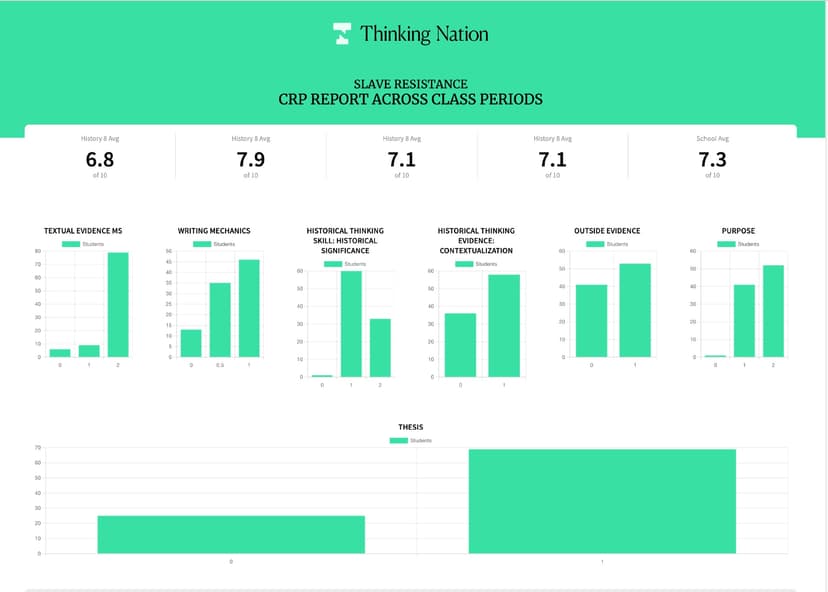
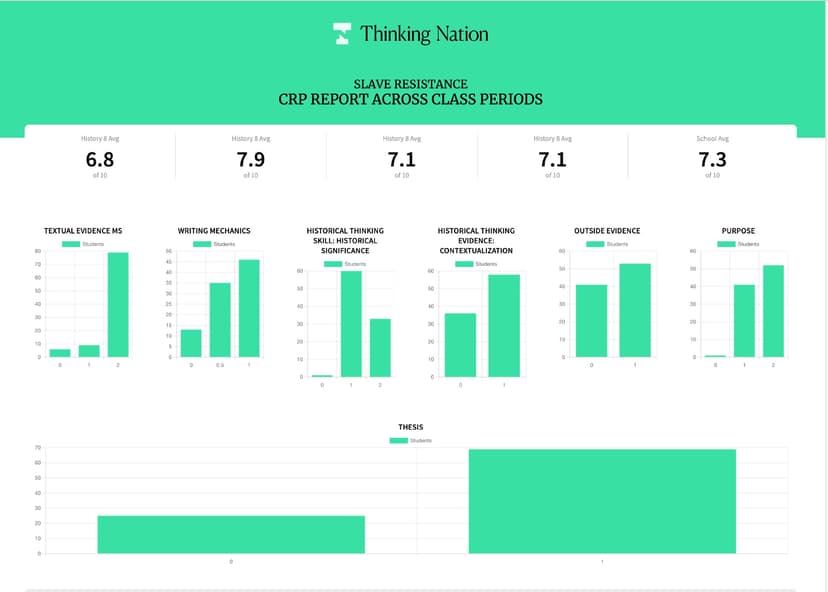
- Uses formative assessments to gauge understanding of specific historical thinking skills before moving to summative tasks.
- Culminating research papers force students to synthesize multiple sources, a proven method for improving critical thinking and retention.
Cons
- Lacks automated, immediate feedback mechanisms to correct misconceptions during the early stages of document analysis.
- High cognitive load during complex primary source reading may overwhelm students without strong foundational literacy skills.
- Effectiveness relies almost entirely on the quality of teacher facilitation rather than independent student engagement.
What Do We Know About Thinking Nation AP Aligned US History Curriculum?
This curriculum is highly effective for developing your child's historical thinking skills, provided they have a teacher to guide them through its rigorous material. Thinking Nation AP Aligned US History Curriculum moves away from traditional textbook memorization and instead forces your child to act like a historian. By reading primary texts and examining visual sources from eras like the Gilded Age or World War I, your child must actively process information and build arguments. Learning science shows that this type of inquiry-based learning improves long-term retention of concepts because it requires deep cognitive processing. However, this is not an app you can hand to your child for independent study. The platform relies on formative assessments and Curated Research Papers that require human grading and feedback to correct misconceptions. If your child struggles with reading comprehension, the high cognitive load of complex historical documents might cause frustration. Parents should understand that this is a school-based curriculum designed to supplement active instruction, not a standalone tutoring tool. When supported by strong classroom teaching, it effectively builds the analytical skills required for Advanced Placement exams and college-level coursework.
How Does Thinking Nation AP Aligned US History Curriculum Work?
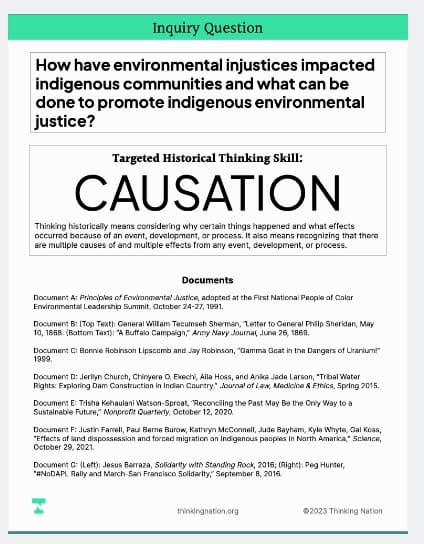
Thinking Nation uses an inquiry-based learning model that centers on primary source analysis and argumentative writing. Students begin units by confronting specific historical questions, such as the impact of the Sedition Act or the realities of the Gilded Age labor movement. Instead of reading a summary, they examine curated historical documents, political cartoons, and visual artifacts. As they work through the sources, the platform provides formative assessments designed to isolate and test specific disciplinary skills, such as contextualization or sourcing. These smaller checks prepare students for the unit's culminating task: a Curated Research Paper. In this final step, students synthesize the evidence they have gathered to construct a formal historical argument. This structure leverages the generation effect, where learning is enhanced because students produce their own answers rather than simply recognizing them on a multiple-choice test. The curriculum requires teachers to review these papers and provide the feedback necessary for skill mastery.
Strengths and tradeoffs of Thinking Nation AP Aligned US History Curriculum
The biggest strength of Thinking Nation is its rigorous application of inquiry-based learning, while its biggest weakness is the potential for cognitive overload in students lacking strong foundational reading skills. Deep processing is the curriculum's core asset. By forcing students to analyze primary sources like the Fugitive Slave Act rather than reading secondary summaries, the platform demands active engagement. This approach strengthens neural pathways associated with critical thinking and long-term memory retention. Furthermore, the inclusion of formative assessments allows educators to identify gaps in specific historical reasoning skills before students attempt the high-stakes Curated Research Paper. Conversely, the reliance on dense historical texts introduces significant cognitive load. Working memory can easily be overwhelmed if a student must simultaneously decode archaic language and synthesize historical context. Without integrated scaffolding, such as vocabulary support or worked examples of document analysis, struggling readers may hit a wall. Additionally, the platform lacks immediate corrective feedback. Because the tasks are highly subjective and writing-heavy, students must wait for teacher evaluation to know if their historical interpretations are accurate, which can delay the correction of misconceptions.
Who Might Benefit From Thinking Nation AP Aligned US History Curriculum?
This curriculum is best for high school students in Advanced Placement history classes who need rigorous practice in source analysis and argumentative writing. Designed specifically for 9th through 12th graders, it serves as a robust classroom tool for educators looking to transition from lecture-based teaching to inquiry-based models. It is highly effective for college-bound students aiming to master the document-based questions found on AP exams. It is not suitable for independent learners or homeschooling parents seeking an automated, self-paced history program, as it requires active teacher facilitation and manual grading to be effective.
Data Transparency
Does Not Meet Data Transparency Standard
Thinking Nation AP Aligned US History Curriculum reaches Level 1 of 3 (Basic protections), below our data transparency standard. Reaching Level 2 needs the policy to document users' right to access their data, data export and self-service deletion.
16 of 35 checks passed
Evaluated September 2026
Privacy Policy →Level 1 · Basic protections
Does not sell data or target ads at students, limits sharing, and lets parents see and delete their child's data.
Level 2 · Parent control (meets the standard)
Families can get their data out, know who processes it, and know how long it is kept.
Not documented: users' right to access their data, data export, self-service deletion
Level 3 · Direct data access
Families or schools can pull their own data through an API, in a stated format.
Not documented: an API for retrieving their own data, a named export format
View all 35 checks
Parent Access5/8
Does the policy mention parents specifically?
“In the event a User or User’s parent, when appropriate, wishes to delete or remove the User’s PII or account, please send an email to [help@thinkingnation.org](mailto:help@thinkingnation.org).”
Can parents view their child's data?
The policy mentions a parent's right to review data only when describing what COPPA requires, and never says parents can view their child's data from TNC.
Can parents modify their child's data?
The policy does not give parents a way to correct or change their child's data; the FERPA definition covers only students getting corrections from their institutions.
Can parents delete their child's account?
“In the event a User or User’s parent, when appropriate, wishes to delete or remove the User’s PII or account, please send an email to [help@thinkingnation.org](mailto:help@thinkingnation.org).”
Is there a dedicated Children's Privacy section?
The policy has no section headed for children's privacy; COPPA appears only in the definitions and compliance list.
Does it reference COPPA compliance?
“TNC and School each will comply with all applicable provisions of CCPA, CIPA, COPPA, FERPA, SOPIPA and any other applicable law including California Education Code sections 49060 - 49085.”
Does it reference FERPA compliance?
“TNC and School each will comply with all applicable provisions of CCPA, CIPA, COPPA, FERPA, SOPIPA and any other applicable law including California Education Code sections 49060 - 49085.”
Is parental consent required for child accounts?
“a description of parental rights including the right to provide consent before the collection of a child’s PII, to review the PII collected, to request the deletion of PII, to refuse to allow further collection of PII, to allow the collection of PII but not the disclosure of it to third parties, etc. The School may act as the agent of the parent and provide consent to the collection of PII, so long as the PII is used exclusively for educational purposes.”
Data Portability0/5
Can users access their personal data?
The policy gives no right for users to access their own personal data from TNC; the CCPA definition covers only disclosure of information about how data is collected and used.
Can users download/export their data?
The policy does not address downloading or exporting data.
Is there a self-service data access tool?
The policy does not describe a self-service data access tool.
Is a specific data format mentioned for export?
The policy names no export format.
Is there an API for data access?
The policy mentions no API for data access; Clever is used only for rostering and sign-on.
Data Minimization0/6
Is data collection itemized?
The policy gives only examples of PII and of the data sent through Clever, not an itemized list of what TNC collects.
Can the app be used without a real name?
The policy states that student names are sent through Clever to set up accounts.
Can the app be used without an email?
The policy does not say student email addresses are never collected, and its PII definition includes email address.
Does it state collection is limited to what is necessary?
The policy limits only what Clever receives to what is necessary, not what TNC itself collects.
Is IP address anonymized or truncated?
The policy calls IP addresses anonymous data but does not say they are anonymized or truncated.
Is location tracking explicitly excluded?
The policy does not address location tracking.
Third-Party Protection7/7
Does it explicitly state no selling of data?
“TNC does not sell or rent PII or other data.”
Are third-party providers named?
“Clever, Inc. Website: clever.com Contact: [privacy@clever.com](mailto:privacy@clever.com) Purpose: Clever is used for identity management, single sign-on (SSO), and student rostering.”
Are providers contractually restricted?
“Each such provider is contractually obligated to handle PII in accordance with applicable student privacy laws, including COPPA, FERPA, SOPIPA, and CCPA, and consistent with this Privacy Policy.”
No-targeted-advertising commitment?
“TNC will not use PII or other data for marketing purposes and will not knowingly direct or send marketing communications to a User. TNC does not permit third-party advertising networks or similar services to access or collect PII or other data from TNC’s website or within the Services.”
Is AI/ML data sharing addressed?
“TNC reviews all AI-driven processes regularly to ensure fairness, transparency, and compliance with applicable education and privacy laws. Data used in AI models is either anonymized or de-identified, where appropriate.”
Child-specific sharing restriction?
“It prohibits TNC from (i) selling student information, (ii) using student information collected from its Services to target advertising, (iii) creating advertising profiles of students; and (iv) the disclosure of PII unless required by law, for education or School purposes only, or as part of the maintenance and development of its Services.”
Cookies/tracking limited or opt-out?
“Users and Schools have a variety of tools to control the use of, block and delete Cookies, Beacons and similar technologies.”
Deletion & Retention2/5
Can users delete their account?
“In the event a User or User’s parent, when appropriate, wishes to delete or remove the User’s PII or account, please send an email to [help@thinkingnation.org](mailto:help@thinkingnation.org).”
Self-service deletion mechanism?
The policy offers deletion only by email request, with no self-service option.
Specific data retention timeline?
“At the conclusion of the school year, all data collected and stored within the system, including personally identifiable information (PII) of students, will be securely stored in the platform and retained for a period of four (4) years, provided that the partner remains contracted with TNC.”
Auto-deletion of inactive accounts?
The policy covers destroying data when a contract ends, but not automatic deletion of inactive accounts.
Post-deletion handling described?
The policy says data is securely destroyed when a contract ends but does not describe what happens after deletion, such as backups or leftover data.
Advertising2/4
Advertising model explicitly disclosed?
“TNC will not use PII or other data for marketing purposes and will not knowingly direct or send marketing communications to a User. TNC does not permit third-party advertising networks or similar services to access or collect PII or other data from TNC’s website or within the Services.”
Free from third-party advertisements?
The policy stops ad networks from accessing data but does not say the product shows no third-party ads.
Children excluded from ad targeting?
“It prohibits TNC from (i) selling student information, (ii) using student information collected from its Services to target advertising, (iii) creating advertising profiles of students; and (iv) the disclosure of PII unless required by law, for education or School purposes only, or as part of the maintenance and development of its Services.”
Ad-free option available?
The policy never says the product has no ads and offers no ad-free option.
What This Means
The policy review did not meet our data transparency standard. The checks above show the documented findings and unknowns. A missing statement does not establish how the app handles data in practice.
About this evaluation: Based on automated analysis of Privacy Policy against 35 policy-disclosure questions, including questions adapted from the Common Sense Privacy Program's published evaluation questions. TLS is not affiliated with Common Sense Media, and this is not a Common Sense rating. Quoted text is copied from the policy; unquoted notes are our summary. Results describe what the policy documents, not the company's actual practices. Privacy policies can change: this review reflects the version we analyzed and does not determine legal compliance.
Sources and review method
TLS combines product information and editorial analysis to explain how Thinking Nation AP Aligned US History Curriculum works, its tradeoffs, and the questions to ask before choosing it. Product features, an instructional rationale and evidence of learning outcomes are different kinds of information.
Formal Learning Standard assessment: not yet completed. Data Transparency findings are reported separately and do not establish learning effectiveness. Read our methodology.
Frequently Asked Questions About Thinking Nation AP Aligned US History Curriculum
Is Thinking Nation AP Aligned US History Curriculum free?
No, it is a paid, subscription-based service designed for schools. Pricing is determined by the number of students enrolled. However, the company offers an equity-based discount that reduces the cost based on the percentage of students receiving free and reduced lunch.
Is Thinking Nation AP Aligned US History Curriculum good for high schoolers?
Yes, it is explicitly designed for 9th through 12th-grade students. The reading level, primary source documents, and Curated Research Papers align with the rigorous expectations of Advanced Placement courses and college-preparatory coursework.
What does Thinking Nation AP Aligned US History Curriculum teach?
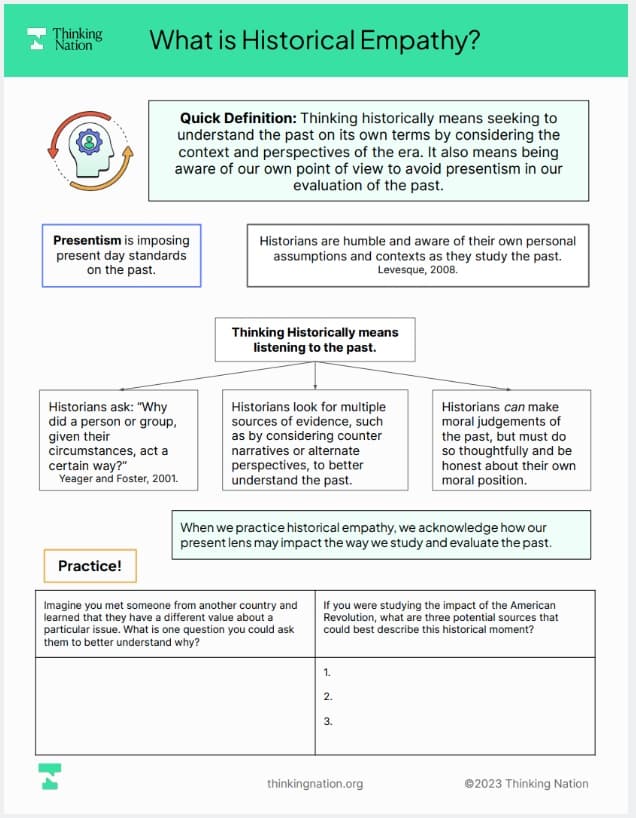
It teaches United States history through the lens of historical thinking skills. Rather than just memorizing facts, students learn how to contextualize events, analyze primary and secondary sources, and build evidence-based arguments covering topics from the 1st Amendment to World War I.
Has The Learning Standard formally evaluated Thinking Nation AP Aligned US History Curriculum?
No, this curriculum is currently pending evaluation. Our independent experts have not yet reviewed it against our full rubric. You can learn more about how we rate educational tools by reading our methodology.
How does Thinking Nation AP Aligned US History Curriculum compare to traditional textbooks?
It replaces passive reading with active inquiry. Traditional textbooks often present history as a settled narrative, which encourages rote memorization. Thinking Nation forces students to act as historians by reading primary sources and forming their own conclusions, which leads to better long-term retention.
Has The Learning Standard evaluated Thinking Nation AP Aligned US History Curriculum?
TLS has not yet completed a Learning Standard evaluation of how well Thinking Nation AP Aligned US History Curriculum teaches. Its privacy policy has been reviewed for Data Transparency and reaches Level 1, Basic protections.
Is Thinking Nation AP Aligned US History Curriculum COPPA compliant?
The reviewed privacy policy references COPPA. A policy reference alone does not establish COPPA compliance. Policy review note: The policy commits to complying with COPPA.
Is Thinking Nation AP Aligned US History Curriculum FERPA compliant?
The reviewed privacy policy references FERPA. A policy reference alone does not establish FERPA compliance. Policy review note: The policy commits to complying with FERPA.
Does Thinking Nation AP Aligned US History Curriculum have a children's privacy policy?
No dedicated children's privacy section was found in the reviewed policy. Policy review note: The policy has no section headed for children's privacy; COPPA appears only in the definitions and compliance list.
Does Thinking Nation AP Aligned US History Curriculum sell student data?
The reviewed policy states that the app does not sell data. This is a policy statement; actual data practices were not verified. Policy review note: The policy states outright that TNC does not sell data.
Can you delete your data from Thinking Nation AP Aligned US History Curriculum?
The reviewed privacy policy describes account deletion. We have not tested the deletion process. Policy review note: Users can ask by email to delete their account.
Follow TLS Research
Subscribe to future TLS research updates: app reviews, findings, and what the evidence shows.
Screenshots
Take Action
For Thinking Nation AP Aligned US History Curriculum
If you represent Thinking Nation and have a correction or new evidence, send the relevant source so we can review and update this page.
Submit a correctionDetails
- Pricing
- We offer a subscription-based model priced by the number of students using the curriculum. We also employ an equity-based strategy which reduces the subscription price by a percentage for the number of students receiving free and reduced lunch.
- Platforms
- Web Browser, iOS (Apple mobile), iPadOS (Apple tablet), Android (Google mobile), Tizen (Samsung mobile), Windows (Microsoft), macOS (Apple), Chrome OS (Google)
- Grade Levels
- 9th Grade, 10th Grade, 11th Grade, 12th Grade
- Website
- Visit site