
Thinking Nation AP Aligned Government and Politics Curriculum
Product by Thinking Nation
Facts checked: Not yet checked
Our take (not a Learning Standard rating). This label applies to learning-science judgments throughout this overview.
Our take (not a Learning Standard rating)
While The Learning Standard has not yet evaluated this curriculum, its inquiry-based approach and reliance on primary source analysis strongly align with cognitive science principles for deep processing. However, without built-in retrieval practice or spaced repetition mechanisms, students lack vital factual retention tools.
Pros
- Requires students to analyze primary sources, promoting deep cognitive processing and critical thinking.
- Uses Curated Research Papers to assess mastery, aligning with proven project-based learning principles.
- Contextualizes abstract political concepts within real-world Supreme Court scenarios to improve knowledge transfer.
- Provides structured inquiry-based units that match the exact scope of the Advanced Placement exam.
Cons
- Lacks automated retrieval practice to help students memorize essential Advanced Placement vocabulary.
- Does not offer spaced repetition algorithms to ensure long-term retention of earlier units.
- Relies heavily on teacher facilitation, meaning effectiveness varies greatly based on classroom instruction.
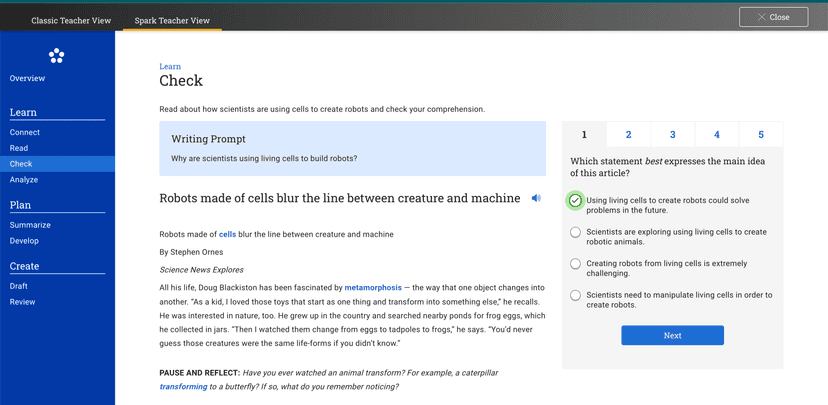
- Provides no immediate digital feedback mechanisms for objective student errors during document analysis.
What Do We Know About Thinking Nation AP Aligned Government and Politics Curriculum?
This curriculum effectively builds critical thinking skills for AP Government students but requires strong teacher facilitation to succeed. Your child will not be passively clicking through multiple-choice questions or watching animated videos. Instead, the program uses inquiry-based learning to force students to analyze historical texts, read Supreme Court decisions, and synthesize information into curated research papers. This method promotes deep processing, a cognitive science principle where grappling with complex material leads to better conceptual understanding. However, parents must understand that this is a school-based curriculum, not an independent study app. Because it lacks automated quizzes, spaced repetition, or immediate digital feedback, your child will rely entirely on their teacher for guidance and correction. If your child struggles with reading comprehension, they will find the heavy emphasis on primary source documents difficult. For AP exam preparation, your child will absolutely need supplementary tools to memorize key terms, as this program focuses strictly on application and analysis rather than factual recall.
How Does Thinking Nation AP Aligned Government and Politics Curriculum Work?
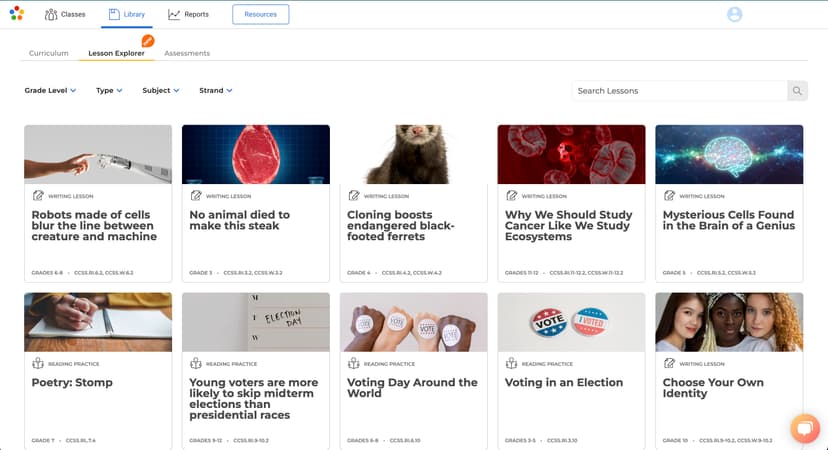
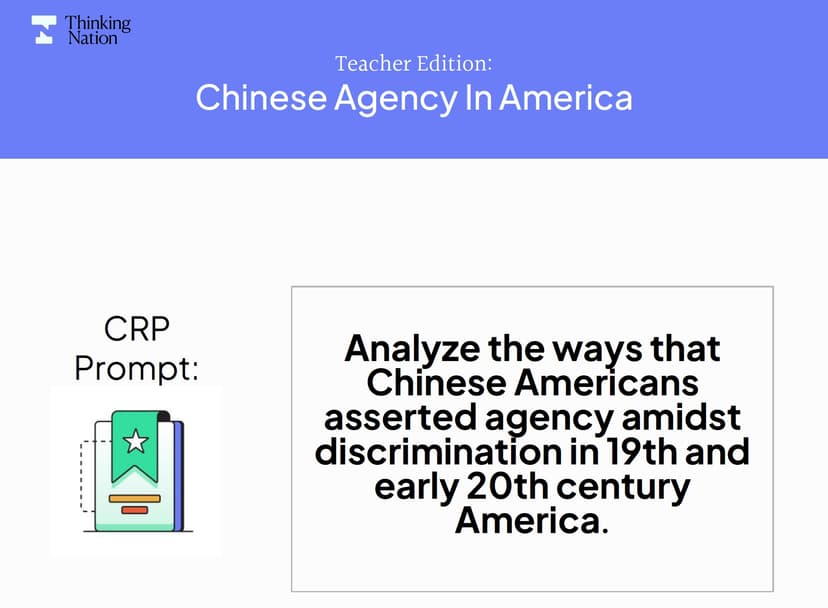
Thinking Nation AP Aligned Government and Politics Curriculum uses inquiry-based learning coupled with document analysis to teach political science. Students progress through thematic units like Civil Liberties and Political Participation by examining primary sources and foundational texts. Rather than memorizing textbook definitions, students read actual Supreme Court decisions and apply abstract constitutional concepts to those specific scenarios. This instructional design leverages contextual learning, forcing students to transfer knowledge from theory to practice. At the end of each unit, students complete a Curated Research Paper. This requires them to synthesize the documents they analyzed and construct an evidence-based argument. The platform provides the curated texts and the essay prompts, but the actual learning happens offline through reading, writing, and classroom debate. Teachers receive professional development and grading rubrics to evaluate these essays. There are no adaptive algorithms or digital practice sets involved in the core loop.
Strengths and tradeoffs of Thinking Nation AP Aligned Government and Politics Curriculum
The biggest strength of this curriculum is its focus on deep processing through primary source analysis, while its biggest weakness is the complete lack of automated retrieval practice. Deep processing occurs when students read complex texts like foundational historical documents and must extract meaning to build arguments. By forcing students to apply constitutional concepts to Supreme Court cases, the curriculum excels at teaching knowledge transfer. Students do not just learn what the First Amendment is; they learn how it applies to specific legal scenarios. This inquiry-based model effectively prepares students for the essay portions of the AP exam. However, the absence of spaced repetition and retrieval practice is a critical flaw for an AP-level course. The AP exam requires students to recall a vast amount of factual information quickly. Because this curriculum does not include daily quizzes or adaptive practice sets, students will likely forget the nuances of early units by the test date. Additionally, without immediate feedback on smaller assignments, students risk solidifying misunderstandings of complex political ideologies.
Who Might Benefit From Thinking Nation AP Aligned Government and Politics Curriculum?
Best for high school classrooms where a dedicated teacher can guide 9th through 12th-grade students through complex text analysis. This curriculum targets students explicitly preparing for the AP United States Government and Politics exam. It is not designed for independent learners, homeschoolers without a political science background, or students who need remedial help. Because it relies heavily on reading comprehension and essay writing, it serves students who already possess foundational literacy skills and need to practice the high-level synthesis required for free-response exam questions.
Data Transparency
Does Not Meet Data Transparency Standard
Thinking Nation AP Aligned Government and Politics Curriculum reaches Level 1 of 3 (Basic protections), below our data transparency standard. Reaching Level 2 needs the policy to document users' right to access their data, data export and self-service deletion.
15 of 35 checks passed
Evaluated September 2026
Privacy Policy →Level 1 · Basic protections
Does not sell data or target ads at students, limits sharing, and lets parents see and delete their child's data.
Level 2 · Parent control (meets the standard)
Families can get their data out, know who processes it, and know how long it is kept.
Not documented: users' right to access their data, data export, self-service deletion
Level 3 · Direct data access
Families or schools can pull their own data through an API, in a stated format.
Not documented: an API for retrieving their own data, a named export format
View all 35 checks
Parent Access5/8
Does the policy mention parents specifically?
“TNC also may collect, use and disclose PII and other data: (a) with the User’s consent or the consent of the User’s parent if applicable or required by law;”
Can parents view their child's data?
The policy mentions a parental review right only when describing what COPPA requires, and does not itself give parents a way to view their child's data.
Can parents modify their child's data?
The policy does not give parents a right to modify their child's data.
Can parents delete their child's account?
“In the event a User or User’s parent, when appropriate, wishes to delete or remove the User’s PII or account, please send an email to [help@thinkingnation.org](mailto:help@thinkingnation.org).”
Is there a dedicated Children's Privacy section?
The policy has no section with its own heading on children's privacy; COPPA appears only as an entry in the definitions list.
Does it reference COPPA compliance?
“TNC and School each will comply with all applicable provisions of CCPA, CIPA, COPPA, FERPA, SOPIPA and any other applicable law including California Education Code sections 49060 - 49085.”
Does it reference FERPA compliance?
“TNC and School each will comply with all applicable provisions of CCPA, CIPA, COPPA, FERPA, SOPIPA and any other applicable law including California Education Code sections 49060 - 49085.”
Is parental consent required for child accounts?
“The School may act as the agent of the parent and provide consent to the collection of PII, so long as the PII is used exclusively for educational purposes.”
Data Portability0/5
Can users access their personal data?
The policy mentions only the CCPA right to request disclosures about collection and FERPA access through schools, and does not give users a way to access their data from TNC.
Can users download/export their data?
The policy does not address downloading or exporting data.
Is there a self-service data access tool?
The policy does not describe a self-service data access tool.
Is a specific data format mentioned for export?
The policy does not name any export format.
Is there an API for data access?
The policy does not mention an API for data access.
Data Minimization0/6
Is data collection itemized?
The policy gives only examples of PII that "may include" certain items and lists what Clever transmits, not a full itemized list of what TNC collects.
Can the app be used without a real name?
The policy says student names are sent to TNC through Clever rostering.
Can the app be used without an email?
The policy does not say student email addresses are never collected, and its definition of PII includes email address.
Does it state collection is limited to what is necessary?
The policy limits only what Clever receives to what is necessary, not what TNC itself collects.
Is IP address anonymized or truncated?
The policy says analytics services may collect IP addresses and does not say they are anonymized or truncated.
Is location tracking explicitly excluded?
The policy does not address location tracking.
Third-Party Protection7/7
Does it explicitly state no selling of data?
“TNC does not sell or rent PII or other data.”
Are third-party providers named?
“Clever, Inc. Website: clever.com Contact: [privacy@clever.com](mailto:privacy@clever.com) Purpose: Clever is used for identity management, single sign-on (SSO), and student rostering.”
Are providers contractually restricted?
“Each such provider is contractually obligated to handle PII in accordance with applicable student privacy laws, including COPPA, FERPA, SOPIPA, and CCPA, and consistent with this Privacy Policy.”
No-targeted-advertising commitment?
“TNC will not use PII or other data for marketing purposes and will not knowingly direct or send marketing communications to a User. TNC does not permit third-party advertising networks or similar services to access or collect PII or other data from TNC’s website or within the Services.”
Is AI/ML data sharing addressed?
“Data used in AI models is either anonymized or de-identified, where appropriate. TNC does not use AI to make high-stakes decisions about students without human review and oversight.”
Child-specific sharing restriction?
“It prohibits TNC from (i) selling student information, (ii) using student information collected from its Services to target advertising, (iii) creating advertising profiles of students; and (iv) the disclosure of PII unless required by law, for education or School purposes only, or as part of the maintenance and development of its Services.”
Cookies/tracking limited or opt-out?
“Users and Schools have a variety of tools to control the use of, block and delete Cookies, Beacons and similar technologies.”
Deletion & Retention2/5
Can users delete their account?
“In the event a User or User’s parent, when appropriate, wishes to delete or remove the User’s PII or account, please send an email to [help@thinkingnation.org](mailto:help@thinkingnation.org).”
Self-service deletion mechanism?
Deletion is only by email request, with no self-service option.
Specific data retention timeline?
“At the conclusion of the school year, all data collected and stored within the system, including personally identifiable information (PII) of students, will be securely stored in the platform and retained for a period of four (4) years, provided that the partner remains contracted with TNC.”
Auto-deletion of inactive accounts?
The policy does not address automatic deletion of inactive accounts.
Post-deletion handling described?
The policy says data is destroyed when the contract ends but does not describe what happens to data after deletion.
Advertising1/4
Advertising model explicitly disclosed?
The policy bars marketing use of data and ad-network access to data, but does not explicitly say the product has no advertising.
Free from third-party advertisements?
The policy bars third-party ad networks from accessing data but does not explicitly say the product shows no third-party ads.
Children excluded from ad targeting?
“It prohibits TNC from (i) selling student information, (ii) using student information collected from its Services to target advertising, (iii) creating advertising profiles of students;”
Ad-free option available?
The policy does not explicitly say the product has no advertising or offer an ad-free option.
What This Means
The policy review did not meet our data transparency standard. The checks above show the documented findings and unknowns. A missing statement does not establish how the app handles data in practice.
About this evaluation: Based on automated analysis of Privacy Policy against 35 policy-disclosure questions, including questions adapted from the Common Sense Privacy Program's published evaluation questions. TLS is not affiliated with Common Sense Media, and this is not a Common Sense rating. Quoted text is copied from the policy; unquoted notes are our summary. Results describe what the policy documents, not the company's actual practices. Privacy policies can change: this review reflects the version we analyzed and does not determine legal compliance.
Sources and review method
TLS combines product information and editorial analysis to explain how Thinking Nation AP Aligned Government and Politics Curriculum works, its tradeoffs, and the questions to ask before choosing it. Product features, an instructional rationale and evidence of learning outcomes are different kinds of information.
Formal Learning Standard assessment: not yet completed. Data Transparency findings are reported separately and do not establish learning effectiveness. Read our methodology.
Frequently Asked Questions About Thinking Nation AP Aligned Government and Politics Curriculum
Is Thinking Nation AP Aligned Government and Politics Curriculum free?
No, it is not free. The developer charges a per-student subscription fee that includes necessary professional development hours for teachers. However, the company employs an equity-based pricing model. This means that districts receive specific deductions based on their populations of students who qualify for free and reduced-price lunch, making it more affordable for under-resourced schools.
Is Thinking Nation AP Aligned Government and Politics Curriculum good for high schoolers?
Yes, it is specifically designed for 9th through 12th-grade students taking AP Government. The reading level and analytical demands of the primary sources precisely match the rigor expected of high school students preparing for college-level exams. Your child will need strong foundational reading skills to engage with the historical texts and Supreme Court rulings included in the lessons.
What does Thinking Nation AP Aligned Government and Politics Curriculum teach?
It teaches the exact scope of the AP United States Government and Politics exam. Units explicitly cover the foundations of American democracy, the interactions among the three branches of government, civil liberties, civil rights, American political ideologies, and political participation. Students learn these concepts by analyzing historical events and modern scenarios rather than just memorizing vocabulary definitions.
Does Thinking Nation AP Aligned Government and Politics Curriculum have a rating from The Learning Standard?
Not yet. This curriculum is currently pending evaluation by our team. Once our educational researchers formally review its instructional design and classroom outcomes against our rigorous methodology, we will update this profile with a comprehensive pedagogical score and detailed findings on its overall effectiveness.
How does Thinking Nation AP Aligned Government and Politics Curriculum prepare students for the AP exam?
It prepares students primarily for the rigorous free-response and essay sections of the test. By forcing students to read foundational historical documents and write detailed Curated Research Papers, it builds the specific analytical and argumentative skills required by the College Board. However, students will likely need supplementary flashcards or practice tests to drill multiple-choice facts and dates.
Has The Learning Standard evaluated Thinking Nation AP Aligned Government and Politics Curriculum?
TLS has not yet completed a Learning Standard evaluation of how well Thinking Nation AP Aligned Government and Politics Curriculum teaches. Its privacy policy has been reviewed for Data Transparency and reaches Level 1, Basic protections.
Is Thinking Nation AP Aligned Government and Politics Curriculum COPPA compliant?
The reviewed privacy policy references COPPA. A policy reference alone does not establish COPPA compliance. Policy review note: The policy commits to complying with COPPA.
Is Thinking Nation AP Aligned Government and Politics Curriculum FERPA compliant?
The reviewed privacy policy references FERPA. A policy reference alone does not establish FERPA compliance. Policy review note: The policy commits to complying with FERPA.
Does Thinking Nation AP Aligned Government and Politics Curriculum have a children's privacy policy?
No dedicated children's privacy section was found in the reviewed policy. Policy review note: The policy has no section with its own heading on children's privacy; COPPA appears only as an entry in the definitions list.
Does Thinking Nation AP Aligned Government and Politics Curriculum sell student data?
The reviewed policy states that the app does not sell data. This is a policy statement; actual data practices were not verified. Policy review note: The policy states that TNC does not sell data.
Can you delete your data from Thinking Nation AP Aligned Government and Politics Curriculum?
The reviewed privacy policy describes account deletion. We have not tested the deletion process. Policy review note: Users can ask by email to delete their account.
Follow TLS Research
Subscribe to future TLS research updates: app reviews, findings, and what the evidence shows.
Screenshots

Take Action
For Thinking Nation AP Aligned Government and Politics Curriculum
If you represent Thinking Nation and have a correction or new evidence, send the relevant source so we can review and update this page.
Submit a correctionDetails
- Pricing
- Pricing includes a per student subscription and professional development hours for teachers. We employ an equity-based model which reflects deductions for free and reduced lunch populations.
- Platforms
- Web Browser, iOS (Apple mobile), iPadOS (Apple tablet), Android (Google mobile), Tizen (Samsung mobile), Windows (Microsoft), macOS (Apple), Chrome OS (Google)
- Grade Levels
- 9th Grade, 10th Grade, 11th Grade, 12th Grade
- Website
- Visit site