The Superkids Reading Program
Product by Zaner-Bloser
Facts checked: Not yet checked
Our take (not a Learning Standard rating). This label applies to learning-science judgments throughout this overview.
Our take (not a Learning Standard rating)
Because while The Superkids Reading Program employs evidence-based systematic phonics, The Learning Standard has not yet evaluated its digital implementation. The curriculum effectively uses explicit instruction to build early literacy, but without formal evaluation data, we cannot definitively verify the efficacy of its digital practice components.
Pros
- Uses explicit, systematic phonics instruction to build foundational decoding skills without relying on guessing strategies.
- Leverages a consistent narrative cast of characters to maintain student engagement and build contextual familiarity for new vocabulary.
- Integrates reading, writing, and spelling together to reinforce early literacy through multiple cognitive and physical modalities.
Cons
- Requires significant teacher or parent facilitation to deliver the core direct instruction components effectively.
- Lacks independent, adaptive digital pathways capable of tailoring difficulty to individual student performance without adult intervention.
- Gated behind institutional sales channels, making it difficult and expensive for individual parents to acquire for casual home use.
What Do We Know About The Superkids Reading Program?
The Superkids Reading Program is a highly structured curriculum that teaches foundational literacy effectively, though The Learning Standard has not yet evaluated its digital components. Your child will experience a comprehensive approach to reading, writing, and spelling that relies heavily on systematic phonics instruction. This means your child learns letter-sound relationships in a deliberate, logical sequence rather than guessing words from pictures or context. The program uses a consistent cast of characters to guide students through the material, which builds narrative familiarity and sustains engagement over an extended period. You will need to actively facilitate many of these lessons, as this is not a supplementary app your child can simply play independently in the backseat of a car. The blended learning model requires a teacher or parent to deliver direct instruction before the child practices the skills digitally or on paper. Because we have not yet evaluated this program, we cannot confirm how well the digital practice utilizes learning science principles like spaced repetition or immediate corrective feedback. However, its core foundation in explicit phonics aligns exceptionally well with established research on how children learn to read.
How Does The Superkids Reading Program Work?
The Superkids Reading Program uses a blended learning approach anchored in direct, explicit instruction and systematic phonics progression. The curriculum introduces specific letter-sound correspondences in a heavily structured sequence, ensuring students master basic decodable sounds before moving on to complex phonetic patterns. Teachers or parents introduce concepts through guided lessons, which are then reinforced by both digital and print practice activities. The entire kindergarten through second-grade journey follows a specific group of characters, allowing the text complexity to scale gradually as the students develop stronger decoding skills. This systematic progression minimizes cognitive overload by isolating new phonetic rules and providing immediate, structured practice before introducing exceptions. While the digital components offer supplemental games and interactive texts, the core engine of the program remains traditional teacher-led instruction followed by guided application.
Strengths and tradeoffs of The Superkids Reading Program
The biggest strength of The Superkids Reading Program is its strict adherence to systematic phonics, while its biggest weakness is a reliance on heavy adult facilitation rather than adaptive, independent digital learning. Explicit phonics instruction is a proven, evidence-based method for teaching decoding, and this program structures that learning logically to prevent cognitive overload. By integrating spelling and writing alongside reading, it uses multimodal reinforcement to strengthen memory pathways and improve long-term retention. The use of continuous characters also provides a familiar narrative schema, which helps young learners focus on decoding rather than constantly acclimating to entirely new settings. However, the program lacks adaptive digital pathways. Because it relies heavily on direct instruction, the software does not automatically adjust difficulty or provide targeted digital remediation based on real-time performance data. Additionally, the lack of an official evaluation by The Learning Standard means we cannot verify if the digital practice utilizes spaced retrieval practice or simply offers rote digital worksheets. It is a highly robust classroom tool, but heavily dependent on the quality of the instructor.
Who Might Benefit From The Superkids Reading Program?
This program is best for K-2 educators and dedicated homeschooling parents who want a comprehensive, evidence-based phonics curriculum. It targets kindergarten through second-grade students who are just beginning to learn letter-sound correspondences, decoding, and early fluency. Because it requires significant direct instruction, it is ideal for structured classroom environments or homeschool settings where an adult can actively guide the daily lessons. It is not recommended for parents seeking an independent, self-paced digital reading app for casual after-school enrichment.
Data Transparency
Does Not Meet Data Transparency Standard
The Superkids Reading Program does not meet our data transparency standard. Its privacy policy does not document basic protections, including parents' right to see their child's data and parents' right to delete their child's data.
22 of 35 checks passed
Evaluated September 2026
Zaner Bloser →Level 1 · Basic protections
Does not sell data or target ads at students, limits sharing, and lets parents see and delete their child's data.
Not documented: parents' right to see their child's data, parents' right to delete their child's data
Level 2 · Parent control (meets the standard)
Families can get their data out, know who processes it, and know how long it is kept.
Not documented: named service providers, self-service deletion
Level 3 · Direct data access
Families or schools can pull their own data through an API, in a stated format.
Not documented: an API for retrieving their own data, a named export format
View all 35 checks
Parent Access5/8
Does the policy mention parents specifically?
“For teacher or parent users, this notification is provided in the form of an announcement message within the portal.”
Can parents view their child's data?
The policy sends student data requests to the school and does not give parents a right to view their child's data.
Can parents modify their child's data?
The policy does not give parents a right to correct their child's data.
Can parents delete their child's account?
The policy gives deletion rights to schools and users but does not give parents a right to delete their child's data or account.
Is there a dedicated Children's Privacy section?
“Consent from Schools regarding Students’ Personal Information:”
Does it reference COPPA compliance?
“We provide the school with this privacy policy, to ensure that the school, in providing its COPPA consent, has full information and assurance that our policies comply with COPPA.”
Does it reference FERPA compliance?
“We comply with FERPA by relying on this form of consent.”
Is parental consent required for child accounts?
“The Children’s Online Privacy Protection Act (“COPPA”) permits a school, acting in the role of “parent” to provide required consents regarding personal information of students who are under the age of 13. Where a school is the subscriber to our portal, we rely on this form of COPPA consent.”
Data Portability2/5
Can users access their personal data?
“As a user of the portal, you have the rights to access, export, be informed about, rectify, object to the further processing of, restrict the processing of, withdraw consent to the processing of and erase your personal information.”
Can users download/export their data?
“As a user of the portal, you have the rights to access, export, be informed about, rectify, object to the further processing of, restrict the processing of, withdraw consent to the processing of and erase your personal information.”
Is there a self-service data access tool?
The policy handles data access by request to the school or by email or phone, not through a self-service tool.
Is a specific data format mentioned for export?
The policy does not name any export format.
Is there an API for data access?
The policy does not mention an API for data access.
Data Minimization3/6
Is data collection itemized?
“MyZBPortal.com (“Portal”) collect the following student PII :”
Can the app be used without a real name?
The policy says the portal collects students' first and last names from the school.
Can the app be used without an email?
“- Student first name (provided by district/school/institution) - Student last name (provided by district/school/institution) - Student ID (provided by district/school/institution) - IP address - Student score data (from completing online activities)”
Does it state collection is limited to what is necessary?
“We limit collection to the information necessary to fulfill those purposes.”
Is IP address anonymized or truncated?
The policy says IP logs are deleted regularly but does not say IP addresses are anonymized or truncated.
Is location tracking explicitly excluded?
The policy does not explicitly rule out location tracking.
Third-Party Protection6/7
Does it explicitly state no selling of data?
“We do not sell student information.”
Are third-party providers named?
The policy describes third-party providers only in general terms and does not name them.
Are providers contractually restricted?
“All third-party service providers must agree to protect student data in a manner no less stringent than Zaner-Bloser's.”
No-targeted-advertising commitment?
“We do not target students with advertisements.”
Is AI/ML data sharing addressed?
“recordings are not analyzed, processed, or scored by automated systems or artificial intelligence”
Child-specific sharing restriction?
“We do not share data with third parties for any other purpose (advertising, marketing, etc).”
Cookies/tracking limited or opt-out?
“Zaner-Bloser, Inc.’s use of cookies is specifically limited to the legitimate business use for operation of the portal and cookies are never used for any targeted advertisements toward students.”
Deletion & Retention4/5
Can users delete their account?
“If you are a student at an educational institution using the Portal, you should direct any requests to exercise your data rights to the appropriate representative at your educational institution.”
Self-service deletion mechanism?
The policy says a Zaner-Bloser representative carries out deletion on request, with no self-service option.
Specific data retention timeline?
“Recordings are permanently deleted no later than the end of the academic year in which they were made, unless the school or district requests earlier deletion.”
Auto-deletion of inactive accounts?
“Zaner-Bloser will permanently delete all Student Data if School maintains zero active or activatable licenses for Zaner-Bloser digital products for six (6) or more consecutive months.”
Post-deletion handling described?
“School information will remain on backup storage for disaster recovery purposes for another 15 days, but thereafter will be removed completely from all storage devices.”
Advertising2/4
Advertising model explicitly disclosed?
“We may also use cookies for the purpose of re-targeting ads to you.”
Free from third-party advertisements?
The policy says students are not targeted with ads but does not state that the product has no ads.
Children excluded from ad targeting?
“We do not target students with advertisements.”
Ad-free option available?
The policy does not state that the product has no ads or offer an ad-free option.
What This Means
The policy review did not meet our data transparency standard. The checks above show the documented findings and unknowns. A missing statement does not establish how the app handles data in practice.
About this evaluation: Based on automated analysis of Zaner Bloser against 35 policy-disclosure questions, including questions adapted from the Common Sense Privacy Program's published evaluation questions. TLS is not affiliated with Common Sense Media, and this is not a Common Sense rating. Quoted text is copied from the policy; unquoted notes are our summary. Results describe what the policy documents, not the company's actual practices. Privacy policies can change: this review reflects the version we analyzed and does not determine legal compliance.
Sources and review method
TLS combines product information and editorial analysis to explain how The Superkids Reading Program works, its tradeoffs, and the questions to ask before choosing it. Product features, an instructional rationale and evidence of learning outcomes are different kinds of information.
Formal Learning Standard assessment: not yet completed. Data Transparency findings are reported separately and do not establish learning effectiveness. Read our methodology.
Frequently Asked Questions About The Superkids Reading Program
Is The Superkids Reading Program free?
No, The Superkids Reading Program is not free. It is a comprehensive commercial curriculum published by Zaner-Bloser rather than a consumer application. Pricing is structured primarily for school districts, institutional buyers, and established homeschool networks. Interested educators or parents must contact the publisher directly to request a custom quote, as there is no standard monthly subscription available for individual home use.
Is The Superkids Reading Program good for kindergarteners?
Yes, it is specifically designed for kindergarten through second-grade students. The program introduces foundational phonemic awareness and basic letter-sound correspondences perfectly suited for early learners. By utilizing a consistent cast of engaging characters, the curriculum helps maintain the attention of younger students during highly structured, explicit phonics lessons. It carefully prevents cognitive overload by introducing skills sequentially, making it highly appropriate for five- and six-year-olds.
What does The Superkids Reading Program teach?
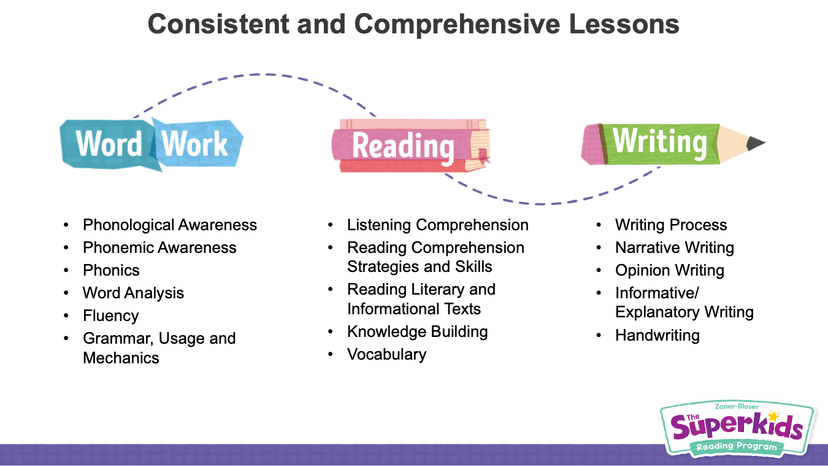
The program teaches comprehensive English language arts with a primary focus on foundational early literacy. Rather than relying on rote memorization, it emphasizes systematic phonics, phonemic awareness, and decoding strategies. Beyond basic reading, the curriculum tightly integrates spelling, handwriting, and early writing skills. This multimodal approach ensures that students are physically writing the letters and words they are learning to decode, reinforcing memory retention through diverse practice.
How does The Superkids Reading Program vs ABCmouse compare?
ABCmouse is a supplementary, independent learning app featuring gamified activities across multiple subjects, whereas The Superkids Reading Program is a formal, teacher-led English language arts curriculum. Superkids provides much deeper, systematic phonics instruction based on the science of reading, but it requires an adult to actively teach the lessons. ABCmouse is designed for independent, self-paced play, making it better for casual enrichment rather than core instruction.
Has The Learning Standard evaluated The Superkids Reading Program?
TLS has not yet completed a Learning Standard evaluation of how well The Superkids Reading Program teaches. Its privacy policy has been reviewed for Data Transparency and does not yet document the basic protections (Level 1).
Is The Superkids Reading Program COPPA compliant?
The reviewed privacy policy references COPPA. A policy reference alone does not establish COPPA compliance. Policy review note: The policy states that it complies with COPPA.
Is The Superkids Reading Program FERPA compliant?
The reviewed privacy policy references FERPA. A policy reference alone does not establish FERPA compliance. Policy review note: The policy states that it complies with FERPA.
Does The Superkids Reading Program have a children's privacy policy?
The reviewed policy includes a dedicated children's privacy section. Policy review note: A section with its own heading covers student data and COPPA consent for children under 13.
Does The Superkids Reading Program sell student data?
The reviewed policy states that the app does not sell data. This is a policy statement; actual data practices were not verified. Policy review note: The policy states the company does not sell student information.
Can you delete your data from The Superkids Reading Program?
The reviewed privacy policy describes account deletion. We have not tested the deletion process. Policy review note: Users have a right to erase their data, which students exercise through their school.
Follow TLS Research
Subscribe to future TLS research updates: app reviews, findings, and what the evidence shows.
Screenshots
Take Action
For The Superkids Reading Program
If you represent Zaner-Bloser and have a correction or new evidence, send the relevant source so we can review and update this page.
Submit a correctionDetails
- Pricing
- Contact Zaner-Bloser for pricing
- Platforms
- iPadOS (Apple tablet), Android (Google mobile), Windows (Microsoft), macOS (Apple), Chrome OS (Google)
- Grade Levels
- Kindergarten, 1st Grade, 2nd Grade
- Website
- Visit site