
The Intelligence Suite: Open-Source AI for Human-Centered Learning
Product by Connected Classroom
Facts checked: Not yet checked
Our take (not a Learning Standard rating). This label applies to learning-science judgments throughout this overview.
Our take (not a Learning Standard rating)
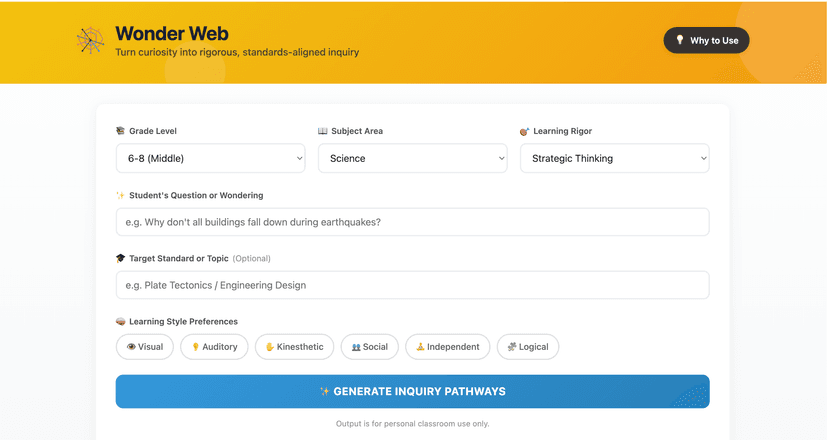
While The Intelligence Suite is primarily a teacher-facing curriculum design tool rather than a direct student instruction app, it strongly supports effective teaching through inquiry-based frameworks. Its open-source AI tools reduce educator workload but rely entirely on the teacher's execution to impact student learning. Formal evaluation is currently pending.
Pros
- Uses Universal Design for Learning frameworks to help teachers scaffold instruction for diverse learners.
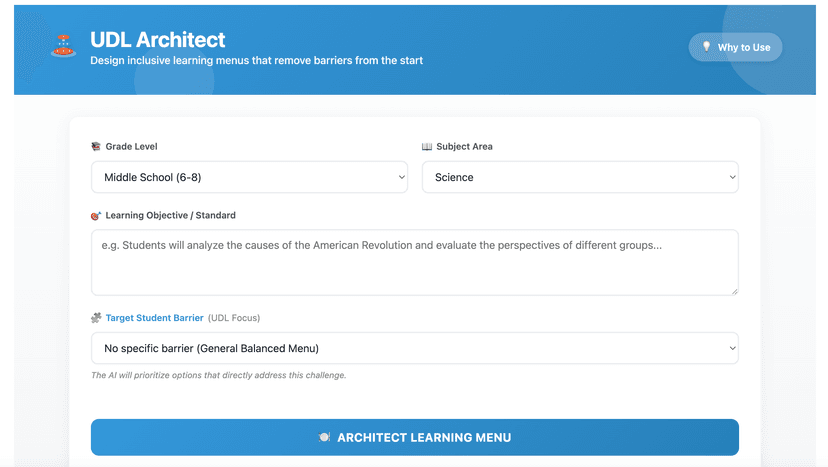
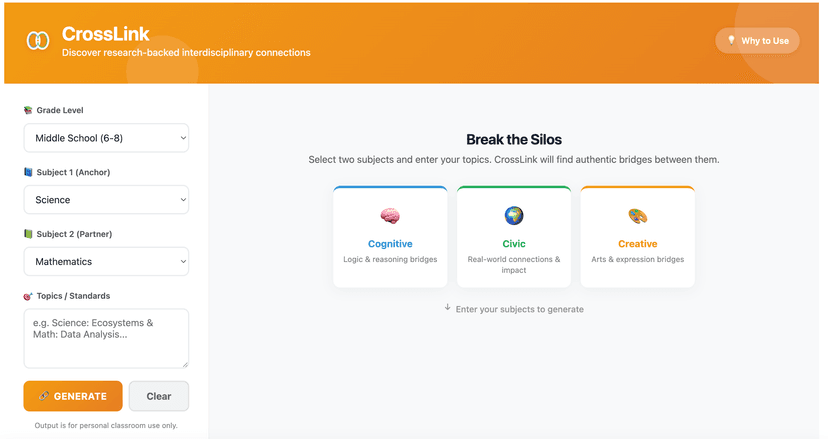
- Promotes inquiry-based learning by generating interdisciplinary lesson plans that connect multiple subjects.
- Prioritizes student privacy through an ephemeral data architecture that deletes inputs immediately after use.
- Removes financial barriers for educators by providing a completely free and open-source platform.
Cons
- Lacks direct instruction, feedback, or retrieval practice mechanics for students.
- Requires high teacher expertise to properly evaluate and refine the AI-generated curriculum materials.
- Provides no built-in assessments or mechanisms to track student mastery over time.
What Do We Know About The Intelligence Suite: Open-Source AI for Human-Centered Learning?
The Intelligence Suite is a highly effective planning resource for educators, but it does not directly teach your child. Instead of a traditional app where students log in to practice math or reading, this is a toolkit designed for teachers to build better lessons. The platform uses artificial intelligence to help educators design cross-curricular projects, apply Universal Design for Learning frameworks, and develop critical thinking exercises. Because the data architecture is ephemeral, it never stores your child's personal information. This tool protects the learning process by keeping the human teacher at the center of the classroom rather than outsourcing instruction to an algorithm. However, its ultimate effectiveness relies entirely on how well the teacher implements the generated lesson plans. If your child's teacher uses this suite, they will likely experience more personalized, inquiry-based assignments rather than rote memorization drills. Formal evaluation by The Learning Standard is currently pending, but the underlying pedagogical models are strongly supported by cognitive science.
How Does The Intelligence Suite: Open-Source AI for Human-Centered Learning Work?
The Intelligence Suite uses an inquiry-based, teacher-mediated approach to curriculum design rather than direct student instruction. The platform consists of seven specialized artificial intelligence tools that educators use to generate lesson frameworks, discussion prompts, and project outlines. A teacher inputs a desired learning objective or topic across various subjects, ranging from 3rd-grade science to 12th-grade humanities. The AI then processes this request through hard-coded, research-backed pedagogical frameworks to produce structured materials. For example, the Universal Design for Learning tool helps teachers modify a single lesson to accommodate different reading levels and learning needs, a practice known as scaffolding. Because the AI is designed to protect human agency, it does not generate automated student grading or direct-to-student chat interfaces. It functions strictly as a planning assistant. Once the materials are generated, the system purges the data to maintain strict privacy. The teacher then takes these structured plans, refines them, and delivers them to the classroom.
Strengths and tradeoffs of The Intelligence Suite: Open-Source AI for Human-Centered Learning
The Intelligence Suite's biggest strength is its strict adherence to Universal Design for Learning frameworks in its outputs, while its biggest weakness is the complete lack of direct student feedback mechanisms. Teacher-Centric Scaffolding: The suite excels at helping educators build scaffolds. Cognitive science shows that reducing extraneous cognitive load helps students process new information; this tool allows teachers to quickly adjust reading levels and create multiple entry points for a single lesson. Inquiry Over Automation: Unlike many AI tools that attempt to replace the teacher by tutoring the student directly, this platform emphasizes inquiry-based learning and human connection. It generates open-ended questions that require critical thinking rather than simple recall. Lack of Direct Practice: Because this is a teacher-facing tool, it does not utilize spaced repetition or retrieval practice directly with the student. Reliance on Implementation: The AI provides the blueprint, but if a teacher fails to execute the lesson effectively, the student sees no benefit. There are no interactive worked examples for students to use independently, demanding a high level of pedagogical expertise from the user to filter and apply the content.
Who Might Benefit From The Intelligence Suite: Open-Source AI for Human-Centered Learning?
The Intelligence Suite is best for classroom educators who want to design inquiry-based, interdisciplinary lessons without sacrificing their planning time. It serves teachers of students from 3rd through 12th grade across all core subjects, including humanities, STEM, and social sciences. Because the platform does not teach students directly, it is not suitable for parents looking for at-home tutoring, homework help, or automated drill-and-practice apps for their children. It is ideal for schools and districts seeking a privacy-first, zero-cost AI alternative that keeps the teacher firmly in control of the learning environment.
Sources and review method
TLS combines product information and editorial analysis to explain how The Intelligence Suite: Open-Source AI for Human-Centered Learning works, its tradeoffs, and the questions to ask before choosing it. Product features, an instructional rationale and evidence of learning outcomes are different kinds of information.
Formal Learning Standard assessment: not yet completed. Data Transparency findings are reported separately and do not establish learning effectiveness. Read our methodology.
Frequently Asked Questions About The Intelligence Suite: Open-Source AI for Human-Centered Learning
Is The Intelligence Suite free?
Yes, The Intelligence Suite is completely free. It is an open-source research initiative provided to educators at no cost. There are no premium tiers, subscriptions, or hidden in-app purchases. The developer currently absorbs the operational costs to ensure ethical AI access for all districts.
Is The Intelligence Suite good for elementary students?
It is a highly effective planning tool for teachers of upper elementary students in 3rd grade and up. It does not provide direct instruction to students of any age. Instead, it helps educators design age-appropriate, cross-curricular lessons that engage young learners through inquiry-based projects.
What does The Intelligence Suite teach?
The Intelligence Suite does not teach specific subjects directly to students. Instead, it assists teachers in creating curriculum for humanities, social science, science, math, and applied science. The platform generates lesson plans, critical thinking prompts, and scaffolded materials that educators use to teach their classes.
How does The Intelligence Suite compare to ChatGPT for teachers?
The Intelligence Suite provides hard-coded pedagogical frameworks, whereas ChatGPT provides generalized text generation. While a teacher must write highly specific prompts to get standards-aligned or inquiry-based lessons from a standard large language model, this platform builds those educational standards directly into its specialized tools.
Has The Learning Standard evaluated The Intelligence Suite: Open-Source AI for Human-Centered Learning?
TLS has not yet completed a Learning Standard evaluation of how well The Intelligence Suite: Open-Source AI for Human-Centered Learning teaches. TLS has not published a Data Transparency result for its privacy policy.
Follow TLS Research
Subscribe to future TLS research updates: app reviews, findings, and what the evidence shows.
Screenshots
Take Action
For The Intelligence Suite: Open-Source AI for Human-Centered Learning
If you represent Connected Classroom and have a correction or new evidence, send the relevant source so we can review and update this page.
Submit a correctionDetails
- Pricing
- The Intelligence Suite is an open-source research initiative provided to the global teaching profession at no cost. There are no subscriptions, no hidden tiered "freemium" models, and no in-app purchases. Our mission is to provide an ethical alternative to commercial EdTech, ensuring that high-quality, research-backed AI tools are accessible to all educators regardless of district budget. The founder takes significant losses and may implement a donation model in the future.
- Platforms
- Web Browser, iOS (Apple mobile), iPadOS (Apple tablet), Android (Google mobile), macOS (Apple), Chrome OS (Google)
- Grade Levels
- 3rd Grade, 4th Grade, 5th Grade, 6th Grade, 7th Grade, 8th Grade, 9th Grade, 10th Grade, 11th Grade, 12th Grade
- Website
- Visit site