Rooted Learning
Product by Rooted Learning
Facts checked: Not yet checked
Our take (not a Learning Standard rating). This label applies to learning-science judgments throughout this overview.
Our take (not a Learning Standard rating)
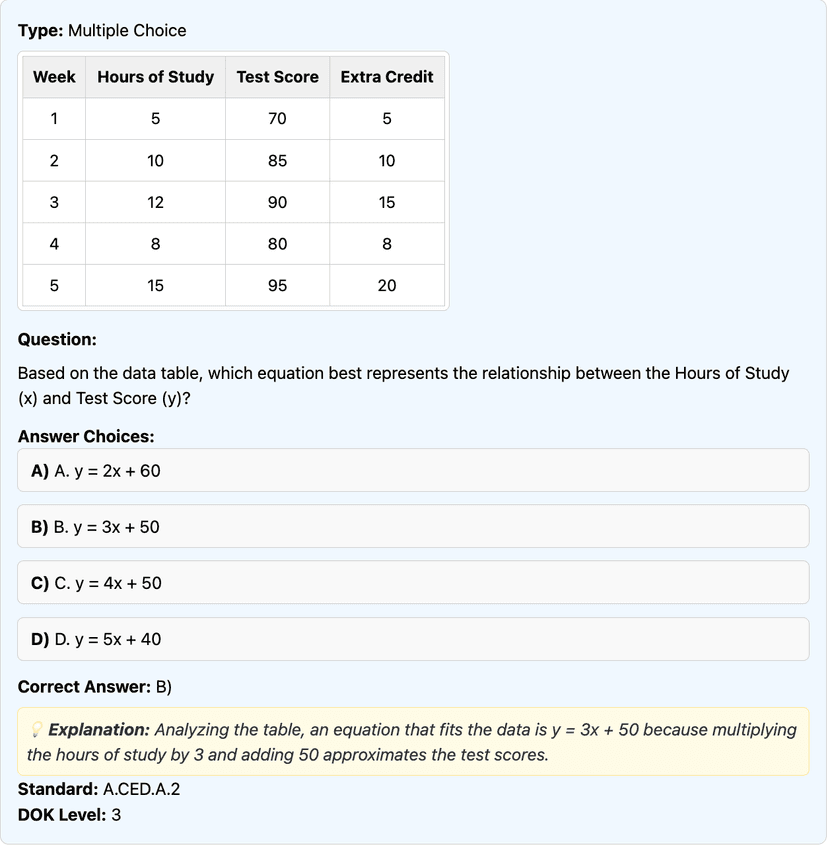
Rooted Learning effectively supports educators by automating the creation of standards-aligned retrieval practice, but it is a teacher productivity tool rather than a direct instruction app. It successfully generates scaffolded questions with multilingual support to aid working memory, though actual student learning depends entirely on how teachers implement these assessments.
Pros
- Automates the generation of retrieval practice items aligned directly to state standards.
- Provides multilingual scaffolds that reduce cognitive load for English language learners.
- Includes explanatory feedback for generated questions to support corrective learning.
- Streamlines formative assessment by exporting directly to Google Forms for immediate classroom use.
Cons
- Relies entirely on teacher implementation rather than providing direct, adaptive instruction to the student.
- Requires manual review by educators to ensure AI-generated questions do not contain hallucinations or pedagogical errors.
- The free tier is highly restrictive, allowing only fifteen generated questions per month.
What Do We Know About Rooted Learning?
Rooted Learning is an effective formative assessment tool that helps teachers create rigorous practice questions, but it does not teach students directly. This platform is designed strictly for educators. Parents will not use this app at home with their children. Instead, your child will interact with the output of this app when their teacher assigns a quiz or practice set through Google Forms. Because the app utilizes AI to generate questions aligned to specific educational standards, your child benefits from targeted retrieval practice that matches exactly what they are learning in class. The platform also generates scaffolds and multilingual support. This helps reduce cognitive load for students who are learning English or need extra help processing complex questions. While The Learning Standard has not yet formally evaluated Rooted Learning, the underlying mechanics of frequent, low-stakes testing are strongly supported by learning science. Frequent formative assessment improves long-term retention. However, the quality of your child's experience depends entirely on the teacher's ability to review the AI-generated questions for accuracy and integrate them into a broader instructional strategy.
How Does Rooted Learning Work?
Rooted Learning uses a teacher-directed model of retrieval practice by generating customized, standards-based assessments. Educators select a specific state standard, grade level, and question type. The artificial intelligence engine then synthesizes these parameters to produce test items. These items include built-in scaffolds and detailed explanations designed to provide corrective feedback. Teachers review the generated content and export it directly to Google Forms. Once exported, teachers assign the practice sets to students. When students complete these practice sets, they engage in retrieval practice, which forces them to recall information from memory and strengthens neural pathways. The inclusion of multilingual support ensures that language barriers do not interfere with the assessment of content mastery. By automating the creation of these items, the platform allows teachers to increase the frequency of formative assessments without a corresponding increase in preparation time. This frequent testing provides both the teacher and the student with immediate data on learning gaps, allowing for targeted intervention before moving on to new material.
Strengths and tradeoffs of Rooted Learning
Rooted Learning's biggest strength is its ability to instantly generate standard-aligned retrieval practice, while its biggest weakness is the inherent risk of AI hallucinations requiring strict teacher oversight. The platform excels at facilitating frequent low-stakes testing. Cognitive science demonstrates that retrieving information from memory significantly improves long-term retention compared to simply restudying material. By allowing teachers to generate 500 questions a month on the basic paid tier, the app removes the preparation bottleneck that often prevents frequent formative assessment. Another major strength is the inclusion of multilingual scaffolds. Providing native language support reduces extraneous cognitive load, ensuring that English language learners are assessed on content mastery rather than language proficiency. Furthermore, the platform generates worked examples and explanations, which are critical for corrective feedback when a student answers incorrectly. On the negative side, the platform relies on generative AI. This means the system can produce inaccurate or poorly phrased questions, demanding careful review by the educator before assignment. Additionally, because the tool is purely an assessment generator, it lacks adaptive sequencing. It cannot automatically adjust question difficulty in real-time based on your child's immediate performance, a feature common in direct-to-student software.
Who Might Benefit From Rooted Learning?
Rooted Learning is best for middle and high school teachers who need to frequently assess student mastery of state standards without spending hours writing quiz questions. The platform is designed for educators teaching 5th through 12th grade across core subjects like Math, Science, Humanities, and Career and Technical Education. It is an ideal fit for classrooms utilizing a blended learning or mastery-based progression model, where continuous formative assessment is required to dictate the pace of instruction. It is also highly beneficial for teachers managing diverse classrooms with multilingual learners who require translated scaffolds to access rigorous grade-level content.
Data Transparency
Does Not Meet Data Transparency Standard
Rooted Learning does not meet our data transparency standard. Its privacy policy does not document basic protections, including limits on sharing children's data, contractual limits on service providers and a COPPA or FERPA commitment.
7 of 35 checks passed
Evaluated September 2026
Privacy Policy →Level 1 · Basic protections
Does not sell data or target ads at students, limits sharing, and lets parents see and delete their child's data.
Not documented: limits on sharing children's data, contractual limits on service providers, a COPPA or FERPA commitment, parents' right to see their child's data, parents' right to delete their child's data
Level 2 · Parent control (meets the standard)
Families can get their data out, know who processes it, and know how long it is kept.
Not documented: data export, a data retention timeline, self-service deletion
Level 3 · Direct data access
Families or schools can pull their own data through an API, in a stated format.
Not documented: an API for retrieving their own data, a named export format
View all 35 checks
Parent Access0/8
Does the policy mention parents specifically?
The policy does not mention parents.
Can parents view their child's data?
The policy does not address parents viewing their child's data.
Can parents modify their child's data?
The policy does not address parents modifying their child's data.
Can parents delete their child's account?
The policy does not address parents deleting their child's account or data.
Is there a dedicated Children's Privacy section?
The policy has no dedicated children's privacy section.
Does it reference COPPA compliance?
The policy does not reference COPPA.
Does it reference FERPA compliance?
The policy does not reference FERPA.
Is parental consent required for child accounts?
The policy does not address parental consent.
Data Portability1/5
Can users access their personal data?
“To request access to or deletion of your data, contact us at [admin@rootedlearning.org](mailto:admin@rootedlearning.org).”
Can users download/export their data?
The policy mentions exporting generated assessments to Google Forms but not exporting users' personal data.
Is there a self-service data access tool?
The policy says data access is requested by emailing the company, with no self-service tool.
Is a specific data format mentioned for export?
The policy names no format for exporting personal data.
Is there an API for data access?
The policy mentions the Google Forms API for building assessments but no API for users to retrieve their own data.
Data Minimization1/6
Is data collection itemized?
“When signing in with Google, Rooted Learning requests access to your basic Google account information, including your email address and public profile (name and profile picture).”
Can the app be used without a real name?
The policy says it collects the user's name from their Google profile.
Can the app be used without an email?
The policy says it collects the user's email address.
Does it state collection is limited to what is necessary?
The policy limits how long data is kept and what service providers process, but does not say collection is limited to what is necessary.
Is IP address anonymized or truncated?
The policy does not address anonymizing IP addresses.
Is location tracking explicitly excluded?
The policy does not address location tracking.
Third-Party Protection4/7
Does it explicitly state no selling of data?
“We do not sell your personal information.”
Are third-party providers named?
“We use OpenAI's GPT models to generate educational content, Google Forms API to build assessments, Supabase to store user data securely, and Stripe to manage payments.”
Are providers contractually restricted?
The policy does not say providers are bound by contracts.
No-targeted-advertising commitment?
“These services may process limited user data as necessary to operate, but your personal information is never sold or shared for advertising or marketing purposes.”
Is AI/ML data sharing addressed?
“Rooted Learning does not use any user data obtained via Google Workspace APIs to develop, improve, or train any generalized machine learning or artificial intelligence models.”
Child-specific sharing restriction?
The policy has no sharing restrictions specific to children.
Cookies/tracking limited or opt-out?
The policy says cookies manage session data and preferences and treats use of the service as consent, with no opt-out.
Deletion & Retention1/5
Can users delete their account?
“You can request deletion of your account and associated data at any time by contacting us.”
Self-service deletion mechanism?
The policy says deletion is requested by contacting the company, with no self-service mechanism.
Specific data retention timeline?
The policy says data is kept only as long as necessary but gives no specific timeline.
Auto-deletion of inactive accounts?
The policy does not address automatic deletion of inactive accounts.
Post-deletion handling described?
The policy does not describe what happens to data after deletion.
Advertising0/4
Advertising model explicitly disclosed?
The policy does not disclose whether the product has advertising.
Free from third-party advertisements?
The policy does not state that the product has no third-party advertisements.
Children excluded from ad targeting?
The policy does not address excluding children from ad targeting.
Ad-free option available?
The policy does not mention an ad-free option or say the product has no ads.
What This Means
The policy review did not meet our data transparency standard. The checks above show the documented findings and unknowns. A missing statement does not establish how the app handles data in practice.
About this evaluation: Based on automated analysis of Privacy Policy against 35 policy-disclosure questions, including questions adapted from the Common Sense Privacy Program's published evaluation questions. TLS is not affiliated with Common Sense Media, and this is not a Common Sense rating. Quoted text is copied from the policy; unquoted notes are our summary. Results describe what the policy documents, not the company's actual practices. Privacy policies can change: this review reflects the version we analyzed and does not determine legal compliance.
Sources and review method
TLS combines product information and editorial analysis to explain how Rooted Learning works, its tradeoffs, and the questions to ask before choosing it. Product features, an instructional rationale and evidence of learning outcomes are different kinds of information.
Formal Learning Standard assessment: not yet completed. Data Transparency findings are reported separately and do not establish learning effectiveness. Read our methodology.
Frequently Asked Questions About Rooted Learning
Is Rooted Learning free?
Rooted Learning offers a highly limited free tier. Solo educators can generate up to 15 questions per month at no cost. To generate a functional amount of content, teachers must upgrade to a paid plan. The individual paid tier costs $6 per month or $60 per year for 500 questions a month. Schools and districts can also purchase tiered group licenses.
Is Rooted Learning good for middle and high school students?
Yes, Rooted Learning is highly appropriate for students in grades 5 through 12. The app generates content specifically calibrated for these grade levels and aligns with state standards for older students. However, students do not use the app directly; they interact with the quizzes and practice sets that their teachers generate and distribute via Google Forms.
What does Rooted Learning teach?
Rooted Learning does not directly teach any subject to students. It is an assessment generation tool for teachers. Educators use it to create practice questions and quizzes for Humanities, Social Science, Science, Math, Applied Science, and Career and Technical Education. The effectiveness of the learning depends entirely on classroom instruction and how the teacher uses the assessments.
How does Rooted Learning compare to Diffit for Teachers?
Both Rooted Learning and Diffit use AI to save teachers time, but they serve slightly different core functions. Rooted Learning focuses strictly on generating rigorous, standards-aligned assessment items and exporting them to Google Forms for retrieval practice. Diffit focuses more heavily on adapting reading levels and generating full instructional resources, texts, and activities alongside basic assessment questions.
Has The Learning Standard evaluated Rooted Learning?
TLS has not yet completed a Learning Standard evaluation of how well Rooted Learning teaches. Its privacy policy has been reviewed for Data Transparency and does not yet document the basic protections (Level 1).
Is Rooted Learning COPPA compliant?
A COPPA reference was not found in the reviewed privacy policy. This does not determine whether the app complies with COPPA. Policy review note: The policy does not reference COPPA.
Is Rooted Learning FERPA compliant?
A FERPA reference was not found in the reviewed privacy policy. This does not determine whether the app complies with FERPA. Policy review note: The policy does not reference FERPA.
Does Rooted Learning have a children's privacy policy?
No dedicated children's privacy section was found in the reviewed policy. Policy review note: The policy has no dedicated children's privacy section.
Does Rooted Learning sell student data?
The reviewed policy states that the app does not sell data. This is a policy statement; actual data practices were not verified. Policy review note: The policy explicitly states it does not sell personal information.
Can you delete your data from Rooted Learning?
The reviewed privacy policy describes account deletion. We have not tested the deletion process. Policy review note: Users can request deletion of their account.
Follow TLS Research
Subscribe to future TLS research updates: app reviews, findings, and what the evidence shows.
Screenshots


Take Action
For Rooted Learning
If you represent Rooted Learning and have a correction or new evidence, send the relevant source so we can review and update this page.
Submit a correctionDetails
- Pricing
- Rooted Learning offers a flexible pricing model for both individual educators and schools. Solo educators can generate up to 15 questions a month for free, 500 questions per month for $6/month, or 650 questions per month for $60/year. Schools can purchase group licenses based on teacher count, with tiered pricing (e.g., $1,200/year for up to 30 teachers). All plans include unlimited exports to Google Forms and access to multilingual scaffolds. Custom quotes available for districts and large-scale implementations.
- Platforms
- Web Browser, iOS (Apple mobile), iPadOS (Apple tablet), Android (Google mobile), Tizen (Samsung mobile), Windows (Microsoft), macOS (Apple), Chrome OS (Google)
- Grade Levels
- 5th Grade, 6th Grade, 7th Grade, 8th Grade, 9th Grade, 10th Grade, 11th Grade, 12th Grade
- Website
- Visit site