OpenClass
Product by OpenClass
Facts checked: Not yet checked
Our take (not a Learning Standard rating). This label applies to learning-science judgments throughout this overview.
Our take (not a Learning Standard rating)
While OpenClass heavily incorporates evidence-based learning science principles like spaced repetition and retrieval practice into its learning management system, The Learning Standard has not yet conducted a full evaluation of its effectiveness. Its mastery-based quizzes and adaptive reviews provide strong theoretical groundwork for high school and adult learners to retain complex information over time.
Pros
- Incorporates proven cognitive science strategies like spaced repetition and retrieval practice directly into the learning management platform.
- Automates mastery-based quizzes to ensure students fully understand foundational concepts before progressing to advanced material.
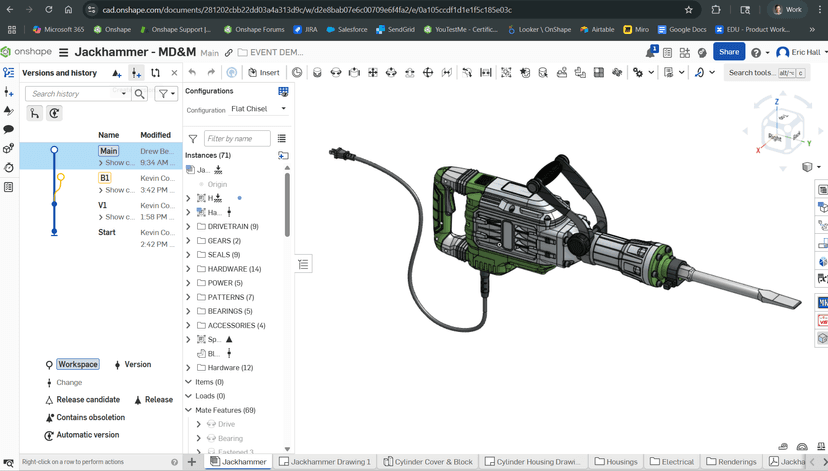
- Includes native in-browser coding environments to allow computer science students to practice skills without external software.
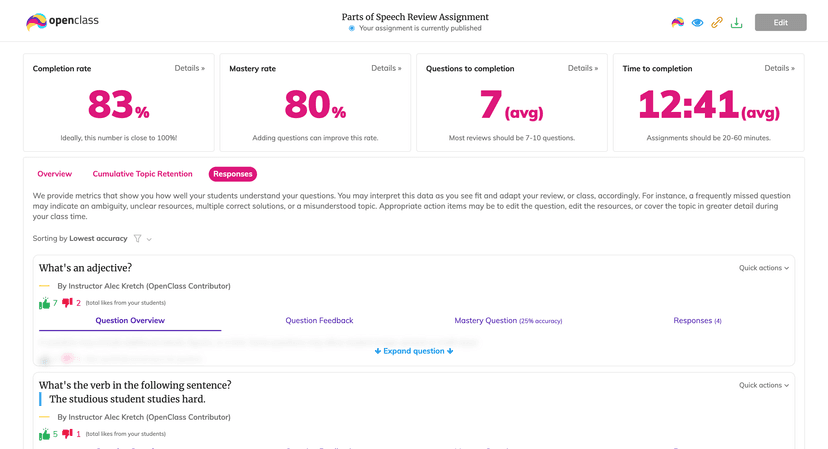
- Provides targeted adaptive reviews that customize practice sessions based on individual student performance and forgetting curves.
Cons
- The integration of AI-powered assignment generation risks producing factually inaccurate practice questions if not rigorously monitored by educators.
- Managing a mastery-based progression system demands significant initial setup time from instructors transitioning from traditional linear grading models.
- The platform lacks built-in parental tracking features, making it difficult for caregivers of high school students to monitor daily progress independently.
What Do We Know About OpenClass?
OpenClass is structurally designed to be an effective learning tool for older students, though its exact efficacy remains pending evaluation by The Learning Standard. As a learning management system, it replaces traditional platforms with an engine built specifically around cognitive science. For your child, this means homework and quizzes behave differently than they might be used to. Instead of moving past a topic after a single test, the platform uses spaced repetition to bring older concepts back into their current assignments. This forces your child to retrieve information just as they are about to forget it, which research shows is the most effective way to build long-term memory. The platform also requires mastery, meaning your child cannot simply pass with a low grade and move on; they must demonstrate true understanding through repeated adaptive practice. Because it is geared toward high school, college, and adult learners, the interface is strictly academic and expects a high degree of self-regulation. You will not find gamified elements or vibrant animations here. Instead, your child will interact with straightforward text, embedded coding environments, and interactive lessons that prioritize rigorous academic focus over entertainment.
How Does OpenClass Work?
OpenClass uses a mastery-based progression model driven by spaced repetition and adaptive retrieval practice. Educators build or import their curriculum into the platform, generating interactive lessons and question banks. As students complete assignments, the system tracks their individual performance on specific learning objectives. Instead of static quizzes, OpenClass deploys adaptive review sessions. The platform algorithmically determines which concepts a student is struggling with and automatically resurfaces those questions in future assignments at optimized intervals. If a student fails to demonstrate mastery on a specific topic, the system requires them to review the foundational material and attempt new variations of the problem until they succeed. For subjects like computer science, this includes typing and executing code directly within the browser, receiving immediate feedback on syntax and logic errors. Instructors can also utilize AI tools to rapidly generate new quiz questions, ensuring students have an endless supply of novel practice items to test their retrieval strength rather than just memorizing specific answers.
Strengths and tradeoffs of OpenClass
The biggest strength of OpenClass is its native integration of spaced repetition into standard course assignments, while its biggest weakness is the reliance on unverified AI generation for critical practice questions. Most traditional learning management systems function simply as digital filing cabinets, but OpenClass actively participates in the learning process by forcing retrieval practice. By systematically delaying and re-testing material, the platform strengthens neural pathways and dramatically improves long-term retention compared to traditional massed practice or cramming. Its mastery-based quizzes further ensure that foundational gaps are closed before a student encounters advanced concepts. However, the inclusion of AI-generated assignments introduces a significant pedagogical risk. Learning science dictates that practice questions must be meticulously aligned with learning objectives and perfectly accurate to prevent negative transfer. If the AI generates flawed distractors or imprecise questions, students may encode incorrect information. Additionally, while the adaptive review is excellent for subjects requiring high volumes of factual recall and procedural fluency, it may prove less effective for deeply subjective humanities courses where mastery is harder to quantify through automated quizzing. Overall, the structural adherence to cognitive science makes it a powerful tool, provided educators carefully curate the content.
Who Might Benefit From OpenClass?
Best for high school and university educators who want to seamlessly integrate evidence-based cognitive science practices into their daily coursework. OpenClass targets students from 9th grade through doctoral and adult education programs. It is an ideal solution for instructors teaching highly structured subjects like mathematics, applied sciences, and computer programming, where procedural mastery is critical. Independent tutors and small classes of under 20 students will benefit most immediately from its free tier, allowing them to implement rigorous adaptive learning without massive enterprise costs.
Data Transparency
Does Not Meet Data Transparency Standard
OpenClass does not meet our data transparency standard. Its privacy policy does not document basic protections, including a commitment against targeted advertising, limits on sharing children's data and parents' right to see their child's data.
15 of 35 checks passed
Evaluated September 2026
Privacy Policy →Level 1 · Basic protections
Does not sell data or target ads at students, limits sharing, and lets parents see and delete their child's data.
Not documented: a commitment against targeted advertising, limits on sharing children's data, parents' right to see their child's data
Level 2 · Parent control (meets the standard)
Families can get their data out, know who processes it, and know how long it is kept.
Not documented: a data retention timeline, self-service deletion
Level 3 · Direct data access
Families or schools can pull their own data through an API, in a stated format.
Not documented: an API for retrieving their own data, a named export format
View all 35 checks
Parent Access5/8
Does the policy mention parents specifically?
“If a child under 13 provided our Website or Products with Personal Information, we ask that a parent or guardian contact us as described below so that we may promptly delete the child”
Can parents view their child's data?
The policy does not give parents a right to view their child's data.
Can parents modify their child's data?
The policy does not give parents a right to change their child's data.
Can parents delete their child's account?
“If a child under 13 provided our Website or Products with Personal Information, we ask that a parent or guardian contact us as described below so that we may promptly delete the child”
Is there a dedicated Children's Privacy section?
“As set forth in the User Agreement, the Products are not meant for users under the age of 13 years old.”
Does it reference COPPA compliance?
The policy does not mention COPPA.
Does it reference FERPA compliance?
“For US Users, Top Hat’s data protection and privacy policies and practices allow Institutions to comply with FERPA, and other applicable federal and state privacy laws.”
Is parental consent required for child accounts?
“if the Student User is are least 13 years of age, but less than 18, years of age, and not enrolled in a higher education Institution, you are the Student User’s parent or guardian with the authority to enter into the User Agreement and can consent to providing Personal Information related to the Student User on behalf of such Student User”
Data Portability2/5
Can users access their personal data?
“You are entitled to access and correct your Personal Information at any time. Top Hat will, at your request, provide you with copies of your Personal Information Top Hat has in its possession”
Can users download/export their data?
“Right to Portability.** You may have the right to receive a copy of the Personal Information we have collected about you in a structured, commonly used and machine-readable format.”
Is there a self-service data access tool?
The policy handles data access by request; its account settings are described only for editing information, not for accessing or downloading data.
Is a specific data format mentioned for export?
The policy says only 'structured, commonly used and machine-readable format' and names no specific file format.
Is there an API for data access?
The policy does not describe an API that users can use to retrieve their own data.
Data Minimization1/6
Is data collection itemized?
“such as first and last name, email address, date of birth, postal address, telephone number, and/or a unique individual password”
Can the app be used without a real name?
The policy says Top Hat collects first and last names.
Can the app be used without an email?
The policy says Top Hat collects email addresses.
Does it state collection is limited to what is necessary?
The policy does not say collection is limited to what is necessary.
Is IP address anonymized or truncated?
The policy says IP addresses are collected and does not mention anonymizing or truncating them.
Is location tracking explicitly excluded?
The policy says location is collected for Secure Attendance and general device location may be identified, so location tracking is not excluded.
Third-Party Protection4/7
Does it explicitly state no selling of data?
“For the avoidance of doubt, we do not sell your contact information, student records, or other information about you to third parties.”
Are third-party providers named?
“Presently, we use Google Analytics.”
Are providers contractually restricted?
“Third-Party Service Providers are bound by agreement or obligations with Top Hat to implement and maintain reasonable security procedures and practices in order to use and disclose your Personal Information in a manner consistent with the use and disclosure provisions of this Policy”
No-targeted-advertising commitment?
The policy says device identifiers may be used to target ads to users in the app, and it makes no no-targeted-ads commitment.
Is AI/ML data sharing addressed?
The policy does not address sharing data for AI or machine learning.
Child-specific sharing restriction?
The policy has no sharing restriction specific to children.
Cookies/tracking limited or opt-out?
“If you do not want information collected through the use of Cookies, you can manage your Cookie preferences through Top Hat’s Privacy Preference Center”
Deletion & Retention2/5
Can users delete their account?
“You may request the deletion of your User Account at any time.”
Self-service deletion mechanism?
The policy offers deletion only by request, with no self-service tool.
Specific data retention timeline?
The policy gives no specific retention period.
Auto-deletion of inactive accounts?
The policy does not address automatically deleting inactive accounts.
Post-deletion handling described?
“we retain full discretion to maintain certain of our information even after honoring a deletion or rights request. For instance, we may need to retain certain information for the purposes of complying with our ongoing legal obligations (including our obligation to maintain a record of your deletion request or past purchases)”
Advertising1/4
Advertising model explicitly disclosed?
“When you use our mobile applications, we or our third party marketing partners may use one or more of several different identifiers for your mobile device, including Apple Identifier For Advertising (IDFA) or Android Advertising ID (AAID), to target and deliver ads to you in our app or other apps.”
Free from third-party advertisements?
The policy says third-party ad networks may target and deliver ads in the app.
Children excluded from ad targeting?
The policy does not exclude children or students from ad targeting.
Ad-free option available?
The policy offers an opt-out from targeted ads but says generalized ads may still appear, so there is no ad-free option.
What This Means
The policy review did not meet our data transparency standard. The checks above show the documented findings and unknowns. A missing statement does not establish how the app handles data in practice.
About this evaluation: Based on automated analysis of Privacy Policy against 35 policy-disclosure questions, including questions adapted from the Common Sense Privacy Program's published evaluation questions. TLS is not affiliated with Common Sense Media, and this is not a Common Sense rating. Quoted text is copied from the policy; unquoted notes are our summary. Results describe what the policy documents, not the company's actual practices. Privacy policies can change: this review reflects the version we analyzed and does not determine legal compliance.
Sources and review method
TLS combines product information and editorial analysis to explain how OpenClass works, its tradeoffs, and the questions to ask before choosing it. Product features, an instructional rationale and evidence of learning outcomes are different kinds of information.
Formal Learning Standard assessment: not yet completed. Data Transparency findings are reported separately and do not establish learning effectiveness. Read our methodology.
Frequently Asked Questions About OpenClass
Is OpenClass free?
OpenClass is free for individual instructors managing classes of up to 20 students. For larger classes, entire schools, or enterprise implementations, the platform charges a licensing fee based on the total number of students enrolled.
Is OpenClass good for high school students?
Yes, the platform is highly appropriate for high school students, particularly in grades 9 through 12. Its mastery-based progression and spaced repetition mechanics help older students develop the independent study habits and long-term retention skills required for college-level academics.
What does OpenClass teach?
OpenClass does not provide its own curriculum. Instead, it is a learning management system where educators input their own materials to teach subjects ranging from humanities and social sciences to math, applied science, and career and technical education.
Has OpenClass been evaluated by The Learning Standard?
Not yet. OpenClass is currently pending evaluation. Once assessed, our team will update this review with definitive data on its pedagogical effectiveness, adhering to the rigorous evaluation criteria outlined in our methodology.
How does OpenClass compare to Canvas or Google Classroom?
Unlike traditional platforms that primarily organize files and gradebooks, OpenClass actively drives instruction using adaptive learning algorithms. While Canvas and Google Classroom require third-party integrations to offer personalized practice, OpenClass builds spaced repetition and mastery quizzes directly into its core infrastructure.
Has The Learning Standard evaluated OpenClass?
TLS has not yet completed a Learning Standard evaluation of how well OpenClass teaches. Its privacy policy has been reviewed for Data Transparency and does not yet document the basic protections (Level 1).
Is OpenClass COPPA compliant?
A COPPA reference was not found in the reviewed privacy policy. This does not determine whether the app complies with COPPA. Policy review note: The policy does not mention COPPA.
Is OpenClass FERPA compliant?
The reviewed privacy policy references FERPA. A policy reference alone does not establish FERPA compliance. Policy review note: The policy states that its practices support FERPA compliance.
Does OpenClass have a children's privacy policy?
The reviewed policy includes a dedicated children's privacy section. Policy review note: Section 15 is a dedicated Children's Privacy section.
Does OpenClass sell student data?
The reviewed policy states that the app does not sell data. This is a policy statement; actual data practices were not verified. Policy review note: The policy states that Top Hat does not sell user information.
Can you delete your data from OpenClass?
The reviewed privacy policy describes account deletion. We have not tested the deletion process. Policy review note: Users can request that their account be deleted.
Follow TLS Research
Subscribe to future TLS research updates: app reviews, findings, and what the evidence shows.
Screenshots
Take Action
For OpenClass
If you represent OpenClass and have a correction or new evidence, send the relevant source so we can review and update this page.
Submit a correctionDetails
- Pricing
- OpenClass is free for individual classes with up to 20 students, making it an accessible solution for small courses and independent instructors. For larger classes, institutions, and enterprise use, pricing is based on the number of students and can be tailored to meet the needs of universities, community colleges, high schools, and training programs. Custom enterprise licenses include scalability, admin controls, and dedicated support to ensure seamless implementation across departments or institutions.
- Platforms
- Web Browser
- Grade Levels
- 9th Grade, 10th Grade, 11th Grade, 12th Grade, Associate's degree, Bachelor's degree, Post-baccalaureate certificate, Master's Degree, Post-master's certificate, Doctoral Degree, Adult Education, Professional or Technical Credential
- Website
- Visit site