NextWave STEM: Robotics
Product by NextWaveSTEM
Facts checked: Not yet checked
Our take (not a Learning Standard rating). This label applies to learning-science judgments throughout this overview.
Our take (not a Learning Standard rating)
While NextWave STEM: Robotics employs strong project-based learning and hands-on inquiry to teach coding, The Learning Standard has not yet formally evaluated its efficacy. It successfully links abstract coding concepts to physical mBot robots to reduce cognitive load, but its high-cost, institutional deployment limits access for individual families.
Pros
- Connects abstract visual programming blocks to immediate physical robot movements, reducing cognitive load.
- Scaffolds instruction across three distinct grade bands to match developmental milestones and working memory capacity.
- Integrates hardware and software to facilitate project-based learning and iterative problem-solving.
- Provides comprehensive professional development for educators to ensure accurate delivery of STEM concepts.
Cons
- Requires a significant financial investment, making it completely inaccessible for individual household use.
- Relies heavily on external hardware which introduces maintenance, charging, and troubleshooting barriers in the classroom.
- Lacks independent, peer-reviewed efficacy data demonstrating measurable student mastery of computational thinking.
- Evaluation of instructional quality depends entirely on the specific classroom teacher delivering the provided curriculum.
What Do We Know About NextWave STEM: Robotics ?
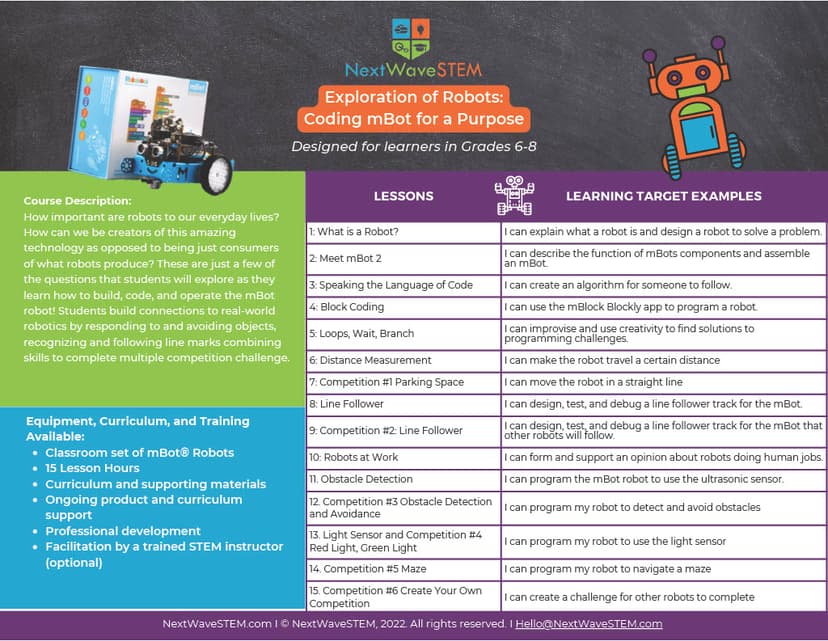
NextWave STEM: Robotics is a structured, school-based curriculum rather than a standalone app your child can play at home, pending formal efficacy evaluation by The Learning Standard. Because it is designed for institutional purchase, you will not be able to download this directly from an app store for personal use. Instead, your child would interact with this program through their school or an out-of-school instructional camp. The curriculum focuses on teaching coding through physical robotics, specifically using the Scratch-based mBlockly platform to program mBot robots. This approach relies on project-based learning, requiring students to test their code in the real world and iterate on their failures. This immediate, physical feedback loop is highly effective for teaching computational thinking, as it grounds abstract programming logic in observable physical actions. For younger learners in kindergarten through second grade, the focus remains on foundational robotics concepts, while older students progress to active block-based programming. Parents should note that the actual learning outcomes will heavily depend on the fidelity of the implementation by the instructor, whether that is a NextWave certified teacher or school staff utilizing their professional development resources.
How Does NextWave STEM: Robotics Work?
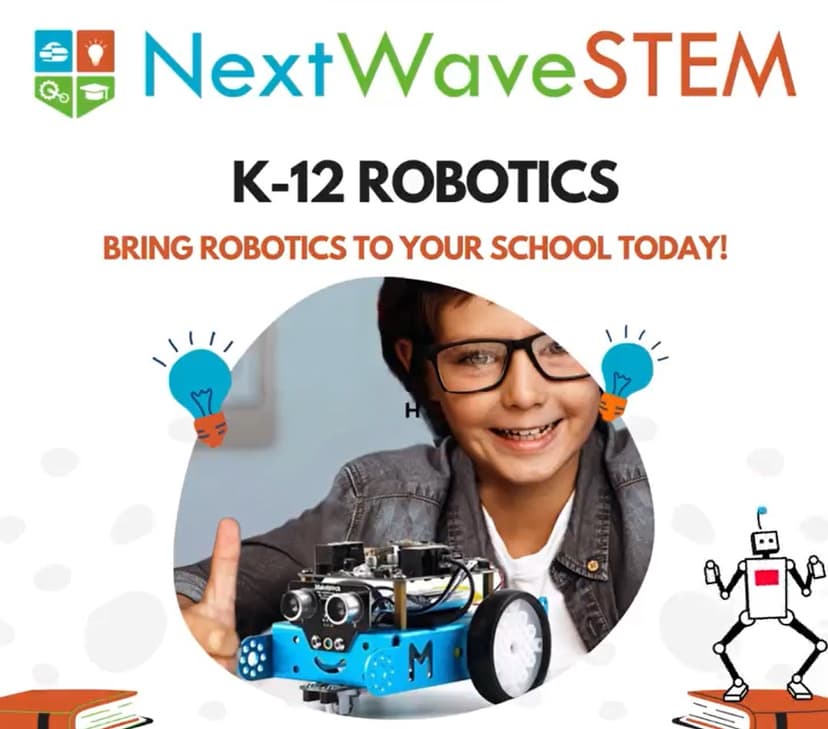
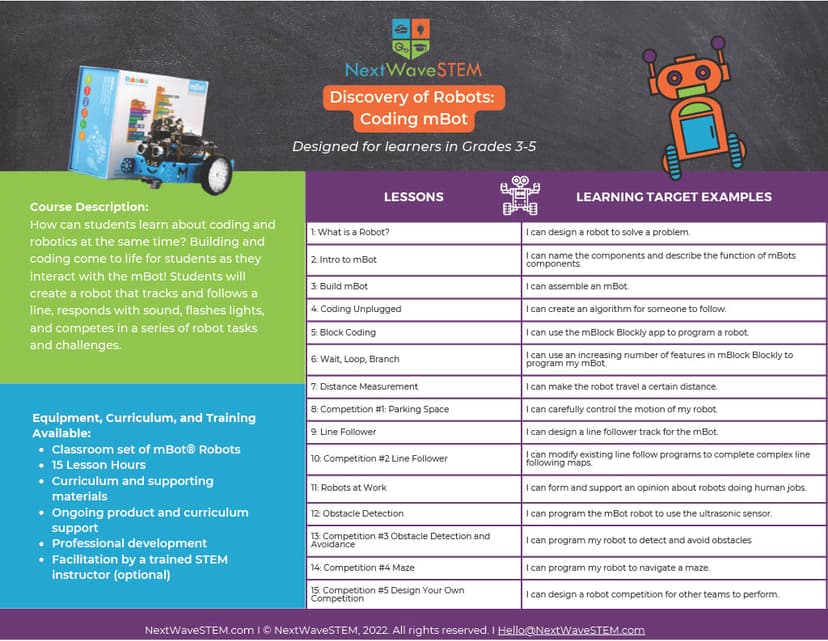
NextWave STEM: Robotics uses project-based and hands-on learning to teach computational thinking and engineering concepts. Students do not simply stare at a screen; they use the visual, block-based programming language mBlockly to write code that dictates the physical movements and actions of an mBot robot. This method bridges the gap between digital software and physical hardware. The curriculum is segmented into three developmental bands: K-2, 3-5, and 6-8. Younger students begin with broad inquiry-based lessons about what robots are and their functions in society. As students mature into the older grade bands, they transition into active programming. They drag and drop interlocking command blocks on a digital device, run the code, and immediately observe the robot's physical response. This immediate feedback loop allows students to spot errors in their logic, debug their code, and try again, modeling the authentic engineering design process.
Strengths and tradeoffs of NextWave STEM: Robotics
The biggest strength of NextWave STEM: Robotics is its integration of physical hardware with digital coding, while its biggest weakness is its high barrier to entry and reliance on institutional adoption. Cognitive offloading is a major advantage here; by watching a physical robot execute their mBlockly code, students do not have to hold complex, abstract sequences in their working memory. They can immediately see where a sequence fails and apply iterative problem-solving. Furthermore, the use of project-based learning encourages students to apply mathematical and scientific concepts to tangible challenges rather than isolated screen-based drills. On the weakness side, the program's effectiveness is entirely mediated by the instructor. Because it relies on physical mBot robots, schools face logistical hurdles including device charging, maintenance, and storage, which can cut into active instructional time. Additionally, this is not a supplementary tool for individual retrieval practice; it requires guided, synchronous instruction. The Learning Standard has not yet evaluated the empirical outcomes of this curriculum, meaning its claims of mastery-based progression remain theoretical pending rigorous classroom data.
Who Might Benefit From NextWave STEM: Robotics ?
NextWave STEM: Robotics is best for schools and districts seeking a comprehensive, turn-key robotics curriculum for K-8 classrooms or after-school programs. It is specifically designed for institutional environments that want to implement project-based STEM education but lack internal curriculum development resources. Because the package includes hardware, software, and professional development, it serves as a complete ecosystem for educators. It is not suitable for individual parents seeking a casual coding app for their child to use independently at home.
Sources and review method
TLS combines product information and editorial analysis to explain how NextWave STEM: Robotics works, its tradeoffs, and the questions to ask before choosing it. Product features, an instructional rationale and evidence of learning outcomes are different kinds of information.
Formal Learning Standard assessment: not yet completed. Data Transparency findings are reported separately and do not establish learning effectiveness. Read our methodology.
Frequently Asked Questions About NextWave STEM: Robotics
Is NextWave STEM: Robotics free?
No. NextWave STEM: Robotics requires a significant institutional purchase, with turn-key packages starting around $5,995 for schools or educational sites. It is not available as a free or paid consumer app for individual families.
Is NextWave STEM: Robotics good for elementary students?
Yes. The program offers distinct curriculum bands for K-2 and 3-5, ensuring that the concepts and physical interactions align with developmental capabilities. Younger students focus on foundational inquiry, while older elementary students engage in active block-based programming.
What does NextWave STEM: Robotics teach?
It teaches computational thinking, coding, and engineering principles. Students learn to use the mBlockly visual programming language to control physical mBot robots, applying math and science concepts through iterative problem-solving and project-based learning.
How does NextWave STEM: Robotics compare to standard Scratch?
While standard Scratch is entirely digital and relies on on-screen sprites, NextWave STEM: Robotics uses mBlockly, a Scratch-based environment designed specifically to control physical mBot robots. This hardware integration provides immediate, tangible feedback in the real world.
Has The Learning Standard evaluated NextWave STEM: Robotics?
TLS has not yet completed a Learning Standard evaluation of how well NextWave STEM: Robotics teaches. TLS has not published a Data Transparency result for its privacy policy.
Follow TLS Research
Subscribe to future TLS research updates: app reviews, findings, and what the evidence shows.
Screenshots
Take Action
For NextWave STEM: Robotics
If you represent NextWaveSTEM and have a correction or new evidence, send the relevant source so we can review and update this page.
Submit a correctionDetails
- Pricing
- Courses are delivered by our certified STEM instructors for both during school time and out-of-school time instruction. Instruction can be delivered in both in-person and remote scenarios. Alternatively, our turn-key solution allows a site/school to own equipment and make use of our professional development, curriculum, and support for 1 year for as low as $5,995. Since instructional hours, equipment, and scheduling are all customizable to customer needs pricing will depend on these factors, in addition to the number of hours purchased. Write to us at Hello@NextWaveSTEM.com or call at (312) 600-8239 for more information.
- Platforms
- Web Browser, iOS (Apple mobile), iPadOS (Apple tablet), Android (Google mobile), Windows (Microsoft), macOS (Apple), Chrome OS (Google)
- Grade Levels
- Kindergarten, 1st Grade, 2nd Grade, 3rd Grade, 4th Grade, 5th Grade, 6th Grade, 7th Grade, 8th Grade
- Website
- Visit site