NextWave STEM: Plants and Hydroponics
Product by NextWaveSTEM
Facts checked: Not yet checked
Our take (not a Learning Standard rating). This label applies to learning-science judgments throughout this overview.
Our take (not a Learning Standard rating)
While pending formal evaluation, this program utilizes project-based learning and hands-on data collection, which strongly support the acquisition of applied science concepts. By requiring students to record observations over 15 lessons, it leverages spaced practice and active engagement to teach hydroponics, though its high cost limits access strictly to schools.
Pros
- Engages students in active learning through daily data collection and physical plant observation.
- Applies project-based learning principles to connect abstract botany concepts to real-world hydroponic systems.
- Incorporates long-term spaced observation, requiring learners to retrieve and apply previous knowledge across 15 distinct lessons.
Cons
- Exhibits a major barrier to entry with high enterprise-level pricing intended strictly for school districts rather than individual parents.
- Lacks independent, asynchronous learning paths, requiring certified instructors or extensive teacher professional development to implement.
- Fails to provide clear evidence of built-in digital formative assessments to catch individual learning gaps during the growing process.
What Do We Know About NextWave STEM: Plants and Hydroponics?
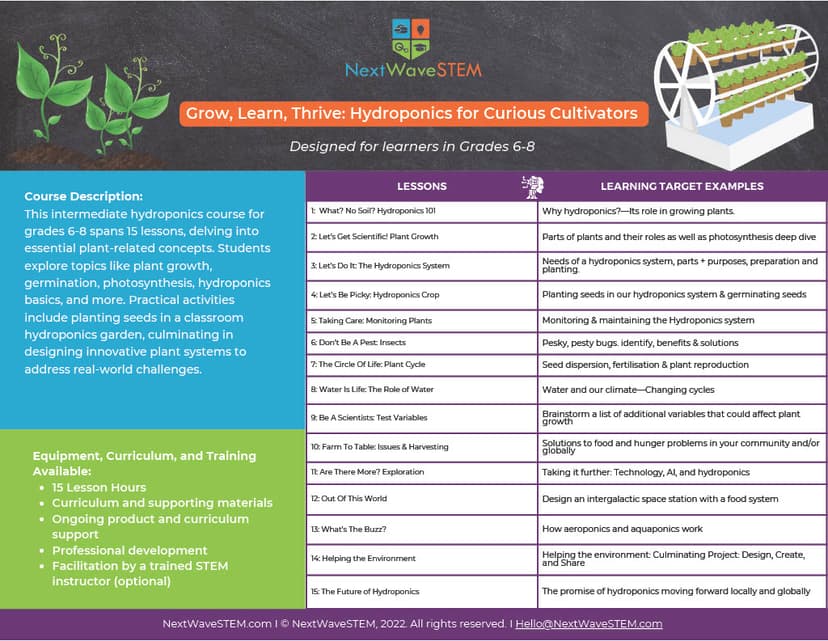
NextWave STEM: Plants and Hydroponics is an effective, school-based curriculum for teaching applied science, though its efficacy relies entirely on how well your child's teacher implements the materials. This is not an app you can download for your child to use on a tablet at home. Instead, it is an enterprise-level, project-based curriculum designed for classroom use. The program spans 15 lessons where your child will actively grow plants, measure progress, and record data.
This hands-on approach uses active learning, moving students from passive reading to physical experimentation. By applying concepts of biology to actual hydroponic systems, your child builds strong mental models of how growing conditions affect living organisms. Because the observations occur over a sustained period, the curriculum naturally builds in spaced exposure to the vocabulary and mechanics of botany. Keep in mind that this program requires school funding and trained instructors to run. If your child's school adopts this, they will benefit from a structured, mastery-based approach to STEM. However, since this program is pending evaluation by The Learning Standard, we cannot yet confirm the exact learning gains compared to traditional science instruction.
How Does NextWave STEM: Plants and Hydroponics Work?
NextWave STEM: Plants and Hydroponics uses project-based learning and guided physical experimentation to teach biology and agriculture. The curriculum is delivered either by NextWave's own certified instructors or through a school's classroom teacher using a turnkey kit.
Over the course of 15 lessons, students plant seeds, set up hydroponic environments, and monitor growth. Instead of clicking through screens, learners physically measure their plants, record data points, and document changing growing conditions. This sequence requires learners to hypothesize, test, and observe results in real-time. The curriculum emphasizes mastery-based progression; students must understand the foundational needs of a plant before moving into the more complex variables of soil-free hydroponic systems. The integration of continuous data collection forces students to engage in elaboration, connecting their raw numerical data back to broader biological concepts like photosynthesis and nutrient absorption.
Strengths and tradeoffs of NextWave STEM: Plants and Hydroponics
The biggest strength of NextWave STEM: Plants and Hydroponics is its reliance on physical, hands-on data collection, while its biggest weakness is the absolute lack of accessibility for individual, at-home learners.
Active learning is central to this curriculum. By requiring students to physically interact with hydroponic setups, the program bypasses the limitations of rote memorization. Students engage in elaboration when they explain why a plant in a specific growing condition thrives or fails, cementing the underlying scientific principles. Furthermore, the 15-lesson structure guarantees spaced practice. Students return to their plants repeatedly over weeks, which fights the forgetting curve far better than a single, crammed unit on botany.
Conversely, the high cost and institutional focus mean you cannot use this to supplement your child's learning independently. The success of the project-based learning model here also introduces a vulnerability: if the physical experiment fails or the classroom instructor lacks deep subject knowledge, the learning outcomes diminish. Because the program is pending evaluation, The Learning Standard has not yet analyzed the specific scaffolds in place to support struggling learners when their physical experiments do not yield the expected scientific data.
Who Might Benefit From NextWave STEM: Plants and Hydroponics?
NextWave STEM: Plants and Hydroponics is best for elementary and middle school classrooms that want to integrate hands-on, project-based agriculture and biology instruction. While the developer lists grades K-12, the 15-lesson observational structure is ideally suited for early to upper elementary students building foundational science literacy. It serves schools looking for a turnkey STEM solution or districts willing to hire external instructors to run specialized science blocks. This is not for individual families or homeschoolers seeking an affordable, self-paced digital app.
Sources and review method
TLS combines product information and editorial analysis to explain how NextWave STEM: Plants and Hydroponics works, its tradeoffs, and the questions to ask before choosing it. Product features, an instructional rationale and evidence of learning outcomes are different kinds of information.
Formal Learning Standard assessment: not yet completed. Data Transparency findings are reported separately and do not establish learning effectiveness. Read our methodology.
Frequently Asked Questions About NextWave STEM: Plants and Hydroponics
Is NextWave STEM: Plants and Hydroponics free?
No, NextWave STEM: Plants and Hydroponics is a highly expensive enterprise solution. Schools purchase it as a turnkey package starting at $5,995 for a one-year license, which includes curriculum, equipment, and professional development. Alternatively, schools pay customized pricing for live, instructor-led sessions. Because of this B2B pricing model, it is entirely unavailable for individual consumer purchase or casual at-home use.
Is NextWave STEM: Plants and Hydroponics good for elementary students?
Yes, the curriculum is highly effective for early and upper elementary students. The 15-lesson structure breaks down complex biological concepts into manageable, hands-on observation tasks. This aligns perfectly with elementary cognitive development, as younger students require concrete, physical interactions to grasp abstract scientific systems. It successfully channels their natural curiosity into structured data collection.
What does NextWave STEM: Plants and Hydroponics teach?
It primarily teaches foundational botany, applied science, and the mechanics of hydroponics, which is the science of growing plants without soil. Students learn to identify distinct plant needs, manipulate environmental growing conditions, and apply the scientific method. By collecting and recording longitudinal data on plant growth, learners also develop crucial foundational skills in mathematics, measurement, and scientific documentation.
How does NextWave STEM: Plants and Hydroponics compare to digital science apps?
Unlike digital simulation apps, this program requires physical materials and real-world time to pass for plants to grow. This approach provides superior active learning and physical sensory engagement. However, it lacks the instant feedback, automated scaffolding, and rapid repetition loops found in purely digital STEM platforms. Both approaches have distinct roles in a complete science education.
Has The Learning Standard evaluated NextWave STEM: Plants and Hydroponics?
TLS has not yet completed a Learning Standard evaluation of how well NextWave STEM: Plants and Hydroponics teaches. TLS has not published a Data Transparency result for its privacy policy.
Follow TLS Research
Subscribe to future TLS research updates: app reviews, findings, and what the evidence shows.
Screenshots
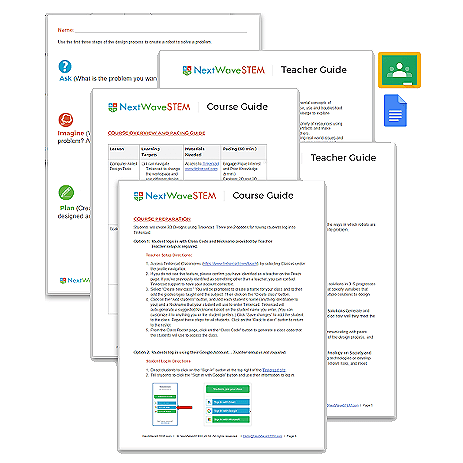
Take Action
For NextWave STEM: Plants and Hydroponics
If you represent NextWaveSTEM and have a correction or new evidence, send the relevant source so we can review and update this page.
Submit a correctionDetails
- Pricing
- Courses are delivered by our certified STEM instructors for both during school time and out-of-school time instruction. Instruction can be delivered in both in-person and remote scenarios. Alternatively, our turn-key solution allows a site/school to own equipment and make use of our professional development, curriculum, and support for 1 year for as low as $5,995. Since instructional hours, equipment, and scheduling are all customizable to customer needs pricing will depend on these factors, in addition to the number of hours purchased. Write to us at Hello@NextWaveSTEM.com or call at (312) 600-8239 for more information.
- Platforms
- Web Browser, iOS (Apple mobile), iPadOS (Apple tablet), Android (Google mobile), Windows (Microsoft), macOS (Apple), Chrome OS (Google), Other
- Grade Levels
- Kindergarten, 1st Grade, 2nd Grade, 3rd Grade, 4th Grade, 5th Grade, 6th Grade, 7th Grade, 8th Grade, 9th Grade, 10th Grade, 11th Grade, 12th Grade
- Website
- Visit site