NextWave STEM: Drones
Product by NextWaveSTEM
Facts checked: Not yet checked
Our take (not a Learning Standard rating). This label applies to learning-science judgments throughout this overview.
Our take (not a Learning Standard rating)
NextWave STEM: Drones utilizes proven project-based learning and experiential mechanics to teach coding and robotics. While hands-on manipulation of Tello drones strongly supports concrete learning of abstract programming concepts, The Learning Standard has not yet formally evaluated this curriculum to confirm its efficacy in the classroom.
Pros
- Connects abstract coding concepts to concrete physical movements using Tello drones.
- Progresses appropriately from basic observation in early grades to block-based programming in later grades.
- Employs experiential learning cycles that require students to test, observe, and debug their code in real time.
Cons
- High cost and hardware requirements create a significant barrier to entry for individual learners.
- Relies heavily on the instructor's pedagogical skill rather than software-driven adaptive feedback.
- Simulator environments may not fully replicate the physical variables encountered during actual drone flight testing.
What Do We Know About NextWave STEM: Drones?
NextWave STEM: Drones is an effective instructional framework for teaching programming and robotics, provided your school has the budget and trained instructors to implement it properly. Your child will not simply stare at a screen; instead, they will write code using a Scratch-based interface and immediately see a physical Tello drone execute their commands. This physical manifestation of digital code is a highly effective way to build mental models of abstract algebraic and programmatic concepts. By iterating on code when the drone fails to navigate an obstacle, your child engages in experiential learning and active debugging. Rather than passive consumption, the curriculum forces students to retrieve knowledge and apply it to physical use cases. However, because this is an instructor-led curriculum rather than a standalone app, its ultimate effectiveness depends entirely on the teacher delivering the lesson. The Learning Standard has not yet evaluated the specific step-by-step lesson plans for cognitive load optimization or spacing. Parents should view this not as an app to download at home, but as a comprehensive school-based intervention requiring physical hardware, dedicated space, and guided facilitation.
How Does NextWave STEM: Drones Work?
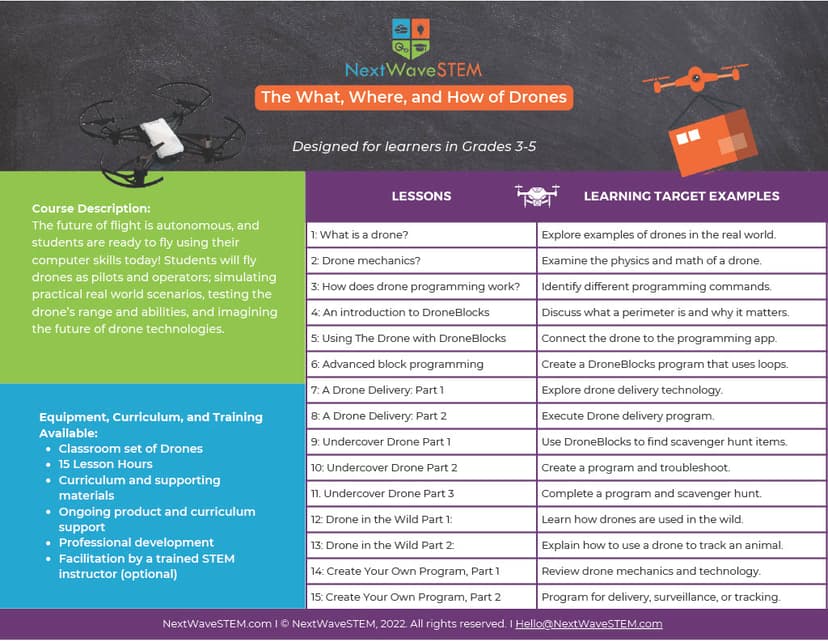
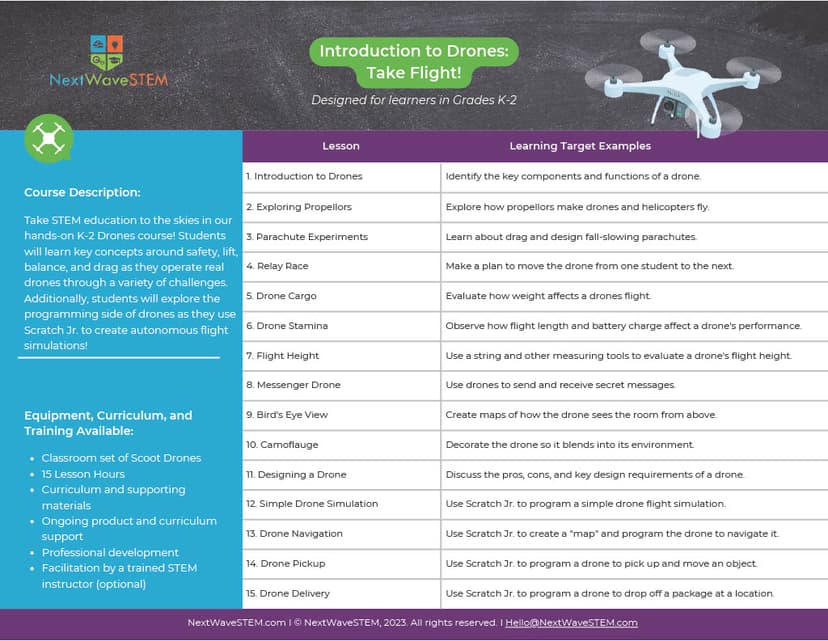
NextWave STEM: Drones relies on project-based learning and experiential learning, asking students to program drone flight paths to solve specific challenges. Younger students in kindergarten through second grade observe physical flight characteristics using simple Scoot drones, building foundational vocabulary. As students progress into upper elementary and high school, the mechanics shift to applied programming. Students use a Scratch-based visual block coding interface to construct flight sequences. They then push this code to a physical Tello drone or a digital simulator to test their logic. When a drone crashes or misses its target, students must debug their algorithms, adjusting variables like speed, angle, and duration. This feedback loop of coding, testing, and revising heavily utilizes the experiential learning cycle. The curriculum assumes mastery-based progression, requiring students to demonstrate successful execution of a basic flight maneuver before moving on to complex scenario abstractions.
Strengths and tradeoffs of NextWave STEM: Drones
The biggest strength of NextWave STEM: Drones is its tangible application of abstract coding concepts, while its biggest weakness is its complete reliance on external instructor capability and expensive hardware. Connecting Code to Reality: By forcing students to test their Scratch-based code on a physical drone, the curriculum bridges the gap between digital logic and physical outcomes. This provides immediate, natural feedback. When the drone fails to fly as intended, the error is obvious, prompting immediate reflection and correction without needing algorithmic grading. Experiential Learning Cycle: The program excels at forcing iteration. Students draft a plan, execute it, observe the physical result, and adjust their code. High Implementation Barrier: Because this is a curriculum package requiring physical Tello drones, flight space, and specialized professional development, it is not accessible for individual home use. Lack of Automated Scaffolding: Unlike software-based adaptive tutors, this platform cannot automatically adjust difficulty or provide step-by-step worked examples if a student struggles. It relies entirely on the classroom teacher to diagnose misconceptions, manage cognitive load, and provide targeted feedback. The Learning Standard has not yet formally rated the efficacy of the provided lesson plans.
Who Might Benefit From NextWave STEM: Drones?
NextWave STEM: Drones is best for school districts and after-school programs seeking a hands-on, instructor-led robotics curriculum for K-12 students. It is highly effective for learners who struggle with abstract programming concepts and need physical, real-world manifestations of their code to grasp algebraic thinking. Because the curriculum requires physical drones, simulators, and trained facilitation, it is designed for institutional use rather than independent at-home learning. It serves schools wanting to implement project-based STEM enrichment across multiple grade levels, offering age-appropriate progression from basic observational science in early elementary to complex programmatic abstraction in high school.
Sources and review method
TLS combines product information and editorial analysis to explain how NextWave STEM: Drones works, its tradeoffs, and the questions to ask before choosing it. Product features, an instructional rationale and evidence of learning outcomes are different kinds of information.
Formal Learning Standard assessment: not yet completed. Data Transparency findings are reported separately and do not establish learning effectiveness. Read our methodology.
Frequently Asked Questions About NextWave STEM: Drones
Is NextWave STEM: Drones free?
No. NextWave STEM: Drones is a commercial curriculum package designed for schools and institutions. Pricing varies based on the number of instructional hours, equipment needs, and whether the school uses NextWave's certified instructors or purchases a turn-key solution with professional development for their own staff. Packages begin around $5,995.
Is NextWave STEM: Drones good for elementary students?
Yes, the curriculum is structured into specific grade bands that accommodate young learners. Kindergarten through second-grade students focus on observing basic flight characteristics using simple Scoot drones, rather than engaging in complex coding. This provides an age-appropriate introduction to physics and robotics without overwhelming their cognitive load with programmatic abstraction.
What does NextWave STEM: Drones teach?
NextWave STEM: Drones teaches algebraic thinking, computational logic, and robotics through the lens of drone flight. Students learn how to use Scratch-based block coding to control Tello drones. The curriculum emphasizes the experiential learning cycle, requiring students to construct flight paths, test their code, observe physical outcomes, and debug errors.
Can my child use NextWave STEM: Drones at home?
No. This is not a standalone consumer app that a parent can simply download. NextWave STEM: Drones is a comprehensive educational program that requires institutional purchase, physical drone hardware, and trained instructors to deliver the lessons effectively.
Has The Learning Standard evaluated NextWave STEM: Drones?
TLS has not yet completed a Learning Standard evaluation of how well NextWave STEM: Drones teaches. TLS has not published a Data Transparency result for its privacy policy.
Follow TLS Research
Subscribe to future TLS research updates: app reviews, findings, and what the evidence shows.
Screenshots
Take Action
For NextWave STEM: Drones
If you represent NextWaveSTEM and have a correction or new evidence, send the relevant source so we can review and update this page.
Submit a correctionDetails
- Pricing
- Courses are delivered by our certified STEM instructors for both during school time and out-of-school time instruction. Instruction can be delivered in both in-person and remote scenarios. Alternatively, our turn-key solution allows a site/school to own equipment and make use of our professional development, curriculum, and support for 1 year for as low as $5,995. Since instructional hours, equipment, and scheduling are all customizable to customer needs pricing will depend on these factors, in addition to the number of hours purchased. Write to us at Hello@NextWaveSTEM.com or call at (312) 600-8239 for more information.
- Platforms
- Web Browser, iOS (Apple mobile), iPadOS (Apple tablet), Android (Google mobile), Windows (Microsoft), macOS (Apple), Chrome OS (Google), Other
- Grade Levels
- Kindergarten, 1st Grade, 2nd Grade, 3rd Grade, 4th Grade, 5th Grade, 6th Grade, 7th Grade, 8th Grade, 9th Grade, 10th Grade, 11th Grade, 12th Grade
- Website
- Visit site