NextWave STEM: Artificial Intelligence Literacy
Product by NextWaveSTEM
Facts checked: Not yet checked
Our take (not a Learning Standard rating). This label applies to learning-science judgments throughout this overview.
Our take (not a Learning Standard rating)
While The Learning Standard has not yet formally evaluated this curriculum, its project-based approach to AI and robotics relies heavily on experiential learning principles. It effectively uses hands-on creation with tools like Scratch to build schema around machine learning.
Pros
- Integrates project-based learning by requiring students to build functional chatbots and train models, fostering deeper cognitive processing.
- Scaffolds complex AI concepts across distinct developmental grade bands to align with age-appropriate working memory capacities.
- Incorporates third-party tools like Scratch and Machine Learning for Kids to provide authentic, experiential practice with text and image recognition.
Cons
- Requires significant instructor facilitation, meaning learning outcomes will vary drastically based on local teacher expertise.
- High cost of entry and need for physical equipment creates accessibility barriers for under-resourced learning environments.
- Lacks built-in, automated spaced repetition for core vocabulary and theoretical AI concepts outside of the active project modules.
What Do We Know About NextWave STEM: Artificial Intelligence Literacy?
NextWave STEM: Artificial Intelligence Literacy provides an effective, hands-on framework for teaching your child modern technology skills, though its success depends heavily on the teacher leading the course. The Learning Standard has not yet formally rated this program, but its curriculum relies on project-based learning rather than passive screen time. Instead of just reading about AI, your child will actively build chatbots and train simple machine learning models using platforms like Scratch. This experiential approach helps anchor abstract concepts like image recognition and algorithms into concrete, working memory.\n\nBecause this is a comprehensive curriculum rather than a standalone consumer app, it is not something your child will use independently at home. It requires either a certified NextWave STEM instructor or a trained teacher at your child's school to facilitate the 15-lesson modules. The curriculum segments its complexity across four grade bands, ensuring the cognitive load matches your child's developmental stage. While the hands-on creation is a massive strength for engagement, parents should note that this model lacks software-driven retrieval practice. Your child will learn by doing, but may need supplementary review to retain specific technical vocabulary long-term.
How Does NextWave STEM: Artificial Intelligence Literacy Work?
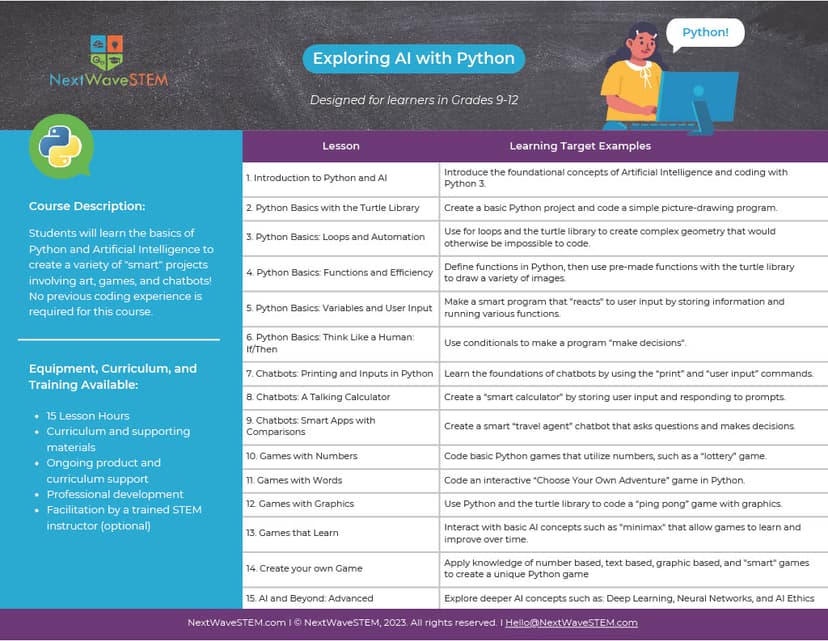
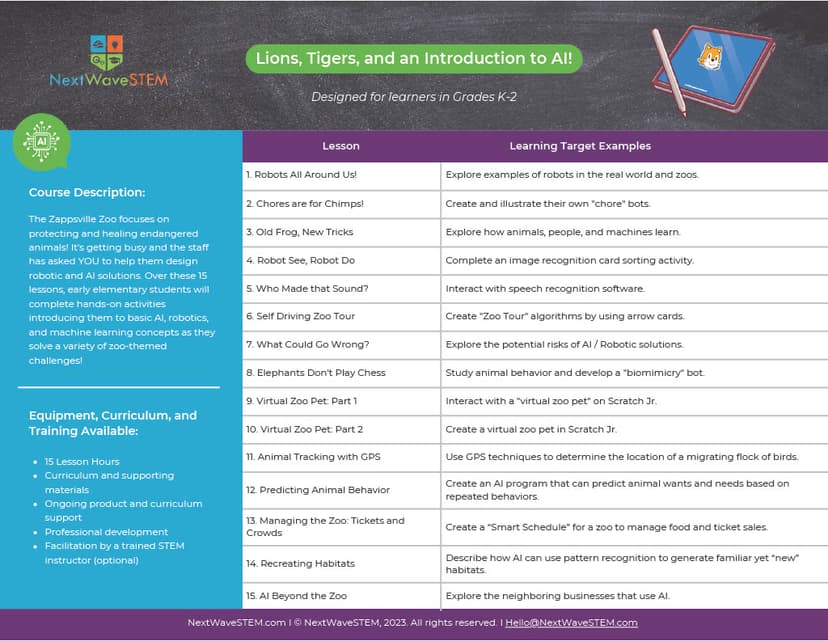
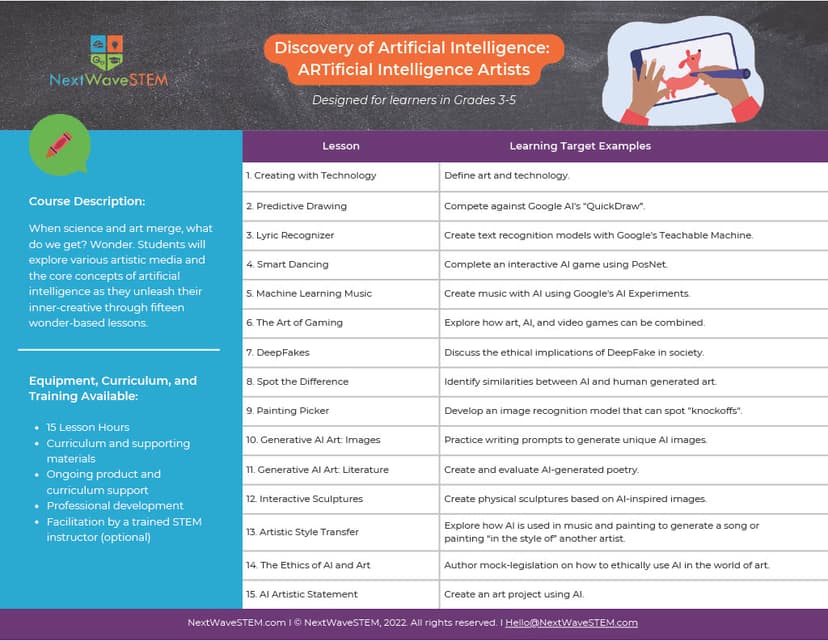
NextWave STEM uses project-based and experiential learning to move students from theoretical AI concepts into active software development. The program is structured around 15 instructor-led lessons tailored to specific grade bands. Younger students engage with basic robotics and foundational logic, while older students tackle applied machine learning.\n\nDuring a typical lesson, students do not just consume content; they use tools like Scratch and Machine Learning for Kids to construct their own virtual characters. They train these characters by inputting data for text, voice, and image recognition. This process mimics actual machine learning workflows, forcing students to apply computational thinking to solve immediate coding challenges. By designing and iterating on chatbots, students engage in productive struggle, which strengthens their understanding of how AI processes information. The curriculum relies on a teacher or certified instructor to introduce the target concepts, monitor the hands-on practice, and assess mastery through the final completed projects.
Strengths and tradeoffs of NextWave STEM: Artificial Intelligence Literacy
The biggest strength of NextWave STEM is its reliance on authentic, project-based creation, while its biggest weakness is its heavy dependence on instructor fidelity for successful learning outcomes.\n\nAuthentic Experiential Learning: By requiring students to use Scratch and Machine Learning for Kids, the curriculum avoids rote memorization. Students engage in active encoding by training text and image recognition models themselves. This hands-on application of abstract concepts reduces cognitive overload and helps students build accurate mental models of how AI actually functions behind the scenes.\n\nDevelopmental Scaffolding: Segmenting the 15 lessons strictly by grade bands ensures that the working memory demands of the coding tasks remain age-appropriate.\n\nImplementation Variance: Because this is an instructor-led curriculum rather than adaptive software, it lacks automated feedback loops. If a student misunderstands a core concept, they rely entirely on the teacher to diagnose and correct the error.\n\nLack of Spaced Retrieval: The project-based nature means students master skills in the moment, but the curriculum lacks built-in spaced repetition mechanisms to ensure students retain technical vocabulary and theoretical knowledge months after the course concludes.
Who Might Benefit From NextWave STEM: Artificial Intelligence Literacy?
NextWave STEM is best for K-12 schools and after-school programs seeking a structured, project-based curriculum to introduce robotics and artificial intelligence. It is ideal for educational environments that want to provide hands-on coding and machine learning experience but lack the internal curriculum to do so. Because the instruction is delivered via 15 distinct lessons, it works well as a semester-long elective or an intensive summer camp module. It is not designed for individual at-home use by parents, as it requires specialized equipment, site licensing, and trained facilitation to execute effectively.
Sources and review method
TLS combines product information and editorial analysis to explain how NextWave STEM: Artificial Intelligence Literacy works, its tradeoffs, and the questions to ask before choosing it. Product features, an instructional rationale and evidence of learning outcomes are different kinds of information.
Formal Learning Standard assessment: not yet completed. Data Transparency findings are reported separately and do not establish learning effectiveness. Read our methodology.
Frequently Asked Questions About NextWave STEM: Artificial Intelligence Literacy
Is NextWave STEM: Artificial Intelligence Literacy free?
No. NextWave STEM is a paid, enterprise-level curriculum designed for schools and districts. Pricing depends on whether a school hires their instructors or purchases a $3,995 annual turn-key license for equipment, curriculum, and professional development.
Is NextWave STEM: Artificial Intelligence Literacy good for elementary students?
Yes. The program offers distinct lesson tracks specifically scaffolded for K-2 and 3-5 grade bands. These early modules focus on foundational robotics and basic logic, ensuring the cognitive load is appropriate for younger children.
What does NextWave STEM: Artificial Intelligence Literacy teach?
It teaches the fundamentals of artificial intelligence, machine learning, and robotics. Students learn computational thinking and coding by using platforms like Scratch to build chatbots, train virtual characters, and explore image and voice recognition.
How does NextWave STEM: Artificial Intelligence Literacy compare to standalone coding apps?
NextWave STEM requires active teacher facilitation and focuses on applied, hardware-integrated projects over a 15-lesson arc. Standalone consumer coding apps rely on automated progression and can be used independently at home, but often lack the deep, experiential chatbot and machine learning training this curriculum provides.
Has The Learning Standard evaluated NextWave STEM: Artificial Intelligence Literacy?
TLS has not yet completed a Learning Standard evaluation of how well NextWave STEM: Artificial Intelligence Literacy teaches. TLS has not published a Data Transparency result for its privacy policy.
Follow TLS Research
Subscribe to future TLS research updates: app reviews, findings, and what the evidence shows.
Screenshots
Take Action
For NextWave STEM: Artificial Intelligence Literacy
If you represent NextWaveSTEM and have a correction or new evidence, send the relevant source so we can review and update this page.
Submit a correctionDetails
- Pricing
- Courses are delivered by our certified STEM instructors for both during school time and out-of-school time instruction. Instruction can be delivered in both in-person and remote scenarios. Alternatively, our turn-key solution allows a site/school to own equipment and make use of our professional development, curriculum, and support for 1 year for $3,995. Since instructional hours, equipment, and scheduling are all customizable to customer needs pricing will depend on these factors, in addition to the number of hours purchased. Write to us at Hello@NextWaveSTEM.com or call at (312) 600-8239 for more information.
- Platforms
- Web Browser, iOS (Apple mobile), iPadOS (Apple tablet), Android (Google mobile), Windows (Microsoft), macOS (Apple), Chrome OS (Google), Other
- Grade Levels
- Kindergarten, 1st Grade, 2nd Grade, 3rd Grade, 4th Grade, 5th Grade, 6th Grade, 7th Grade, 8th Grade, 9th Grade, 10th Grade, 11th Grade, 12th Grade
- Website
- Visit site