MedMicroMaps
Product by MedMicroMaps, LLC.
Facts checked: Not yet checked
Our take (not a Learning Standard rating). This label applies to learning-science judgments throughout this overview.
Our take (not a Learning Standard rating)
MedMicroMaps offers an immersive virtual environment that grounds abstract microbiology concepts in spatial learning, which aids memory retention for complex Latin terminology. However, as it is pending formal evaluation by The Learning Standard, we cannot definitively confirm its long-term impact on knowledge transfer compared to physical lab experience.
Pros
- Uses spatial presence in extended reality to reduce cognitive load when learning complex anatomical and microbial structures.
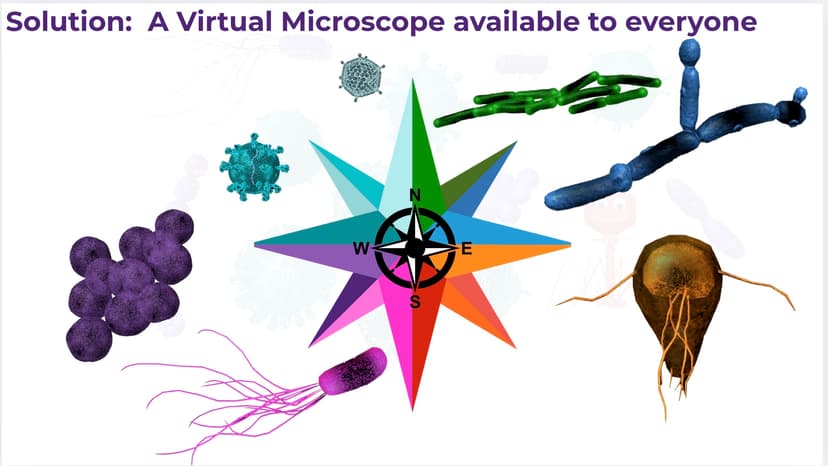
- Provides a virtual microscope tool that allows students to manipulate specimens directly, supporting embodied cognition.
- Integrates AI mentors to offer immediate, context-specific feedback during mission-based games.
- Bridges the gap between abstract Latin terminology and visual representation through direct tactile interaction in virtual reality.
Cons
- Extended reality environments can easily cause cognitive overload if the interface distracts from the core learning objective.
- Relies heavily on access to specialized headset hardware, limiting utility for underfunded classrooms.
- Lacks transparent data reporting on how well virtual microscope skills transfer to physical laboratory settings.
- Currently lacks independent efficacy data confirming that AI mentors improve long-term retention of microbiological terms.
What Do We Know About MedMicroMaps?
MedMicroMaps is a potentially effective tool for teaching your child abstract microbiology concepts, though it remains pending formal evaluation by The Learning Standard. By replacing expensive physical microscopes with a virtual reality alternative, the app allows your child to manipulate microscopic life forms using their hands. This approach leverages embodied cognition, a learning science principle showing that physical movement enhances memory retention. Instead of passively reading dense Latin terminology in a textbook, your child completes mission-based games where they must identify and interact with pathogens directly. The inclusion of AI mentors means your child receives immediate feedback on incorrect identifications, which is critical for correcting misconceptions before they take root. However, parents should be aware that immersive virtual environments can sometimes distract from the actual learning goals if the game mechanics overshadow the science content. Because this app is designed for a massive age range spanning middle school to doctoral candidates, the complexity of the terminology may not perfectly adapt to your child's specific grade level without direct educator oversight. While the single-player mode is free, maximizing the collaborative learning elements requires an institutional subscription and VR headsets.
How Does MedMicroMaps Work?
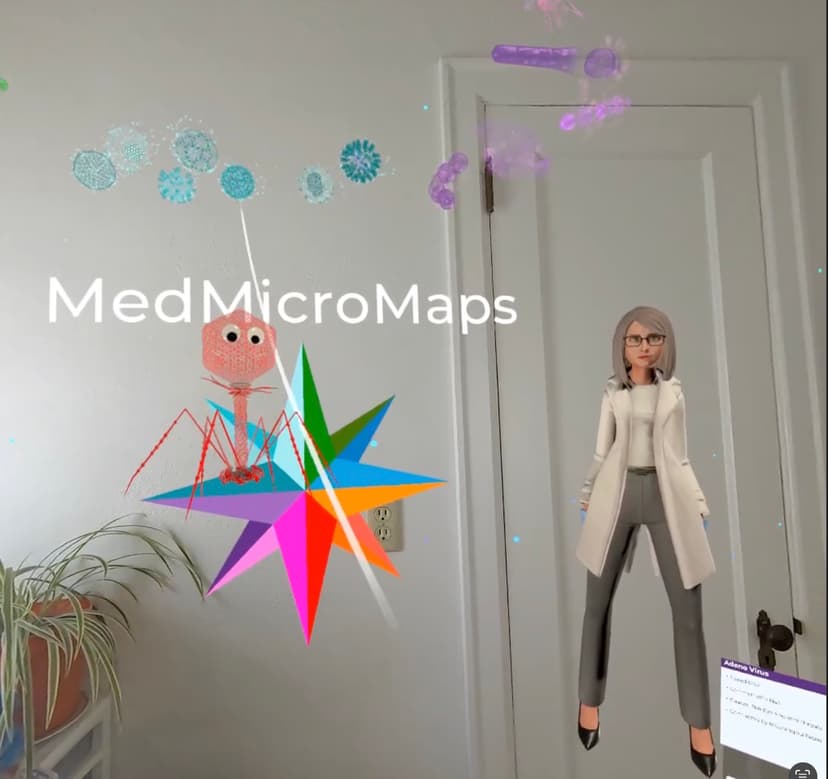
MedMicroMaps uses immersive experiential learning combined with game-based missions to teach microbiology and cellular structures. Students enter a Unity-based extended reality environment where they access a virtual microscope to examine digital specimens. Rather than memorizing static textbook diagrams, learners physically manipulate 3D models of microscopic life forms, connecting abstract Latin names to visual, spatial, and tactile representations. The app structures learning through mission-based games that require students to achieve specific clinical or scientific objectives, such as identifying a specific bacterium. During these missions, AI-driven mentors monitor student choices and provide real-time instructional support. This immediate feedback loop ensures learners do not practice incorrect identifications. For schools using the multiplayer version, students can collaborate in the same virtual lab space, applying social learning dynamics to complex scientific problem-solving. By simulating a real laboratory, the app attempts to provide the visual and tactile input necessary for robust concept formation in health sciences without the cost barriers of traditional lab equipment.
Strengths and tradeoffs of MedMicroMaps
The biggest strength of MedMicroMaps is its use of spatial learning to make abstract microbiology concrete, while its biggest weakness is the risk of cognitive overload inherent in rich virtual reality environments. Spatial learning and embodied cognition are highly effective for teaching complex anatomy and cellular biology. By allowing students to touch and manipulate 3D microbes, the app builds stronger memory traces than 2D textbook images. This multimodal input connects difficult Latin terminology to distinct visual and physical interactions, facilitating easier retrieval practice. The AI mentors provide immediate, corrective feedback during missions, which aligns with evidence-based practices for mastery learning. Conversely, the immersive nature of extended reality introduces significant extraneous cognitive load. Students must navigate a complex interface while simultaneously processing high-level scientific concepts, which can overwhelm working memory, particularly for younger learners in eighth or ninth grade. Furthermore, while the app simulates tactile input, it is unclear if the skills transfer effectively to operating a physical microscope in a real clinical setting. As this tool is currently pending evaluation by The Learning Standard, educators must carefully monitor whether the game mechanics are driving genuine scientific comprehension or merely superficial engagement.
Who Might Benefit From MedMicroMaps?
Best for high school and early college health science students who lack consistent access to physical wet labs. MedMicroMaps targets learners from eighth grade through post-graduate studies, but its dense Latin terminology and clinical focus make it most appropriate for biology, pre-med, and career and technical education students. It is highly effective for visual and kinesthetic learners who struggle to conceptualize microscopic processes through traditional textbook reading. Educators dealing with budget constraints for laboratory equipment will find the free single-player virtual microscope highly useful for introducing tactile microbiology concepts before students transition to physical clinical environments.
Sources and review method
TLS combines product information and editorial analysis to explain how MedMicroMaps works, its tradeoffs, and the questions to ask before choosing it. Product features, an instructional rationale and evidence of learning outcomes are different kinds of information.
Formal Learning Standard assessment: not yet completed. Data Transparency findings are reported separately and do not establish learning effectiveness. Read our methodology.
Frequently Asked Questions About MedMicroMaps
Is MedMicroMaps free?
The single-player version of MedMicroMaps is completely free. The multiplayer version, which allows for collaborative lab work, costs $25 per headset per academic year.
Is MedMicroMaps good for middle schoolers?
MedMicroMaps is rated for students starting in eighth grade. However, the heavy use of Latin-based microbiology terminology may require significant teacher scaffolding for younger students to prevent frustration.
What does MedMicroMaps teach?
MedMicroMaps teaches microbiology, cellular structures, and related health science terminology. It uses virtual microscopes and 3D models to help students identify and understand microscopic life forms and pathogens.
Does MedMicroMaps replace a real microscope?
No. While MedMicroMaps provides excellent spatial learning and visual representation, virtual manipulation does not fully replicate the precise fine motor skills required to prepare slides and focus a physical microscope.
Has The Learning Standard evaluated MedMicroMaps?
TLS has not yet completed a Learning Standard evaluation of how well MedMicroMaps teaches. TLS has not published a Data Transparency result for its privacy policy.
Follow TLS Research
Subscribe to future TLS research updates: app reviews, findings, and what the evidence shows.
Screenshots
Take Action
For MedMicroMaps
If you represent MedMicroMaps, LLC. and have a correction or new evidence, send the relevant source so we can review and update this page.
Submit a correctionDetails
- Pricing
- Single player is free; multiplayer is subscription $25/headset per academic year
- Platforms
- Other
- Grade Levels
- 8th Grade, 9th Grade, 10th Grade, 11th Grade, 12th Grade, Associate's degree, Bachelor's degree, Post-baccalaureate certificate, Master's Degree, Doctoral Degree
- Website
- Visit site