
Equatio®
Product by Everway (formerly Texthelp and n2y)
Facts checked: Not yet checked
Our take (not a Learning Standard rating). This label applies to learning-science judgments throughout this overview.
Our take (not a Learning Standard rating)
Equatio does not teach math concepts directly, but it highly optimizes the learning process by removing accessibility barriers. By allowing students to dictate or draw math, it reduces cognitive load and frees up working memory for problem-solving, though it requires an external curriculum to function.
Pros
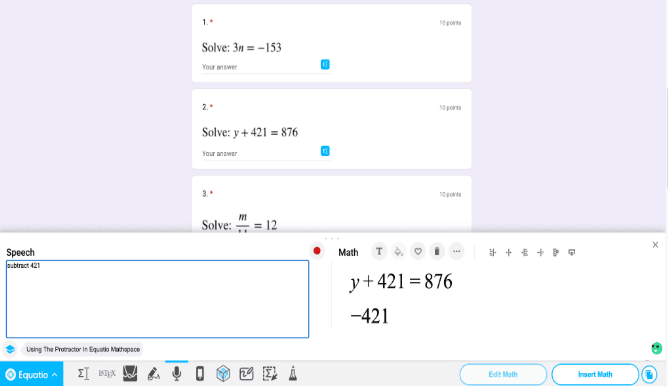
- Reduces extraneous cognitive load by allowing students to input complex math formulas via speech or handwriting.
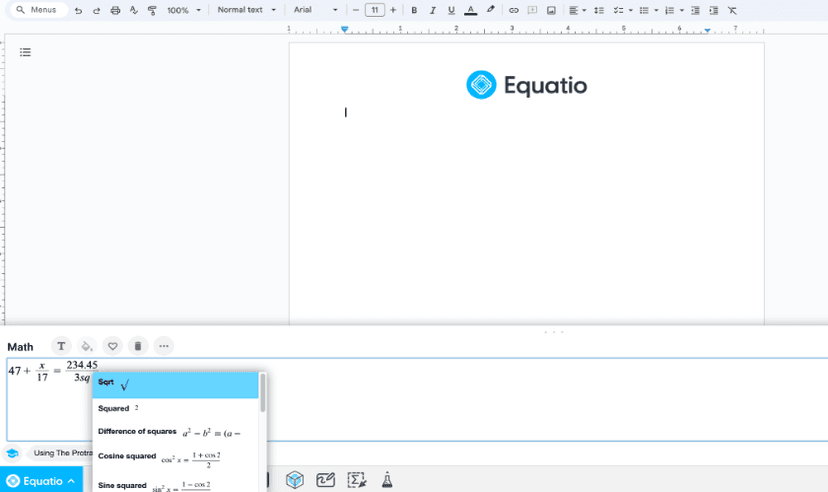
- Supports multimodal learning through an interactive math whiteboard that links visual representations with symbolic equations.
- Provides immediate auditory feedback with math-to-speech functionality, aiding error detection for students with dyslexia or dyscalculia.
- Integrates seamlessly into existing learning management systems to ensure consistent accessibility across varied digital assignments.
Cons
- Lacks built-in instructional content or curriculum, meaning it cannot teach new math concepts independently.
- Offers no adaptive feedback or error correction on the mathematical accuracy of the student's work.
- Requires significant upfront training for younger students to master the various input tools and interface.
- Individual licensing is highly cost-prohibitive for individual families compared to the heavily discounted district pricing.
What Do We Know About Equatio®?
Equatio is effective for making math accessible, but it does not teach your child math concepts directly. Instead of acting as a tutor or a curriculum, it functions as a highly specialized digital pencil box designed specifically for mathematical thinking. If your child struggles with dyscalculia, dyslexia, or fine motor skills, this tool removes the physical and cognitive barriers of writing out complex equations. By allowing your child to speak or draw their math problems, the app frees up working memory so they can focus on solving the problem rather than struggling to format it correctly on a screen. The text-to-speech feature also allows your child to hear their equations read aloud, which is a proven method for catching transcription errors in their own work. However, you must provide the actual math problems and instruction. The app will not tell your child if an answer is correct, nor will it offer worked examples or step-by-step hints when they get stuck. It is best used as a daily companion tool alongside formal instruction or homework provided by their school.
How Does Equatio® Work?
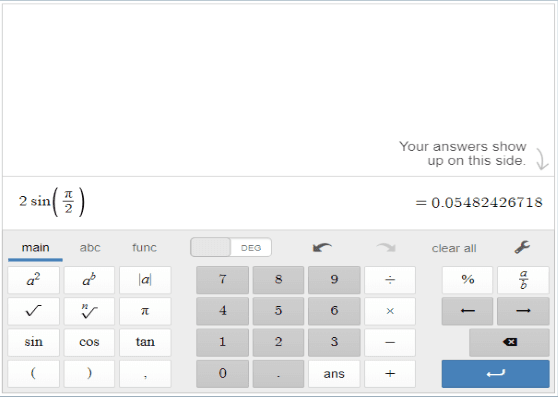
Equatio relies on Universal Design for Learning (UDL) principles to provide multiple means of mathematical expression and representation. The core mechanic involves translating various physical inputs into formatted, digital mathematical expressions. A student can dictate a formula into their microphone, draw it on a touchscreen, or type it using predictive text, and the software instantly converts it into clean digital math. The tool includes a digital whiteboard workspace where students can combine these equations with shapes, freehand annotations, and integrated Desmos graphing calculators. This allows learners to actively connect abstract symbolic math with concrete visual representations. For reading comprehension, the math-to-speech function uses natural language processing to read complex equations aloud accurately, ensuring visually impaired students or those with reading difficulties can access digital math documents independently. It operates primarily as an extension or overlay within Google Workspace, Microsoft 365, and major learning management systems rather than a standalone destination site.
Strengths and tradeoffs of Equatio®
Equatio's biggest strength is its ability to reduce extraneous cognitive load during math input, while its biggest weakness is the complete absence of instructional feedback. Cognitive Load Theory dictates that learning is severely hindered when a student's working memory is overwhelmed by tasks unrelated to the immediate learning goal. For a student with fine motor challenges or dyscalculia, simply writing or typing fractions can consume all of their mental resources. Equatio eliminates this barrier by offering seamless speech-to-math and handwriting recognition. This allows students to dedicate their full cognitive capacity to actual problem-solving and critical thinking. Furthermore, the inclusion of multimodal representations linking spoken words, visual graphs, and symbolic text helps build stronger neural connections regarding foundational mathematical concepts. On the negative side, the tool provides no corrective feedback. Without built-in retrieval practice, spaced repetition, or worked examples, it cannot guide a struggling student toward mastery. If a student dictates an incorrect formula, Equatio simply digitizes the error perfectly. Therefore, it is strictly an accessibility layer rather than an instructional engine.
Who Might Benefit From Equatio®?
Equatio is best for students with specific learning disabilities, visual impairments, or motor skill challenges who need an accessible way to engage with digital math assignments. While marketed for all ages, it is most practical for middle school, high school, and higher education students who regularly deal with complex formulas, algebra, and STEM subjects. It is an ideal accommodation tool for educators to include in an Individualized Education Program (IEP). It is not designed for students who simply need foundational math tutoring, adaptive practice, or step-by-step instructional guidance.
Data Transparency
Does Not Meet Data Transparency Standard
Equatio® does not meet our data transparency standard. Its privacy policy does not document basic protections, including limits on sharing children's data, parents' right to see their child's data and parents' right to delete their child's data.
21 of 35 checks passed
Evaluated September 2026
Privacy Policy for Everway Products →Level 1 · Basic protections
Does not sell data or target ads at students, limits sharing, and lets parents see and delete their child's data.
Not documented: limits on sharing children's data, parents' right to see their child's data, parents' right to delete their child's data
Level 2 · Parent control (meets the standard)
Families can get their data out, know who processes it, and know how long it is kept.
Level 3 · Direct data access
Families or schools can pull their own data through an API, in a stated format.
Not documented: an API for retrieving their own data, a named export format
View all 35 checks
Parent Access5/8
Does the policy mention parents specifically?
“In order to remain compliant with COPPA the licensee (The School District, School or Teacher) must obtain verifiable parental consent to store the following student information on the online platform.”
Can parents view their child's data?
The policy gives access rights to users generally but does not give parents a right to view their child's data.
Can parents modify their child's data?
The policy does not give parents a right to change their child's data.
Can parents delete their child's account?
The policy gives erasure rights to users generally but does not give parents a right to delete their child's data or account.
Is there a dedicated Children's Privacy section?
“In order to remain compliant with COPPA the licensee (The School District, School or Teacher) must obtain verifiable parental consent to store the following student information on the online platform.”
Does it reference COPPA compliance?
“Everway have signed the Student Privacy Pledge, and implement FERPA, COPPA, and comply with the California Consumer Privacy Act (CCPA), the Australian Privacy Act and the General Data Protection Regulation (EU GDPR) compliant data policies.”
Does it reference FERPA compliance?
“Everway have signed the Student Privacy Pledge, and implement FERPA, COPPA, and comply with the California Consumer Privacy Act (CCPA), the Australian Privacy Act and the General Data Protection Regulation (EU GDPR) compliant data policies.”
Is parental consent required for child accounts?
“In order to remain compliant with COPPA the licensee (The School District, School or Teacher) must obtain verifiable parental consent to store the following student information on the online platform.”
Data Portability2/5
Can users access their personal data?
“You have the right to request the amending, erasure or a copy of your personal information that we may collect and store while you use our products.”
Can users download/export their data?
“You have the right to request the amending, erasure or a copy of your personal information that we may collect and store while you use our products.”
Is there a self-service data access tool?
The policy offers access only through a request form, phone or email, not a tool users operate themselves.
Is a specific data format mentioned for export?
The policy does not name an export format.
Is there an API for data access?
The policy does not describe an API that lets users access their data.
Data Minimization2/6
Is data collection itemized?
“The Teacher or Student first and second name - The Teacher or Student email address - Their Google Profile image (if the school policy permits access) - Audio recordings of the student - Their running record (WCPM and teachers comments)”
Can the app be used without a real name?
The policy says student first and last names are stored for products such as Fluency Tutor, WriQ and Mathspace.
Can the app be used without an email?
The policy says student email addresses are collected for licensing and stored by several products.
Does it state collection is limited to what is necessary?
“Where possible the only student information that we store is the student's Login ID. We need to store this so that we can store the user's preferences and data, and to confirm that they are a licensed user.”
Is IP address anonymized or truncated?
The policy does not say IP addresses are anonymized or truncated.
Is location tracking explicitly excluded?
The policy does not explicitly rule out location tracking.
Third-Party Protection5/7
Does it explicitly state no selling of data?
“We never sell any personal information.”
Are third-party providers named?
“Everway product End-user personal information is stored in AWS and Microsoft Corporation (Microsoft Azure). We have entered into Standard Contractual Clauses with AWS and Microsoft Azure to ensure we comply with the EU and UK GDPR rules on international transfers.”
Are providers contractually restricted?
“We have entered into Standard Contractual Clauses with AWS and Microsoft Azure to ensure we comply with the EU and UK GDPR rules on international transfers.”
No-targeted-advertising commitment?
“We do not display advertising, therefore, no data is collected through our software for ad targeting.”
Is AI/ML data sharing addressed?
The policy does not address AI or machine-learning data sharing.
Child-specific sharing restriction?
The policy has no sharing restriction specific to children.
Cookies/tracking limited or opt-out?
“The software will save a cookie to your computer's hard drive in order to track and monitor your engagement and usage of the website but will not store, save, or collect personal information.”
Deletion & Retention3/5
Can users delete their account?
“You have the right to request the amending, erasure or a copy of your personal information that we may collect and store while you use our products.”
Self-service deletion mechanism?
“You can remove the server credential by signing out / disconnecting Google in Settings (revoke).”
Specific data retention timeline?
“When using the OCR Scanning feature, PDFs that are sent for OCR are stored by Everway for 24 hours to ensure repeated requests are cached for optimum performance. After this period, the PDF is automatically deleted.”
Auto-deletion of inactive accounts?
The policy does not describe automatic deletion of inactive accounts.
Post-deletion handling described?
The policy does not describe how data is handled after an erasure request, such as in backups.
Advertising4/4
Advertising model explicitly disclosed?
“We do not display advertising, therefore, no data is collected through our software for ad targeting. We do not operate any referral program and do not display any sponsored links.”
Free from third-party advertisements?
“We do not display advertising, therefore, no data is collected through our software for ad targeting. We do not operate any referral program and do not display any sponsored links.”
Children excluded from ad targeting?
“We do not display advertising, therefore, no data is collected through our software for ad targeting.”
Ad-free option available?
“We do not display advertising, therefore, no data is collected through our software for ad targeting.”
What This Means
The policy review did not meet our data transparency standard. The checks above show the documented findings and unknowns. A missing statement does not establish how the app handles data in practice.
About this evaluation: Based on automated analysis of Privacy Policy for Everway Products against 35 policy-disclosure questions, including questions adapted from the Common Sense Privacy Program's published evaluation questions. TLS is not affiliated with Common Sense Media, and this is not a Common Sense rating. Quoted text is copied from the policy; unquoted notes are our summary. Results describe what the policy documents, not the company's actual practices. Privacy policies can change: this review reflects the version we analyzed and does not determine legal compliance.
Sources and review method
TLS combines product information and editorial analysis to explain how Equatio® works, its tradeoffs, and the questions to ask before choosing it. Product features, an instructional rationale and evidence of learning outcomes are different kinds of information.
Formal Learning Standard assessment: not yet completed. Data Transparency findings are reported separately and do not establish learning effectiveness. Read our methodology.
Frequently Asked Questions About Equatio®
Is Equatio free?
No, Equatio is not free. Schools and districts can purchase group licenses starting around $2.05 per student with minimum seat requirements, or K-12 group licenses for $17 per student. Individual licenses for parents or college students are significantly more expensive at $175.
Is Equatio good for elementary students?
It is partially helpful for elementary students, but generally better suited for older learners. While younger students can definitely benefit from the digital whiteboard and drawing tools, navigating the interface and understanding equation prediction requires a level of digital literacy that is more common in middle and high school.
What does Equatio teach?
Equatio does not teach any specific math or science concepts. It is an accessibility tool that translates spoken, drawn, or typed input into clean digital math equations. It must be paired with an actual curriculum, teacher instruction, or separate homework assignments to facilitate actual learning.
How does Equatio compare to a math tutoring app like Khan Academy?
Equatio and Khan Academy serve entirely different educational purposes. Khan Academy provides mastery-based instructional videos and adaptive practice problems to teach specific math concepts. Equatio provides absolutely no instruction or practice problems; it simply provides the digital tools to write, speak, and draw math accurately across other digital platforms.
Has The Learning Standard evaluated Equatio®?
TLS has not yet completed a Learning Standard evaluation of how well Equatio® teaches. Its privacy policy has been reviewed for Data Transparency and does not yet document the basic protections (Level 1).
Is Equatio® COPPA compliant?
The reviewed privacy policy references COPPA. A policy reference alone does not establish COPPA compliance. Policy review note: The policy says Everway implements COPPA.
Is Equatio® FERPA compliant?
The reviewed privacy policy references FERPA. A policy reference alone does not establish FERPA compliance. Policy review note: The policy says Everway implements FERPA.
Does Equatio® have a children's privacy policy?
The reviewed policy includes a dedicated children's privacy section. Policy review note: A section headed "Verifiable Parental Consent" covers COPPA consent for student data.
Does Equatio® sell student data?
The reviewed policy states that the app does not sell data. This is a policy statement; actual data practices were not verified. Policy review note: The policy says Everway never sells personal information.
Can you delete your data from Equatio®?
The reviewed privacy policy describes account deletion. We have not tested the deletion process. Policy review note: Users can request erasure of their personal information.
Follow TLS Research
Subscribe to future TLS research updates: app reviews, findings, and what the evidence shows.
Screenshots
Take Action
For Equatio®
If you represent Everway (formerly Texthelp and n2y) and have a correction or new evidence, send the relevant source so we can review and update this page.
Submit a correctionDetails
- Pricing
- K-12 Group: $17 per student (Minimum purchase of 150 seats required) K-12 District: Pricing from $2.05 per student (Minimum seat purchase required) Individual license: $175
- Platforms
- iOS (Apple mobile), iPadOS (Apple tablet), Android (Google mobile), Windows (Microsoft), macOS (Apple), Chrome OS (Google)
- Website
- Visit site